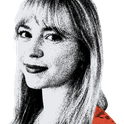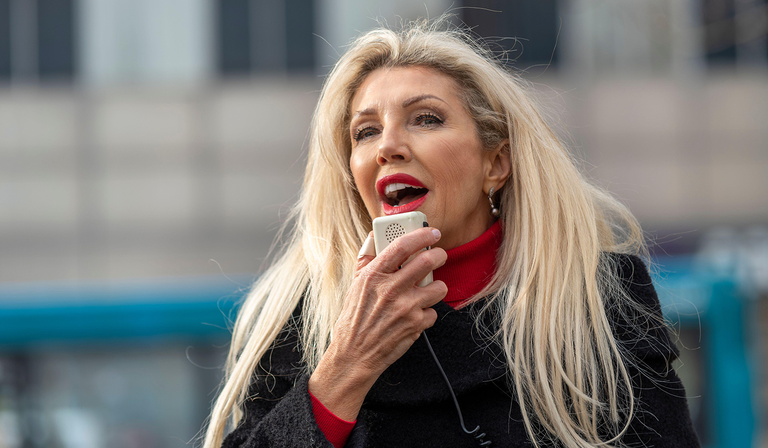
“You look so much like Paloma,” says conspiracy theorist and anti-vaxx campaigner Kate Shemirani, referring to her late daughter who died two years ago. Sat on a camping chair in her garden, she analyses my side profile; I feel as though I’m the one being interviewed. Glamorous, with long blonde hair and a full face of make-up, Shemirani has a significant online following, with nearly 200,000 followers across social media.
An hour earlier I had arrived at her home on a quiet cul-de-sac in East Sussex. “I’ve got 18 cats buried in the lawn”, she remarked as we got out of her car. Over the course of the next four hours, I receive a long list of pseudo-health tips. Don’t wear sunglasses, she warns, but do whiten your teeth. We move inside after I worry about sunburn. “Oh, don’t tell me you wear suncream,” she laughs.
Shemirani, 60, was born into a working-class family in Nottingham, and later trained as a nurse at the Glasgow Royal Infirmary. While working as an aesthetics practitioner and independent prescriber during the Covid pandemic, Shemirani had her nursing licence revoked by the Nursing and Midwifery Council (NMC) in 2021, for “actively discouraged people from wearing masks, adhering to social distancing, and taking vaccinations”. She claims she “didn’t care” about losing her licence and views it as a “badge of honour”.
In 2012, Shemirani was diagnosed with an aggressive form of breast cancer. She was at the hair salon when she received the call from the hospital: “I went ‘I’m getting my roots done, I’ll come and see you when I’m finished’.” She chose not to tell her children about her diagnosis.
Shemirani underwent a double mastectomy and a breast reconstruction in London. Two days later she decided she’d made a mistake. She turned down chemotherapy and had the breast implants removed. Instead, she turned to holistic methods including mistletoe injections and Gerson therapy—a plant-based nutritional system developed in the 1930s. (According to Cancer Research UK, there is no scientific evidence for using it as a treatment for cancer.)
Her self-treatment also included drinking 13 homemade juices a day, along with coffee enemas (coffee injected into the rectum and colon), a vegan diet and more than 100 supplements which Shemirani claims “detoxified” her body of breast cancer. I’m offered one of these juices—it’s called the “Pineapple Paloma”, she tells me.
She recalls a conversation with an oncologist: “He said, ‘I’ve heard coffee enemas are dangerous and they can kill you.’ I said, ‘Really? I’ve heard cancer’s dangerous and oncologists can kill me.’” Shemirani says she “bought biochemistry and haematology books, and taught myself”.
I ask whether she still has cancer. “Everybody has cancer,” she responds evasively.
Eleven years after her own diagnosis, Shemirani’s daughter, Paloma, a Cambridge graduate, was diagnosed with Non-Hodgkin lymphoma and told by doctors that chemotherapy would give her a high chance of survival. Paloma refused chemotherapy and died seven months later in July 2024. Her vacant bedroom, now being refurbished for guests, retains the ballet-pink walls she chose as a child. Last October an inquest concluded that Paloma was “adversely influenced” by her mother and that she had “more than minimally” contributed to her daughter’s death. The coroner said that Shemirani’s care of Paloma was “incomprehensible but not unlawful killing”.
Shemirani has little regard for the inquest’s findings. When discussing Paloma’s death, she is first a grieving mother. But the emotion is overshadowed by her offering up piles of legal and medical paperwork which, she alleges, prove Paloma was non-consensually given chemotherapy. “They lied to her, and they gave her the drugs,” she says. The allegations are entirely unproven.
In April 2024, Paloma’s twin, Gabriel, older brother, Sebastian, and former boyfriend, initiated High Court proceedings to assess Paloma’s ability to make decisions independently of her mother’s influence. Paloma died before the case concluded. Gabriel Shemirani has publicly blamed his mother for her death and the two are estranged. “He tried to take away her [Paloma’s] ability to choose”, says Shemirani referring to the legal proceedings. I ask how being blamed by her own son affects her as a mother. “If you know the truth, why would it affect me?” she replies.
As she drives me back to the train station, her mood switches suddenly: “you better write something controversial,” she quips, “or else you’ll get the sack.”