Death comes for us all, but few people are as eager to meet it as Sue Black. “I can’t wait,” she tells me, “I’m not looking to hasten it in any way, but I’m only going to do it once and I really want to know: what does it feel like? What does it taste like? What does it smell like? What does it look like?
“Don’t medicate me beause I want to be able to experience this,” says Black. “I’ll forget it the minute I’m dead, but I’d like to know… because I’ve been around it so long and you only experience [death] through other people until it’s your own.”
Not only is she looking forward to it, she has a distinct plan for what happens next. Fittingly for someone whose life has been dedicated to science and the service of others, she wants to be dissected, not by medical students (“they don’t do enough detailed anatomy”) but by those training to become anatomists.
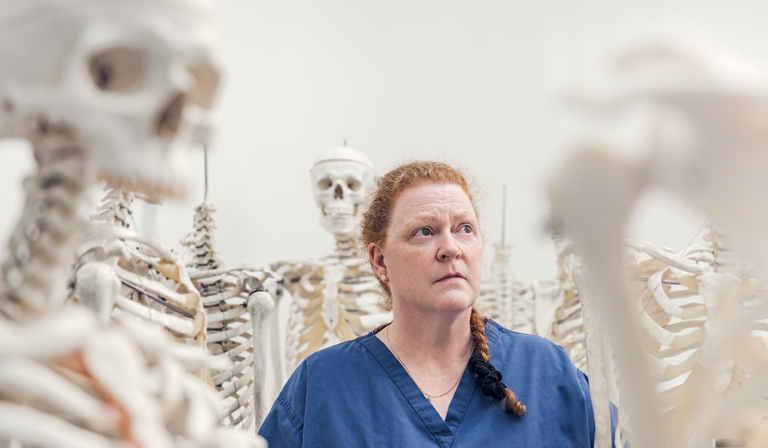
We’re sitting in the warm interior of her office in St John’s College, Oxford, where she is president. Over coffee and biscuits, Black imagines students pulling her mortal body apart and drawing knowledge from her interior. “What a blessing” it would be, she says, after they’re done with her body, to have the fat boiled off her bones and to become a teaching skeleton at the anatomy department in the University of Dundee, where she taught for 15 years as a professor of anatomy and forensic anthropology.
Her ease with death and dissection started at a young age, she says. “I’d go out shooting with my dad—it was only ever for the pot, it was never sport—and, from an early age, I’d think nothing about carrying home the dead rabbits. I’d sit at the back door with my father, and he would show me how to skin a rabbit or pluck a pheasant or gut a deer. And so, from the age of five, I’m up to my elbows in blood.” At the age of 12, she started working in a butcher’s shop.
My father showed me how to skin a rabbit or pluck a pheasant or gut a deer. From the age of five, I’m up to my elbows in blood
Since then, Black has become a leading forensic scientist and educator, as well as a crossbench peer. Her work has taken her to conflict zones around the world: assisting war crimes investigations in Kosovo by identifying victims after the 1998 war, where she and her team exhumed mass graves of people killed by Serbian troops—work for which she received an OBE. Black has been a consultant for the Foreign and Commonwealth Office and the United Nations, leading forensic teams in conflict zones such as Iraq, Sierra Leone and Grenada, and identifying victims after the 2004 Boxing Day tsunami in Thailand.
In 2016, she received a damehood for her services to forensic anthropology. Some years earlier, her method for identifying people in photographs based on the vein patterns in their hands had formed part of a case that led to the conviction of Scotland’s largest paedophile ring.
This kind of work is something friends actively warned her against. When Black started undertaking child sexual abuse image work, she spoke to a close friend, who is now a retired senior officer. “He went, ‘Don’t do this, because you’re going to see things that you’re never ever going to get out of your mind. And one day, one of them might bite you fatally.’ I thought that was such a strong piece of advice. If you’re aware of that, then you can protect yourself as much as you can, but you can never be 100 per cent certain. Never.”
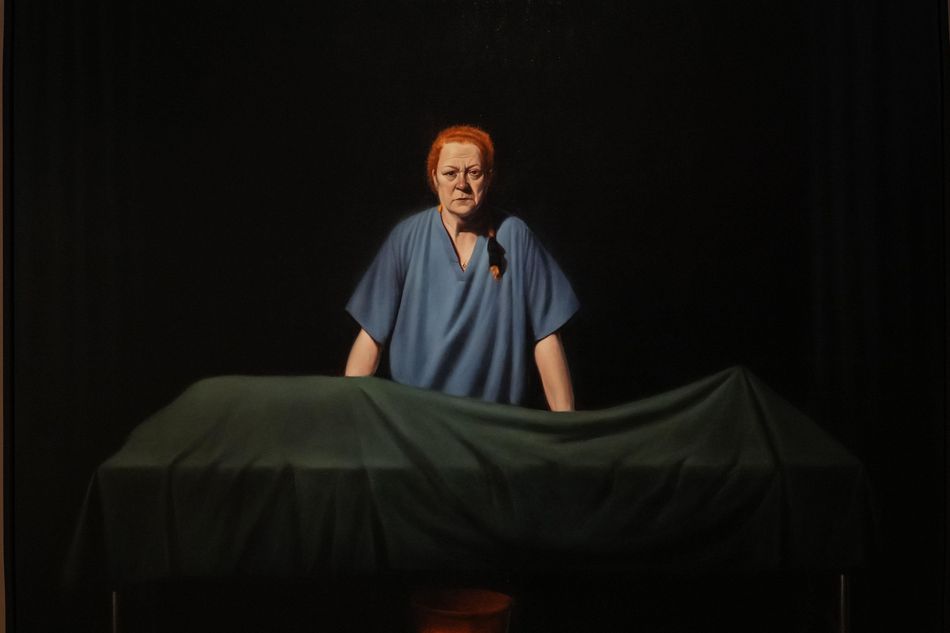
A portrait of Black, titled Unknown Man, hangs in the Scottish National Portrait Gallery in Edinburgh. It depicts Black in scrubs, standing behind a gurney on which lies a body covered by a sheet. Her bloodshot eyes stare out to the observer. The artist, Ken Currie, told Black he was imagining her at the end of an 18-hour shift, haunted by what she had seen and still fiercely guarding the body she is looking after, until the work is done.
“I think we are all haunted,” she tells me. “It would be untruthful to say that there aren’t moments when you go back to some of the cases and you think: ‘Could we have done more?’ Every case lives with you, if you care. You can’t unsee these things.”
Black tries not to let her professional life “bleed into” her personal life: “I’ve always tried to have a clinical box inside my head. When I go to work, I go in there and close the door behind me and I do everything I need to do. When I come out, I close the door behind me. I don’t want to open the door and start poking around in there, because I don’t know what would happen.”
For an intensely private person who knows how to control her answers, Black says that each of her three memoirs has elicited more from her than she expected. Partly, she says, because she didn’t expect people to read them and partly because she feels she doesn’t have the right to hide from her reader. In Written in Bone (2020), which explores how life experiences leave physical traces on the body, she wrote for the first time about abuse she suffered as a child. It was a revelation she says she didn’t expect to ever write about. But while retelling “the case of the young boy whose remains we could see showed evidence of growth disturbance, I found myself naturally writing that in there. And I thought: why not?”
Her new book, An Expert Witness: Forensic Science On Trial, brings further personal revelations, including a highly publicised court case that nearly ended her work as an expert witness, following intense media scrutiny. It was the “lowest and the darkest” she had felt in her career; “I’ve never been able to talk about it without anxiety levels and stress levels rising.” But after her final experience in court, she returned to writing in order to exorcise her fears. “I think all my demons have gone now. They’re out there in the public.”
The book also charts the rise of forensic science and its place in the modern justice system. “I had done my last criminal court case in Chelmsford, and I thought, actually, now I can tell the story of what it’s like to be a scientist going into the courtroom. What does it mean to be an expert witness? And what’s it like to have science really dissected by the law?”
It comes at a crucial time: forensic science has faced a series of budget cuts in Britain, which could crucially impact how justice is served.
“The system is not working for anybody,” says Black. “We had created the Westminster report to look at it. The House of Lords Science and Technology Committee then did a subsequent follow-up report and agreed with everything we found that said the system is broken.”
The 2025 Westminster report, commissioned by parliament, concluded that the forensic science sector is in an “almost irretrievable graveyard spiral”. It judged that the introduction of a commercial system in England and Wales for forensic science has led to a monopoly in provision, leading to “poor police investigations, increasing unsolved crimes and more wrongful convictions”.
A government white paper in January this year proposed the creation of a National Forensic Service (NFS) under the umbrella of a single, centralised police force. It argued that this would allow new technologies and best practices to be rolled out more efficiently. Though forensic science services operate within the public sector in Scotland and Northern Ireland and are wholly separate from the national police forces, Black “[doesn’t] think it’s the way we’re going to go in England and Wales”. “That worries me terribly,” she says, “because it makes me fearful that we’re going to see more miscarriages of justice that are going to be laid at the door of forensic science. [But] it’s not the science that’s the problem, it’s the bureaucracy and the way in which it is governed.”
Will forensic scientists be able to remain impartial if their employer is working with the prosecution? “If I’m coming in as an employee from the police force, [even] with the best will in the world, I’m going to feel I’m partisan… I think the biggest thing that we could do to try to save forensic science, is to ensure that we retain a sterile clinical corridor between science and the police, and science and the law.”
“When these miscarriages of justice occur—and we know they do because we’ve seen them—these are people’s lives. Science needs to be independent.”
We’re going to see more miscarriages of justice that are going to be laid at the door of forensic science
Around the time Black left her position as pro-vice-chancellor for engagement at the University of Lancaster in 2022, she vowed to stop taking on active forensic cases: “I’d had my time in court and it is so adversarial and stressful. I knew I’d done my share and I didn’t want to do any more.”
She still does intelligence work for the government, but has left behind active casework. “I have no hankering to go back. I have no hankering to go down into a hole and dig out the deceased and go to court about it. Just none.”
A lifetime spent learning and teaching means Oxford is a natural home, for now. “It’s the most glorious bubble here. I have no Oxbridge background, so I came into it slightly cynical, I would say. But it’s a real privilege.” Not in terms of wealth, which is the way in which many people think about the university, she says, “but it’s a privilege to get into an institution that is solely focused on the fact that you are at the top of your intellectual game as a student.”
Black is clear that, as a student, Oxford wouldn’t have been the place for her. “I wouldn’t have got in here. I wasn’t a particularly good scholar. I like to be practical rather than academic.”
“You have to understand that I’m a Scottish Presbyterian… It’s just not possible for us to blow our own trumpet,” she adds. “I am really happy to take criticism. I really don’t like praise. Because I think if you start to believe the rhetoric of others, then you become something that you’re not. And for me, that would be a terribly unpleasant place to be.”
When she eventually leaves Oxford, she plans to give up academia. She is excited by the prospect of the unknown. “I believe that when you leave a place, you have to leave something behind because you have to create space for new experiences,” she says.
Her oldest PhD student, a former Second World War pilot, was in his 80s when he began researching forensic podiatry. “Whenever you find [your calling], if it’s the right thing for you, you should do it. But we’re very scared to do that these days. We’ve become quite conservative in the way in which we plan our lives. But, before you know it, you’re more than halfway through your life and you’ve perhaps not given yourself up to opportunities that you couldn’t imagine.”
Perhaps it is the proximity to death that has ensured she has made the most of her time. Black’s first memoir, 2018’s All That Remains: A Life in Death, was written for her daughters and granddaughters. Documenting her life and career, it is, she says, a story that she would have loved to read about her own grandmother.
Her paternal grandmother, who was born on the west coast of Scotland in the late 1800s, would speak about death plainly. “She was one of these superstitious old women who believed in an afterlife. She used to say that her mother would dream about funerals and she would know who was going to die by who was leading the funeral.”
“My grandmother would talk about death, as ‘she’”, says Black, “So, I grew up thinking of death as female.”
Black also had a close relationship with her father, and credits him (“although he was a military man and a man of his generation”) for never treating her differently because of her gender. “He expected me to be able to bake a rhubarb crumble with my mother in the kitchen,” but, equally, to gut animals at the back door. “He didn’t have an expectation of me as a girl, so I never really thought of myself as a girl. Of course I knew I was, but it didn’t define me.”
Even later in life, ‘‘I’ve never really had to fight that corner of being a woman needing to be heard,” she says. “I never really allowed anyone in the fields I worked, in the police or the military, to treat me as something different. I was one of the team.”
This isn’t something she takes lightly, “I know from the work I do that the vast majority of victims are female. In the work that I’ve done with child sexual abuse, most of those victims are young girls. Not always, but most of them are.”
She is concerned about a political and social environment where, in some respects, “women are being viewed again in that way to be dominated. That’s very dispiriting as someone who is the mother of girls and the grandmother of a granddaughter.”
When her own mother died, Black remembers going to the funeral home with her three young daughters. The children huddled together, eventually deciding that they wanted to see their grandmother laid out. Her oldest daughters seemed afraid: “You could see the nerves in them; they didn’t know what to expect of the dead… and my baby, who was about eight at the time, with absolutely no fear in her at all, walked up to granny and stroked her hand and chatted away and I thought: ‘that’s the truth.’ There is no fear in death, but there is reality.”
Black believes the way society interacts with death has changed over the past few decades. “In our family, it was just such a natural part of life that you didn’t think about it. People used to be laid out in the sitting room and you would go and sit with the dead, you’d talk about stories and hold their hand.
“My grandmother believed that death walked alongside you every moment of your life and, at some point or another, your paths would cross: it may be when you’re very young or very old, but eventually you would cross. And she said: ‘If death is going to walk alongside you, wouldn’t it be better that death was your friend, and not your enemy?’”
Sue Black’s “An Expert Witness” is published by Doubleday