As a struggling young writer, Ben Okri had a recurring dream. “Every night, people would pinch at my flesh,” he tells me, miming a vicious movement with his fingers. “This was in my difficult days, just after the time I was homeless. I was afraid to go to sleep because these people would come and pluck out bits of my flesh.”
If he was a character in one of his own fantastical novels, those dreams might have been the work of a sprite, a demon or some kind of ancestral magic. But Okri chalks it up to his subconscious speaking to him. The dreams stopped, he says, when he won the Booker prize. The message? “Get your act together,” he chuckles.
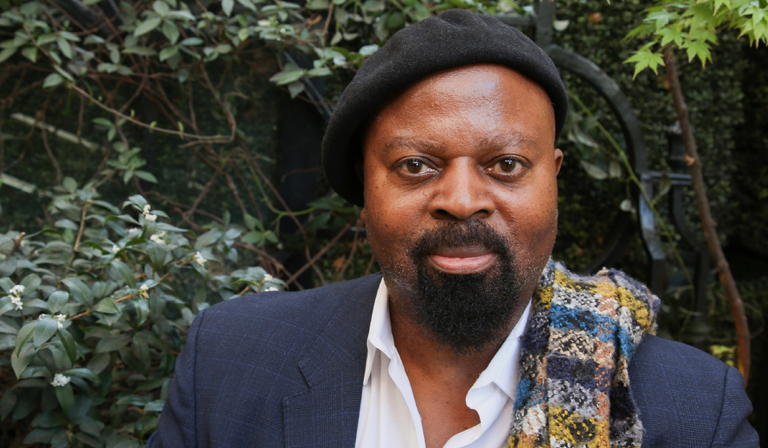
We’re speaking in a quiet corner of the Coral Room, a grand, chandeliered bar in the heart of London. Okri is wearing a dark blue suit jacket and his signature black beret. He is good company, exuding warmth, speaking softly, often pausing to find the right word. Hearing my literary name makes his afternoon. “I met [novelist Graham Greene] as an old man. He was wonderful. He came into town and asked to see all the best young writers, which at that time was people like me, Salman Rushdie, Michael Ondaatje… I was the only one who had the nerve to bring a copy of a book for him to sign. When I whipped it out, the others were, like, ‘You jammy bastard…’”
Okri was born in 1959 in the Nigerian city of Minna. His father, Silver, was of Urhobo ethnicity; his mother, Grace, half-Igbo. He was not even two years old when he and his mother were brought over to Peckham in London to join his dad, who was studying law. Okri’s earliest impressions of the UK are of cold weather and mist. He discovered reading, too. “There’s a story in my family that I started reading the Times at four years old,” he says.
Walking home from school with his father became a rough awakening. “These kids would start throwing snowballs with stones in the middle of them at us, and calling us funny names. I never understood what was going on. My dad didn’t want me hurt, but he never really explained [what racism was]. I worked it out later, from certain words and speaking to other black kids at school.” The “illogicality” of racism was—and still is—what Okri found so baffling. “Until someone makes a difference clear to you, you don’t think of difference. I got angry every time. Dad said ‘Don’t!’, but I threw stones back at them.”
Once his father completed his studies, the family returned to Nigeria. Okri, still a young boy, was initially excited by “the light, the vitality, the teeming streets” and “a rich community of aunts and uncles”. He also remembers the sense of a golden age: “A generation of Nigerians had come to England and America to study, then came back to be the leaders of the new generation.” It was “a time of great hope, just after independence [in 1960], where Nigerian people had found their voice and were in charge of their own destiny”.
But the country was descending into civil war, which lasted from 1967 to 1970. “It happened gradually,” Okri says quietly. “We’d hear rumbles, politicians demonising the Igbos in the press. One day, we realised mum had to be hidden in the house. She couldn’t be visible. There was a terrible killing of young women—people were hunting for Igbos. I was nearly killed myself. My mum had come to collect me from school. If you were too fair-skinned, you were possibly Igbo.”
He recalls the terror of air raids, bombings and people being shot at checkpoints. “My first trauma was when I was wandering at night and I saw lumps in the river near us in the evening. I just thought they were lumps. But then I looked closer. They were young boys who’d been shot and thrown in the river, from the rebel tribe [Igbo]. I learned a great deal about how easy it is to demonise.” It is the reason why Okri is sensitive to language: “When you demonise people because of colour or tribe, I’ve seen it has the same effect: the killing of people, genocide…”
Years later, Okri found himself back in England studying literature at the University of Essex. There had been a time when science looked the more likely path. “I was going to be an inventor,” Okri says. “I had many ideas, such as a jacket that’s also a radio. You just tap a part of you,” he taps his suit’s chest pocket, “and music comes on.” But discovering books by the likes of Chekhov, Ibsen, George Orwell, Charlotte Brontë and Miguel de Cervantes, as well as “proper British comics, like the Beano”, set him on a different path.
In 1989, Okri published his first book, Flowers and Shadows, while still at university. But, in what he reluctantly suggests was a case of corruption, his Nigerian scholarship money “disappeared” and Okri became homeless. He slept on friends’ sofas, then in parks and on London streets. It was a grim period of his life, especially in winter. But Okri also recalls “meeting likeminded people in bars or places like the Africa Centre. The anti-Apartheid movement was very strong in England, with a lot of black South Africans and Zimbabweans in London. It was a time of tremendous intellectual, cultural and political excitement. There wasn’t a day when I didn’t write.”
“I always had a notebook and pen, scribbling poems. Some people go to great colleges and study literature, and they know their path is already cut out for them. For me, literature was always a romantic thing. It was something you did against the difficulties of the world. It was something that redeemed all of life.”
He remembers meeting his friends in the pub, after which he’d seek out the warmth of a Tube station. “Sometimes the police would shoo you on and you’d go to another Tube station, or I sat outside banks—banks’ doorways had a warm draught.”
‘Literature was something you did against the difficulties of the world. It redeemed all of life’
Homelessness, he says, taught him a lot. “You find your way. I learnt so much about this city. There are no safety nets. When you fall, you could go on falling. I knew writing was a very risky thing. [But] I just had this blind, crazy belief in literature, in words and stories, and that that alone, if you did it well, would carry you.”
Okri got back on his feet. In 1991, The Famished Road was published, a novel he’d worked on for years and which drew on his own traumatic memories of Nigeria’s civil war, exploring societal conflict through the tale of an abiku or spirit child.
The book didn’t have an especially auspicious start. “The reviews were okay,” he says. “I didn’t think I was going to win the Booker. Everyone was pushing for Martin Amis to win [for Time’s Arrow]—he was the golden boy. On the day, I was having a ball, then my name was called and I slipped into a dream state. I sat there for a full minute to get used to it. I realised my life was never going to be the same again.”
He was right. Okri, just 32, was the first black author to win the Booker—and the youngest, at the time. “They even asked me to do some modelling for Topshop,” he says.
Though he’d left behind the snowballs packed with rocks, success brought another brutal “othering”. “The backlash came very quickly. Shooting up into fame like that disturbs the landscape. I didn’t come from any of the sanctioned places. The phrase used for me was that I ‘came from nowhere’. [But] I came from a rich tradition. My mother is from a royal family and my dad is from a family of chiefs. But from their point of view, I came from nowhere. There were bets from certain people afterwards on how long I’d last. They gave me a couple of years and then said I’d be forgotten. I felt like Eddie Murphy in Trading Places.”
Decades on, those wagers are long lost. Okri was awarded an OBE in 2001 and knighted in the 2023 Birthday Honours. He received an invitation to Buckingham Palace, where he discussed climate change with King Charles.
His new novel, Waking the Warriors (2026), sees three characters set out on a dangerous quest to wake mythical fighters who can defeat the forces of an evil leader, driven on by dreams sent to them by a witch. Dreams and visions often feature in his novels, in which physical and spiritual worlds meld together. For Okri, fantasy isn’t a form of escapism, but a way to grapple directly with urgent issues in the modern world.
The novel describes a future where climate change warnings have been ignored: “Cities sinking below the rising waters… half of Africa now desert… ice shelves of Antarctica melted… thousands perishing trying to migrate here… and we’re going to the dogs… having fewer babies… isolated as a people… turning on ourselves…” There are scenes with long lines of dejected refugees, young and old, looking for safety that doesn’t come.
Okri has a little fun along the way, however, as the antagonist declares: “I am a winner. You follow me, you win… Get it out there now. The people need to know what I’m thinking the moment I think it.” The character also counts a “hair expert” among his inner circle.
But mostly there’s a sense of the world weighing heavily on the author. As the novel’s jackal-faced armies burn towns, seize land and construct a massive wall, Okri probes how authoritarian regimes take hold.
“I’ve been feeling in a weird way, over the last five years or so, that we’re living in a kind of condition of unstated censorship,” Okri says. “Our protest has [increasingly] become criminalised. That nervousness, that sense of being under a cloud of a limitation around some of our freedoms, is one of the roots of the book.” He sees the role of the writer as “picking up signals of distress from our civilisation”.
To occupy the land and exploit a country’s wealth, leaders first have to seize people’s hearts and minds, Okri argues. He describes “a world that has lost its centre”, a great emptiness existing where guiding beliefs—political, religious, spiritual, personal—used to be. “We don’t know who we are any more,” he writes. “We lost meaning. We lost purpose. We lost the sense of the mystery of life.”
“Something in us has been neutralised,” Okri tells me. “It’s neutralised us in terms of our ability to be able to do anything. It’s about taking away the individual’s belief in their effectiveness to make change.”
He’s especially concerned about “the way in which truth has itself become a fiction, because of the idea of alternative truths, which has been exacerbated by the targeting of journalists and the erosion of trust in mainstream media. We don’t know who to trust any more.”
We shift from tea to G&Ts and I ask Okri what his own belief system is, given the preoccupation in his books with fantastical or metaphysical realities. “I believe reality is way more wondrous and unimaginably profound than we realise,” he says. “And I think we, humans, are immeasurable. I’m not an atheist, as I think reality is just too rich. What we see is 0.00001 per cent of what is there. [My worldview] definitely has a spiritual quotient in the sense of this essential wonder of things.”
Okri lives in west London with his partner, a dancer from Sussex (“We’re hoping to get married”) and his daughter, Mirabella (“the single most important enrichment to my life”), who is nine. He worries about his daughter’s future. “For young women, there’s an oversexualised world, a world Jeffrey Epstein has left his messy hands on, a world of the internet and dark spaces of pornography. There are 1,001 things they have to deal with now that we didn’t need to deal with as kids.”
A committed climate activist for the past decade, he also fears for the planet she and other young people will inherit. But anxiety is not helpful, he points out. “Anxiety is part of how we’re defeated. We need to think in the same way the great thinkers and fighters did during and after the Second World War. In times of big crisis for humanity, when everything seemed burnt down, we had to start afresh.”
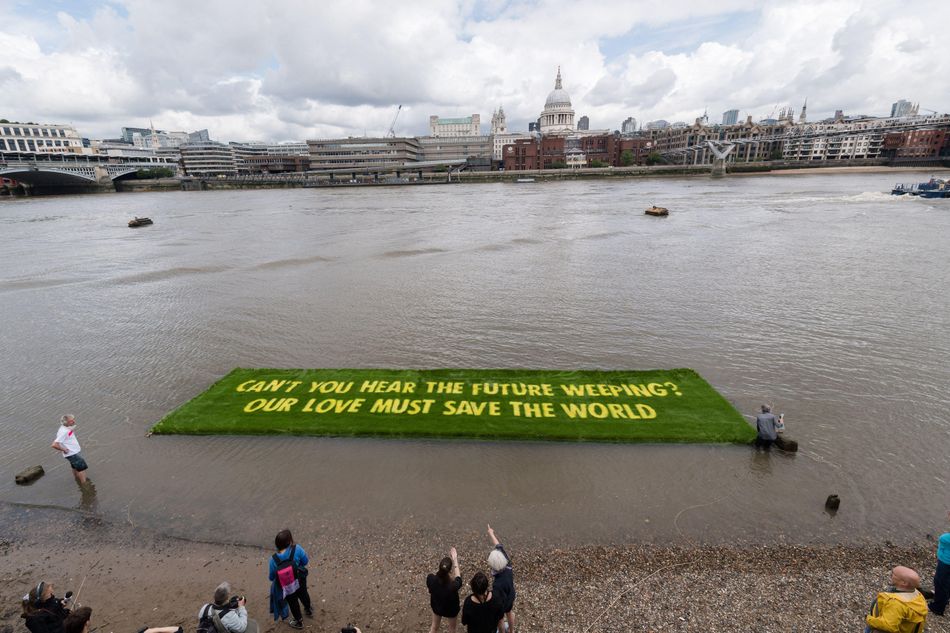
It’s an idea found in much of Okri’s work: that out of hardship and suffering, there’s always the possibility of something new. “We can redream this world and make the dream real,” he wrote in The Famished Road. In his essay collections A Way of Being Free and A Time for New Dreams, he explored the idea that imagination and storytelling are essential to societies, as is the conviction that we can make them real.
“If you can’t tell stories, people will tell stories for you,” Okri says. “And when they tell stories for you, they have power over you. It’s the first form of diminishment of a community and a people: to rob them of the power to tell stories.”
“Very early on, I realised power is about a battle of mythologies,” he adds. “Sometimes it’s done with the gun, the jackboot, the truncheon. But it’s a contestation of mythology, or fake mythology. One of the things I’m trying to achieve in that book is to help reawaken that sense of myth, the myth that re-empowers, the myth that re-engages our passion, our feeling for justice, for freedom, for the value of the individual voice.
“One of the biggest problems of the left is that it has abandoned the power of mythology and left it to the right, who know how to use it, even if it’s dishonest. Look at America. Who is dealing with myth better right now: Republicans or Democrats?”
Okri’s hope seems inextinguishable. Even in his poem “Grenfell Tower, June, 2017”, he saw an opportunity for a better future: “If you want to see how the poor die, come see Grenfell Tower. / See the tower, and let a world-changing dream flower.”
“I just can’t entirely give up on the human,” he tells me. “I’m aware of how much evil and stupidity we’re capable of, but I’m also aware how we can turn societies around and come up with solutions when we’re up against it. That is where my hope comes from.”
Now is not the time to despair and cede control of our stories and our lives over to darker forces, he says. “Separating us is much easier—coming together is much stronger. We need to re-establish truth for our children. For me, it’s a time to rebuild. We have to re-enchant our minds and make sure our minds remain our own. With community, with stories, with mythology, with activism.” His eyes light up as he realises another. “And, finally, with love.”
Ben Okri’s “Waking the Warriors” is published by Head of Zeus