“All of my earliest memories are of forms and shapes and textures,” the sculptor Barbara Hepworth (1903–75) once recalled of a childhood spent driving through the rolling contours of West Yorkshire with her father. She revelled in the sensation of roads cutting through hills and carrying her through hollows and over peaks. Long before she picked up a chisel, she was already thinking like a sculptor, with an innate sensitivity to form and space, mass and movement.
A new exhibition at the Courtauld, Hepworth in Colour, is the first to explore a less familiar aspect of her work: her fascination with colour and its ability to create new spatial and optical effects. Intimate in scale, with just 20 sculptures and 30 drawings, the exhibition encourages visitors to orbit her works, experiencing them as Hepworth intended—in motion. “Sculpture to me is an affirmative statement of our will to live,” she wrote in 1966, “whether it be small, to rest in the hand; or larger, to be embraced; or larger still, to force us to move around it and establish our rhythm of life.”
Hepworth studied at the Leeds School of Art, where she formed a lifelong friendship with fellow student Henry Moore. After winning a scholarship to Florence, she learnt marble carving under the Italian sculptor Giovanni Ardini and married the artist John Skeaping in 1925. Her first breakthrough exhibition came at the Beaux Arts Gallery in 1928, but her real artistic breakthrough arrived four years later with Pierced Form (1932), her first punctured sculpture. From then on, Hepworth moved decisively towards abstraction, a shift encouraged by her relationship with the painter Ben Nicholson and exposure to the work of European modernists.
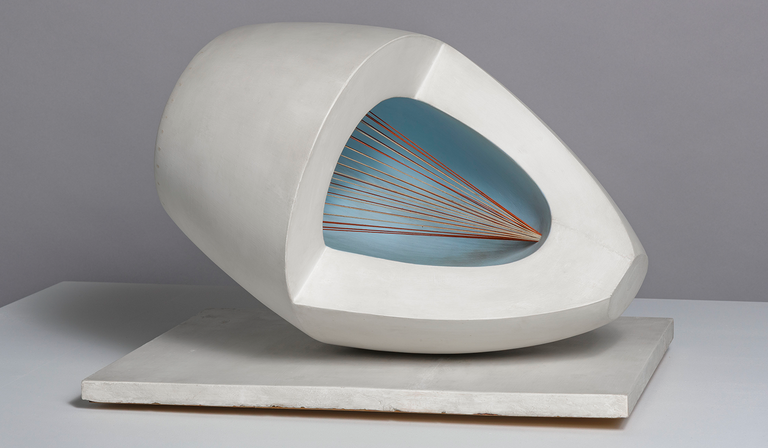
As the shadow of war stretched over London in 1939, Hepworth and Nicholson left for St Ives with the triplets she shared with him and a son from her marriage to Skeaping. She brought only the plaster prototype for Sculpture with Colour (Oval Form): Pale Blue and Red (1943). One of the exhibition’s highlights, it is among her earliest works to incorporate taut coloured strings, stretched across a pale-blue interior.
She arrived in St Ives in the thrashing rain in “zero spirits”, but the move to Cornwall proved transformative. Hepworth became quickly enraptured by West Penwith’s rugged tors and standing stones, while the granite cottages, beaches and coastal light seeped into her art through colour.
While searching for a permanent studio, she began producing a series of abstract drawings inspired by crystals, geological forms and simple geometric shapes. Several are displayed at Hepworth in Colour. Up close, you can see how she built up surfaces through layers of pencil and gouache, sometimes scoring the paper with sharp tools. Linear forms arc across the compositions; some appear taut, others slackened, evoking wind currents, fishing nets or the rigging of boats in St Ives harbour.
The sea became Hepworth’s greatest muse
In 1942, Hepworth moved into a house in Carbis Bay, where the sea became her greatest muse. Seven years later, she found Trewyn Studio on Barnoon Hill, complete with a stone-carving yard that gave her the space to operate on a more ambitious scale and, as she put it, “work in open air and space”. It was during the 1940s that colour assumed a new importance within her sculpture. Cerulean blues began to appear in her work; colours that, as she later recalled, plunged her into the “depths of water, caves or shallows”.
Pelagos (1946) is among the exhibition’s finest works. Carved from elm and threaded with strings, it was inspired by the view from her studio and the Atlantic beyond. The sculpture curls in on itself like a breaking wave, while its strings stretch across the interior, suggesting the infinity of the ocean. In Sculpture with Colour (Eos), Hepworth turns from the sea to the sky. A thumbprint of vivid blue sits within soft grey stone, framed by a crescent-shaped carving that could be the moon lingering at daybreak.
Hepworth’s interest in colour continued throughout the 1950s and 1960s, finding expression in her painterly bronze patinas and experiments with coloured marble. Trewyn Studio remained the centre of her world until her death in 1975, when a fire broke out there, engulfing her.
Hepworth in Colour reveals an artist who transformed sculpture from a solid mass into something living, where polished stone and pools of colour could call forth the sea and the sky. Visting the exhibition, it is difficult to disagree with her own assessment: “I, the sculptor, am the landscape. I am the form, and I am the hollow, the thrust and the contour.”