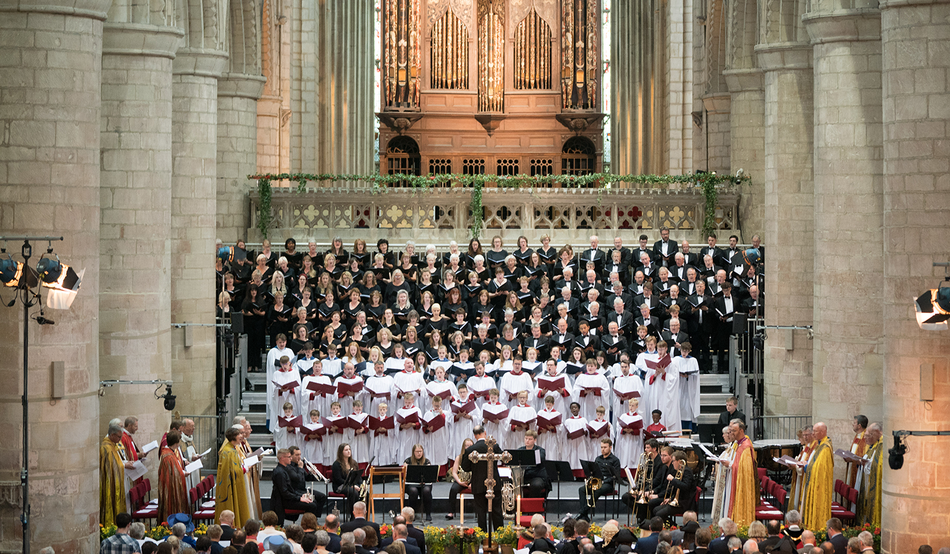
The cathedral nave full to bursting point. A rousing climax so loud it practically blew the Norman roof off. Welcome to the opening night of the Three Choirs Festival, often claimed to be the oldest music festival in the world, and, on the evidence of this stunning concert, in the rudest of health.
Gloucester is hosting this year (the other two venues are Hereford and Worcester), which meant that its own director of music, Adrian Partington, took the baton for the first night performances, on Saturday, of Elgar’s Symphony No1 and William Walton’s virtuoso oratorio Belshazzar’s Feast.
The two pieces were separated by just 23 years. Could you, on a blind listening, spot a piece written in 2003 against one written today? But the emotional and harmonic world of the Elgar—written just six years before the First World War—is in an entirely different universe from the Walton, premiered in Leeds Town Hall in 1931.
Elgar conducted his symphony at the Three Choirs Festival in Hereford in 1909. Belshazzar’s Feast had a rockier history with the festival, with the Times’s influential music critic, HC Colles, denouncing it as “stark Judaism from first to last” and Ivor Atkins, organist at Worcester, helping ensure that it was banned from the Three Choirs for 25 years.
Partington has been at Gloucester since 2008, so he knows better than anyone the idiosyncratic acoustics of the cavernous nave. There’s a notorious moment in the Walton when the entire chorus shouts “Slain!” I counted another three full beats before the echo disappeared. And yet, both in the Elgar and the oratorio, the tempi he chose allowed for clear textures even in the fastest of passages. And he drew out the shattering climaxes of both pieces with great skill. The great 14th-century East Window must have trembled in its tracery.
Partington is mainly a choral conductor, but he inspired the Philharmonia orchestra to produce a memorable account of Elgar’s magnificent, sprawling masterpiece. The slow movement had hushed moments of exquisite soft playing. The finale movement, in which the original sedate tune returns—to buffeting challenge—was simply thrilling.
So, too, was the Walton, with two brass bands in exuberant antiphonal competition from north and south transepts. The baritone solo, courtesy of David Stout, was stentorian and aptly dramatic. The festival chorus was in full-throated form. And the evening was sparked into life with a noisy, sparkling fanfare by Gavin Higgins.
The 1909 performance of the symphony coincided with the 186th meeting of the three choirs. A contemporaneous account of the event in the Hereford Times stated that, for many years, “it has been recognised as one of the leading festivals in the provinces”.
Today, scratch “provinces” and substitute “the world”.
The Three Choirs Festival runs until 1st August