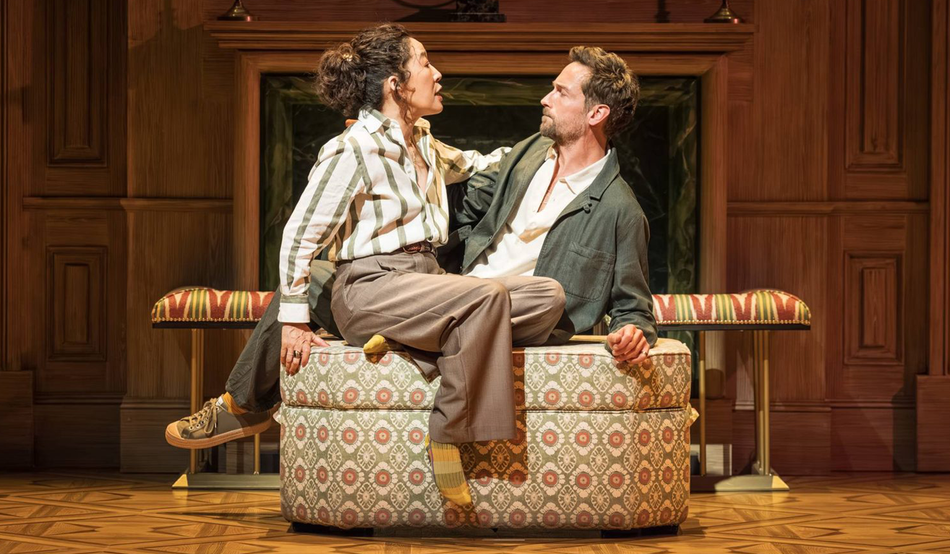
Is Molière’s eponymous The Misanthrope a healthy cynic or just one more provocateur in a world of poseurs? The question should make this 1666 verse drama a play for our times. In Molière’s original, the protagonist Alceste rails against the “politesse” of French society, which imposes strict norms of conduct and ostracises those who expose its absurdities. In the opening of Martin Crimp’s new adaptation at the National’s Lyttleton theatre, we meet Sandro Oh as a gender-flipped Alceste, a post-feminist novelist who rails against cancel culture and refuses to limit her thinking to the niceties of left or right. It should all work so well.
Crimp has history with Molière’s play. His previous adaptation, with a male protagonist and turn-of-the-millennium concerns, premiered in 1996 and was revived in 2009 starring Damien Lewis. In this version, he tackles the very live issue of enforced political speech. “Alice”, as Alceste becomes, has been cancelled from a festival in Berlin because she refuses to recant her use of a specific word. Esmée, an insufferable gen Z influencer, pours further opprobrium on her for refusing to praise her fashionable novel.
Oh is luminous. Watching her opening exchanges with Paul Chahidi as John, a soft-spoken playwright who urges social compromise and small acts of queer resistance, I was filled with the excitement of watching a promising setup. The rest of the ensemble are impeccably cast: Tom Mison as Oh’s slick, addict lover; a brittle Jemima Rooper as his exhausted ex-wife; a stand-out turn from Rina Fatania as a petulant and increasingly desperate PR guru. Yet, despite all this talent on stage, Crimp’s text doesn’t have anywhere worthwhile to take us.
Crimp spends more energy on inside jokes about the arts world than meaningful analysis of its issues. There are digs at fashionable theatre directors—the auteur Simon Stone comes in for a sideswipe, when Alice and John hold forth on the merits of staging Chekhov in a glass box; Crimp even recycles a similar joke here about Damian Hirst from his 1996 text. Esmée turns out to be the nepo baby of a powerful man on the board of Alice’s publishers, a troubled entity with a name that rhymes with “Hachette”. Yet from this marriage of Molière’s original and the mores of 2026, Crimp fails to craft a credible storyline. The resolution, when it comes, is risible.
Fortunately, fans of French verse and literary self-reference have a shimmering alternative in the West End, in Simon Evans and Debris Stevenson’s RSC adaptation of Cyrano de Bergerac. Both Misanthrope and Cyrano are plays about power of literary form. Does language reveal or conceal us? Can language be violence? Both are also dominated by a protagonist whose cynicism reveals a deep romantic vulnerability. Two centuries before playwright Edmond Rostand immortalised him in the late 19th century, the historical Cyrano de Bergerac was a near-contemporary of Molière. As Crimp acknowledges in his programme note for Misanthrope, “Libertines – Cyrano de Bergerac being a well-known example – were dangerous because, not believing in God, they questioned the structures that organised society.” Their sexual adventures, their scepticism and their profound loneliness tie these two together.
Adrian Lester is at the height of his powers here, duelling across the stage with the agility of a far younger man
Cyrano engages better with this material, in part because it maintains the balance between the emotional heft of Rostand’s central romance and the intellectual gamesmanship with which he explores different literary modes. Scott Handy’s Comte de Guiche still depends on shallow rhymes to express his villainy; Adrian Lester’s Cyrano still outwits him with complex sonnets and acrostics. Lester is at the height of his powers here, duelling across the stage with the agility of a far younger man. Evans unleashes the production’s tragic impact at its climax, giving Susannah Fielding’s Roxanne licence to express a healthy sense of rage at the discovery that Cyrano’s bro-code sense of honour has cost them their chance at love.
Watching Lester’s performance as Cyrano, we believe that this is a character who chooses his words carefully, each one landing with intelligence and weight. By contrast, Sandra Oh and her co-stars have been encouraged to rattle off verses like casual patter. (There might be an allusion to Gaza, but it is swallowed in mumbling—“If you’re going there, have the courage of your convictions!” I wanted to scream.) It is the latest disappointment from Indhu Rubasingham, the still-new artistic director of the National Theatre, who also directs.
All newcomers to this job have had a rough start. The Misanthrope also showcases Rubasingham’s great strengths: creative commissioning, alchemical casting, a sparkling understanding of the classical canon and its potential for reinvention. The Wife of Willesden, Zadie Smith’s version of Chaucer’s Wife of Bath, was her project, and will live with me as one of the best plays of the last decade. But after The Bacchae, Hamlet and Les Liaisons Dangereuses, it would be nice to see a show at the National that has put more care put into script development than luxurious costuming. I have no doubt that time will come.