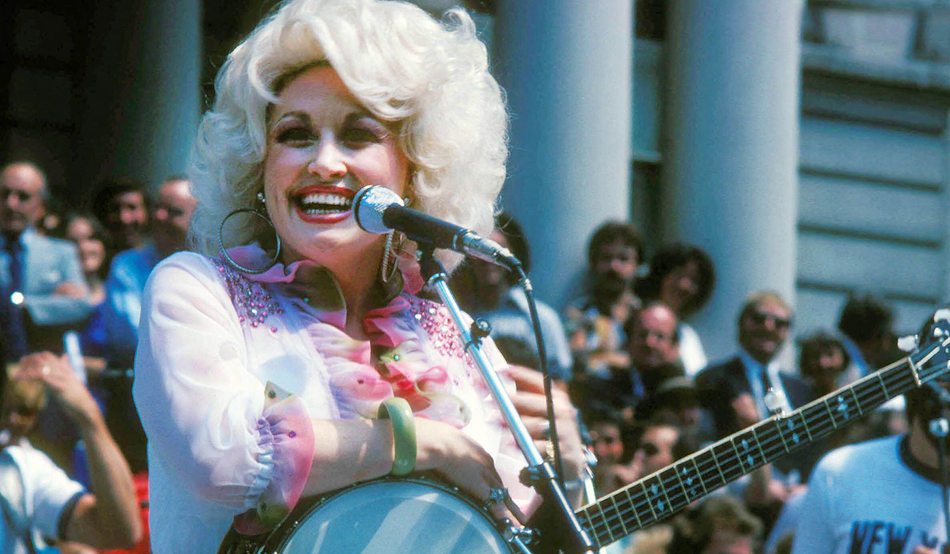
In September 1971, Dolly Parton released a single she named “Coat of Many Colors”. It was a true story—of how Parton’s mother had, when she was a child, made her a coat stitched together out of scraps of fabric, and how, to her great bewilderment, her classmates had laughed when she wore it to school.
In her memoir My Life and Other Unfinished Business, the singer explained how she had written the song at the age of 23, while on a tour bus with her long-running duet partner, Porter Wagoner. With no paper to hand, she wrote the lyrics on the back of a dry-cleaning receipt for one of Wagoner’s stage suits.
Of the hundreds of songs Parton wrote in her 80 years, it would remain her personal favourite; one that displayed her remarkable skill as a songwriter and, as she emerged into her solo career, that would help to establish a presiding theme of her music: what can you make out of nothing?
Parton grew up poor. The fourth of 12 children, she was famously raised in a two-room cabin in Tennessee’s Smoky Mountains. There was no running water, no electricity, and the family largely got by on food they either grew or hunted.
The tale of how she became a singer, a songwriter and a performer was rich with examples of stitching together: she made her first guitar out of an old mandolin and two bass guitar strings; she turned a tin can into a microphone and would sing to the dogs and the chickens in the yard. “I could catch on to anything that had a rhythm, and make a song to go with it,” she claimed. The examples she cited included the snapping of peas and the honking of geese. Years later, she told Michael Parkinson of her early, makeshift attempts at a kind of showbiz glamour: powdering her face with flour, drawing on eyebrows with a burnt match, staining her lips with bright red Mercurochrome antiseptic.
A 1987 clip from her TV variety show Dolly shows Parton uniting both the homemade music and the glitz, as she invites Patti LaBelle to find “a little rhythm” via the unlikely medium of their acrylic nails—a form of skiffle as they harmonise the Tennessean folk song “Shortnin’ Bread”: “Mammy’s little baby loves shortnin’, shortnin’/ Mammy’s little baby loves shortnin’ bread.”
Of course Parton would go on to see great wealth and success—there were 25 number ones on the Billboard country charts, 11 Grammys, a net worth of some $450m, a home far removed from that two-room shack. But still, there was always something in the way that she lived that carried an air of stitching together.
This week, in a tribute after Parton’s death, Jad Abumrad, who created the podcast Dolly Parton’s America, spoke of how, after interviewing Parton more than a dozen times, he had realised that “Dolly’s particular gift“ was to to “present two opposing thoughts, juxtaposed”.
Parton was willing to pick up causes, campaigns and individuals that had been overlooked or pushed aside
In her philanthropic work, she performed a similar trick—willing to pick up causes, campaigns and individuals that had been overlooked or pushed aside—taking scraps and turning them into something not merely acceptable but wearable. Dollywood, the theme park that she built in her hometown of Pigeon Forge, transformed the local economy, while among the many acts of generosity by her charity, the Dollywood Foundation, was the gifting of more than 300m books to children via the Imagination Library.
There was the $500 award for every child who graduated from high school in her home county (reducing the drop-out rate from 35 per cent to 6 per cent) and a new regional hospital with a dedicated women’s treatment wing. There were scholarships, disaster funds, donations to children’s hospitals, even a bald eagle sanctuary. In 2020 came a $1m donation to the Vanderbilt University Medical Center, for research into coronavirus treatments, and—during a time of great fear and scepticism—she filmed herself being vaccinated, to encourage others to do the same.
During the 1980s and 1990s, she did much to destigmatise HIV/Aids, joining other country stars in awareness campaigns targeted at rural communities and donating her song “You Gotta Be My Baby” to the Red Hot Organization’s Red Hot + Country charity album. In 1989, her production company, Sandollar Productions, co-produced Common Threads: Stories from the Quilt, an Academy Award-winning film about the Names Project Memorial Quilt.
Her fanbase was, accordingly, diverse. She insisted she was not in any way “political” and remained popular in conservative Southern communities. But she also recorded “Travelin’ Thru”, the theme song for the 2005 film Transamerica, about a trans woman travelling across the country with her son. And, some years ago, she spontaneously entered a Dolly Parton lookalike contest in Los Angeles, losing, happily, to a drag queen.
At times, it felt as though Parton was determined to sew two opposing patterns together. “A Dolly Parton concert is like a local census, bringing together peoples across lines of race, gender, sexuality, and, miraculously, political affiliation,” the New Yorker once noted. When asked how she balanced supporters on the religious right and the LGBT+ community, Parton herself was gracious: “It’s two different worlds,” she said, “and I live in both and I love them both.”
Look closely at Parton’s songwriting, and it’s clear that love was the one thing that could not be substituted or faked or stitched together. Love is precious, “a rare and gentle thing,” she explains in her 1974 hit “Love Is Like a Butterfly”. “You could have your choice of men / But I could never love again,” she tells her love rival in “Jolene”. “I will always love you,” she wrote, in the song Whitney Houston would later turn into a juggernaut. In “Coat of Many Colors”, she recounts how she was surprised by her schoolmates’ taunts: “For I felt I was rich,” she sang. “And I told ’em of the love / My momma sewed in every stitch.”
In 2011, “Coat of Many Colors” was added to the Library of Congress’s National Recording Registry of sound recordings that are “culturally, historically, or aesthetically important, and/or inform or reflect life in the United States”. A replica of the coat itself is exhibited in the Chasing Rainbows Museum at Dollywood, alongside the framed dry-cleaning receipt, donated by Porter Wagoner. They’re pleasingly tangible examples of Parton’s success, of course, there to rank alongside all the chart positions and the sales and the prizes and the charitable achievements, and a reminder of how far she travelled.
But, for me, this song’s gift has always been a simple thing. A story of a proud and easy love, and a voice that carries such beauty and variegation, that makes something magical out of thin mountain air.