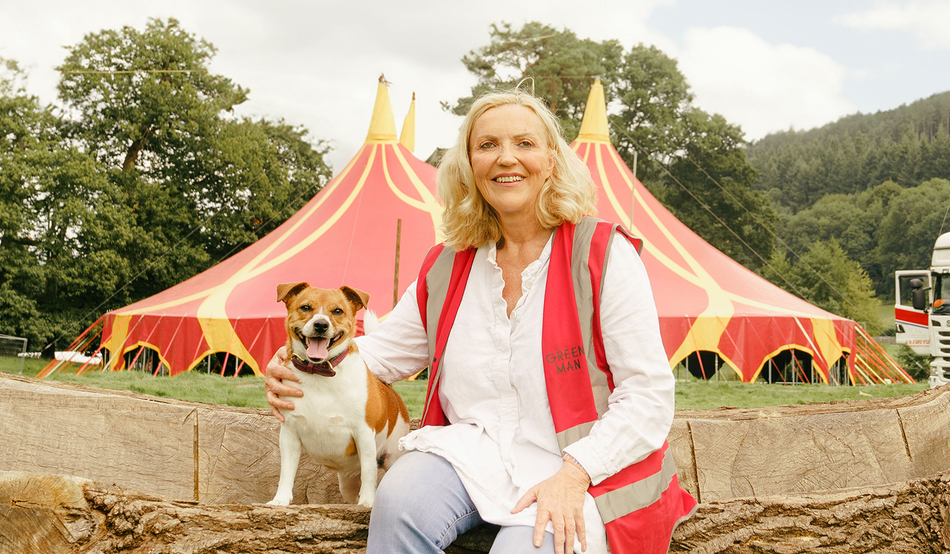
“People think independent festivals are twee, country-fair kinds of things,” Fiona Stewart tells me, a few weeks before the gates open at Green Man, the festival she has owned and run for two decades. “They don’t see the economic impact. In fact, we generate £28m for the Welsh economy.”
This is Green Man’s moment. With Glastonbury taking its traditional fallow year—Worthy Farm belongs to the cows until June 2027—the four-day festival at Glanusk Park, in the Bannau Brycheiniog National Park, is the closest thing this British summer has to a centre of gravity. Not that it needed the help. All 25,000 tickets for each day sold out last September, in under an hour, before a single act had been named. When I ask Stewart whether Glastonbury’s absence changes anything for her, the answer is a cheerful no.
Stewart’s route here was not the standard one. There was bar work, waitressing, cleaning, stints with drag acts. “I tried to be useful and was very hardworking,” she says. “Eventually people got to know me and they’d ask me to work.” For a number of years, she was at—yes—Glastonbury doing crowd-management assessments; then a friend at the Big Chill asked her to represent that festival at its hearing after it got into licensing trouble. “At the end of the hearing, the council said that they wanted me to operate the festival.” She did—pioneering what became known as the boutique festival—before taking over Green Man in 2006, then a folky gathering of a few hundred souls, and building it into the largest festival in Wales and one of the three remaining large independent UK festivals.
Its singularity is by design. Stewart capped the capacity in 2016, refuses sponsorship to retain curatorial freedom, and has rebuffed the corporate consolidators who now own much of the industry. “We don’t have a VIP area,” she says. “You won’t really find us hanging out in green rooms. We’re very much around the audience.” The operation runs on the efforts of 78 freelance managers, each given a brief and the autonomy to deliver it: “There’s no rehearsal. It has to work from the beginning.”
The programming is just as unusual. Alongside this year’s headliners—Wolf Alice, Mogwai, Wilco and Four Tet—there is comedy (Joe Lycett, among others), a cinema tent and a science area curated with the help of actual researchers and interpreted by artists. Its newest stage, Pandemonium, is built on the cheerful premise that we may already be in hell, which might strike a chord with anyone who has sweated their way through this summer’s heatwaves. Except: “there’s no point in just shocking people,” Stewart adds. “We present quite heavy facts [about the state of the climate], but also ways of getting out of it.” The bill is split 50:50 by gender, a policy Green Man adopted before it was fashionable. “We were on of the first,” she says, of this and much else. “And we’re Welsh.”
Its newest stage is built on the cheerful premise that we may already be in hell
Ah, yes, the Welshness. I should declare an interest: I grew up in Wales and have the plastic pint glasses to prove my attendance at previous… Green Men? The festival has always struck me as Welsh in ways that go beyond its bilingual signage; something in its unhurried, hospitable temper. Stewart doesn’t resist the reading. “We are a fundamentally Welsh festival, but outward-looking,” she says. “Not only are we talking to people in Wales, we’re talking about Wales to people outside of Wales.” The festival has been identified as a soft-power asset for the nation. Rather than owning its contractors, Green Man hires small firms—tent-makers, brewers, pie men—so the money ripples outwards. The festival is, she says, “the biggest opportunity Welsh brewers have to promote their wares internationally”.
The festival’s conscience is the Green Man Trust, the charity Stewart founded in 2014, which has put more than £2,465,000 into Welsh projects, from repairing village halls to skills training and theatre workshops for excluded pupils. Her deeper worry is loneliness. “Getting people together in a field is magical,” she says. “I’m worried that people aren’t seeing the risk of isolation as much as they should.” Independent venues, she argues, ought to be treated as “a stimulus in the high street”, with a mental-health value attached—both in city centres, where shops are shutting down, and rural areas like mid-Wales, where the schools are closing because the young are leaving. “It’s not always about bringing in Nissan to stimulate growth. Sometimes you have to think laterally.” She is, she says, “ever the hopeful person” that the current political moment might mean that “things get done that really need to get done”. Green Man “would love to be part of that strategy”.
When this year’s festival opens on 20th August, the first act on the Mountain Stage will be Tall Child, winner of the Green Man Rising competition for new artists from some 4,000 entries. “They’ve really made it,” Stewart says. “It’s a massive deal for them.” Meanwhile, she will be where she always is: watching films in the Cinedrome at 2.00am, wandering to the comedy tent, a cider from the Welsh beer festival in hand. “I love what I do, and I work with very good people.” In a summer without a Pyramid, the mountains will do.