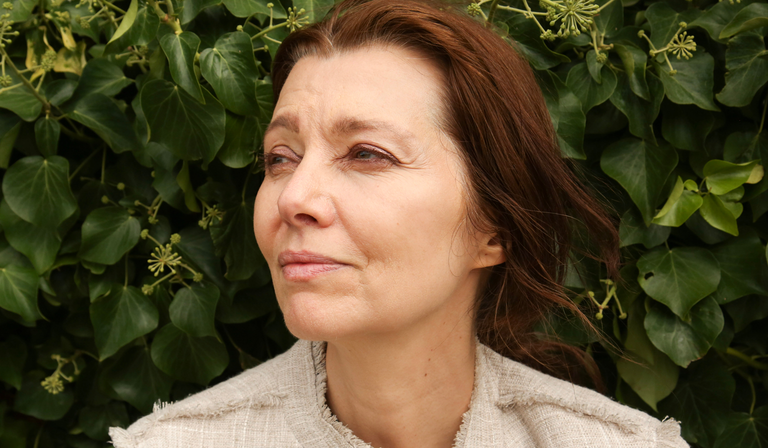
Sitting next to the Thames on a cool, late-summer afternoon, Elif Shafak remembers the last time she stepped foot in Istanbul, her home in a previous life. She pictures herself walking down the steep street of Kazancı Yokuşu (the “Cauldron Makers’ Slope”) in the bohemian Beyoğlu district of Turkey’s best-known city, an area that has historically been home to ethnic minorities, sexual minorities, writers and artists. Beyoğlu was the place Shafak “fell in love with” as an aspiring young author, the place where she experienced the devastating 1999 earthquake that killed more than 17,000 people, and a place that features in many of her novels.
She was last in Istanbul 11 years ago for book signings and to spend time with her ageing mother. Had she known it would be her last visit for many years, she might have taken a memento with her to London to remind her of home. “I would love to have brought a fig tree sapling over,” she tells me. “The fig tree comes from Cyprus, so it’s an immigrant tree.”
As she talks through the idea, she realises that importing a foreign plant to grow in British soil would likely have landed her in trouble with the authorities here. “Maybe it’s illegal to sneak it into your suitcase,” she shakes her head, smiling. “But that was the yearning I had: to plant a fig tree here.”
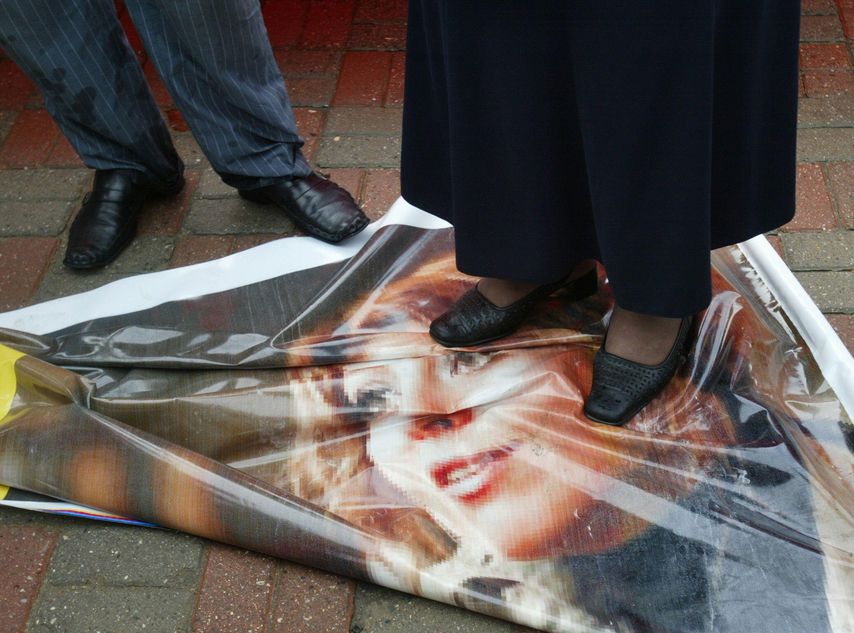
I joke that the last thing she needs is more time inside a courtroom. Shafak winces, then chuckles knowingly. She has had more than her fill of legal dramas. Shafak was taken to court by an ultra-nationalist group after the publication of her 2006 novel The Bastard of Istanbul, which discussed the Armenian genocide that took place between 1915 and 1916, a sensitive subject in Turkey. “That was a very difficult year for me emotionally, as I was also pregnant,” she tells me. “I was put on trial, accused of ‘offending Turkishness’. The prosecutor asked for three years in prison. There were groups on the street burning pictures of me, spitting at pictures of me, burning EU flags because they thought I was a stooge of European powers, whatever that means.”
The case attracted national and global attention. Shafak was acquitted on all charges. Having received threats, she had to have a bodyguard for a year and a half. “Having a bodyguard felt so surreal,” she recalls. “I’m a fiction writer. I’m not a politician.” The “unsettling and scary experience” also led to postpartum depression. “I knew I needed another home,” she says.
We’re talking over tea at a crowded riverside café in west London. Loud music plays inside, while seagulls call across the silty shores of the heatwave-depleted Thames. Shafak measures her responses carefully, gesturing with hands adorned with chunky silver rings. She comes across as sincere and thoughtful, as well as a little world-weary.
In 2019, Turkish police launched investigations into her novels The Gaze and 10 Minutes 38 Seconds in This Strange World, over allegations of obscenity for their descriptions of sexuality and child sexual abuse. Again, Shafak was vindicated. “As a Turkish writer, it’s almost like the sword of Damocles is hanging over you,” she tells me. “You know that at any moment you can be investigated, prosecuted, attacked, targeted, slandered, exiled or imprisoned.”
In 2008, Shafak and her two children moved to London. Her husband, Turkish journalist and editor Eyüp Can, would follow a few years later. For a while, she maintained a close relationship with her home country. But the government’s clampdown on journalists, intellectuals and artists, along with her own experiences on trial, meant Shafak needed to get away. “I felt suffocated,” she explains. “I also received a lot of abuse after I gave two TED talks, especially after the second, when I came out as bisexual. There was a lot of abuse and online and media attacks for months. There came a point in my life when I felt lonely and hurt. I love Istanbul—the people, the culture, the country—with all my heart. That will never change. We carry our motherlands with us. But I needed some cognitive distance. I also needed freedom, as a writer, if I wanted to continue to write my novels, especially as a novelist who’s interested in the ‘silences’ of official history. For that, I had to send myself permanently into self-exile.”
A timid, introverted child, Shafak would not have seemed an obvious bet to trouble any governments. Born Elif Bilgin in 1971 in France, her parents soon split up, and her mother took her back to Turkey as a young child. From the area of students and immigrants where she’d lived in Strasbourg, which was “heavy with Gauloises cigarette smoke and leftists talking about revolution and reading Jean-Paul Sartre”, Shafak was transported to “a very traditional, patriarchal, inwards-looking, conservative, middle-class neighbourhood in Ankara. It was a big rupture.”
There, Shafak was raised by her maternal grandmother, while her mother went back to university and pursued a career, bucking the trend in Turkey for divorced mothers to remarry older men. “My grandmother intervened and said ‘No, my daughter should have choices in life,’” Shafak says.
Her grandmother was also a storyteller. “She wasn’t very well educated but she had an incredible wisdom and a memory of folktales from Türkiye, the Balkans, the Levant, the Mediterranean and the Middle East,” she tells me. “I loved her stories, and I loved observing her superstitions—a woman who would do coffee cup readings or melt lead in water to interpret the shapes that formed.”
Shafak therefore grew up in “a very matriarchal house in the middle of a very patriarchal culture, observing these opposites”. Though her grandmother was “very compassionate, generous and loving”, Shafak felt a powerful sense of loneliness as a child. Her mother was often away and her father, an academic, was painfully absent. “I grew up almost without seeing my father at all,” she says. “He was very disconnected from me. He never celebrated my birthday or came to see me.”
After her mother became a diplomat, Shafak moved between cities, including Madrid, Amman and Cologne. “I always felt an ‘in-between-dom’”, she says of the nomadic life. “You’re enough of an insider to connect with a place and people, but enough of an outsider to be aware of the alienation. It’s a good place for art, but a very lonely place for the artist. That feeling of otherness has never abandoned me throughout the years, even now. I can empathise with anyone who feels lonely, othered, misunderstood or left behind.”
Shafak credits her mother and their time in Spain for developing her love of literature. “Books change people,” she says. “I was a very lonely child. The books I found became my companions.”
Later, when she began publishing fiction in Istanbul, Shafak decided she needed a pen name and adopted her mother’s first name, Şafak—meaning “dawn”—as her surname. “It was an act of self-creation,” she says. “I connected to my maternal side.” Her first published collection of stories, Kem Gözlere Anadolu, was published in 1994, followed by several novels written in Turkish before Shafak switched to writing in English around 25 years ago.
In total, Shafak has published 21 books, including 14 novels. Set across cultures and history, they often tackle difficult subjects, including violence against women, addiction, colonialism and climate change. Her stories often use imaginative perspectives and framing devices—their narrators have included a talking fig tree and a murdered female sex worker whose body is dumped in a bin, while There are Rivers in the Sky follows the lifespan of a raindrop over several centuries.
Choosing her pen name was ‘an act of self-creation’
With a PhD in political science, Shafak has also taught at universities in Turkey, the United States and the UK.
She has been critical of the Turkish government, especially as President Recep Tayyip Erdoğan’s regime has tightened its grip on the country’s universities, media and judiciary, restricting dissent and exerting pressure on artists, women’s rights organisations and the LGBTQ+ community. “It breaks my heart because Türkiye is a beautiful country with beautiful people, and it deserves a proper, functioning, liberal democracy,” she says.
Her own “absurd and surreal” experience of being put on trial “for writing a work of fiction” is one of many reasons she feels a strong kinship with the French author Gustave Flaubert, the subject of her new novel In One Brief Moment All Eternity. In 1857, Flaubert was taken to court over his now classic novel Madame Bovary’s depictions of Emma Bovary’s adultery, sexuality and suicide, as well as his use of religious imagery, which the French authorities considered an “outrage to public and religious morality”. Like Shafak, Flaubert was acquitted. In fact, the publicity generated by the trial helped make Madame Bovary famous.
The heavily fictionalised biography allows Shafak to look at the “iconic male author, regarded as a connoisseur of the female psyche, and flip it upside-down, to let women tell his story”. Among the novel’s narrators are Flaubert’s mother, his nanny, a corpse, an Egyptian belly dancer and his fictional creation Emma Bovary herself. Flaubert was radical in creating Bovary as “a complicated woman, neither an angel nor wicked,” suggests Shafak—even if he did then “give her arsenic, so she suffers a very painful death.”
Like Shafak, Flaubert “dedicated his life to literature”. He reportedly grew up lonely, finding solace and inspiration in books. “It’s a book about loneliness,” says Shafak of her novel. “It’s about otherness. This man, who today we respect as a great author, was, throughout his childhood and youth, regarded as the ‘family idiot’ by those who were closest to him. He was belittled and underestimated.”
The book was borne out of a period of depression for Shafak, which began around the publication of her popular novel There are Rivers in the Sky in 2024. “World events became darker and darker,” she explains. “There was Ukraine, the destruction of Gaza, Sudan… It’s been a time of anger and anxiety. I never believe fiction is a luxury—I believe it’s existential.
“‘What kind of stories can we tell in a moment like this?’ became an important question for me. That led me to Flaubert. We tend to forget he wrote fiction in the middle of chaos, war, starvation, siege, destruction… Madame Bovary was written at a time when the world was falling apart.”
Perhaps if literature had no power, governments wouldn’t waste time suppressing voices they perceive as a threat, I suggest. “There are people who don’t realise that fiction is so essential for our existence,” Shafak nods. “We are storytelling animals. This has never changed over millennia, but in times of crisis, chaos and confusion, our need for stories is even deeper.”
Shafak is “not a religious person at all”. Agnostic and spiritual, rather than an atheist, her usually soft voice hardens when she shares her view that “organised religions divide humanity into ‘us’ versus ‘them’, and they believe ‘us’ is somehow closer to God or closer to truth than ‘them’.”
What she does strongly believe in, though, is the importance of human connections. In her 2020 non-fiction book How to Stay Sane in an Age of Division, she explored nationalism, populism and polarisation, writing that: “The moment we stop listening to diverse opinions is also when we stop learning. Because the truth is we don’t learn much from sameness and monotony. We usually learn from differences.”
Our digital world, including 24/7 news cycles and social media, provides “too much information, too little knowledge, and even less wisdom,” Shafak argues. “We cannot process this much information. It’s making us anxious and tired. What scares me is not pessimism; what scares me is apathy.”
She is particularly concerned by the fact that: “Many people in the UK have started saying, ‘I don’t read the news anymore. It’s too tiring. It’s too demoralising.’ The moment you stop following news sources, it’s a dangerous world. We retreat from the public space. People with more extreme views start to dominate the public space. It’s not a coincidence that in every country where we’ve seen a rise in authoritarianism and a decline in democracy, there has been extreme polarisation. Autocrats love extreme division, when people stop speaking to each other.”
‘What scares me is not pessimism; what scares me is apathy’
The answer, she tells me, is “to connect human–to–human, across borders, across identity politics, across tribes. My worry is that when we become so isolated from each other, there’s a numbness that seeps in. That’s the moment we stop caring about other human beings, about what’s happening in the world. For me, literature is the antidote to apathy, because it helps us to care. It helps us to connect. It helps us to feel again what it is like to be someone else.”
Our teacups long since emptied, we walk along the Thames, chatting about music for a while. “I’m a ‘metalhead’,” Shafak chuckles. “I have been since my early years,” she adds. “I never write in silence. Every day, I choose one song that speaks to me, and I listen to that song on a loop 70, 80, 90 times. I find that energy very inspiring. I love the fire in heavy metal. When I listen to it, my writing is calm.”
She talks, too, about the complexities of family, and how a child’s early experiences can shape the rest of their life. Shafak’s mother is still in Turkey and occasionally visits the family in London. But her father passed away in 2015. “In my 20s, I was very angry at him,” she confides. “Towards the end of his life, we did manage to connect. I wanted him to have a close relationship with his grandchildren; otherwise, the cycle never breaks. He came to our house many times, so we were a little bit closer.”
Shafak has now lived in London for nearly two decades. In 2025, she was appointed as the new president of the Royal Society of Literature, taking over from Bernardine Evaristo. “My children were babies when they came here. They have London accents,” she says. “The fact that children in London go to school and have friends with children of all religions and none, celebrating each other’s rituals and cultures… I treasure that. I feel connected to London, to the Thames. I believe in multiple ‘belongings’. There is the melancholy of a loss [for Turkey], which I carry with me but there’s also the cultural enrichment that you obtain if you remember that each and every one of us are citizens of humankind.”
Given her experiences, which have “scarred” her, she expects that she won’t ever live in Turkey again. “Istanbul is very much in my heart. My connection with the people in Türkiye—women, the working class, youth, sexual minorities—has not diminished one bit. But my home is London. I feel rooted here.”
In the future, she would like to attend literary events again in Turkey, where her books are still widely read. But as the repressive atmosphere that drove her out of the country seems only to worsen, a return still seems distant. “I’m very hopeful that one day soon, I’ll feel comfortable enough to go back,” she says. “We don’t forget our motherlands just because we are miles and continents away. That emotional bond is always there. But I can’t say realistically that it will happen. I don’t know that. At this moment, all I can say is ‘I hope’.”
Elif Shafak’s “In One Brief Moment All Eternity” is published by Viking