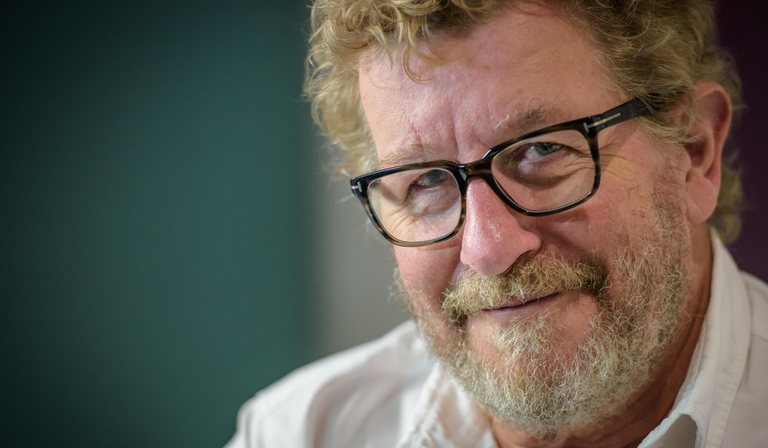
It’s a sunny day at Sebastian Faulks’s home in leafy west London. The place had housed students before he and his wife moved in more than 25 years ago, and it was initially in such a state that electricity wires fizzed on the outside of damp walls. There’s no sign of that now, as we sit in a room with large sash windows, stacked with books written by Larkin, Solzhenitsyn and Gunn. On top of one pile is Faulks’s new novel Farewell to Eden, which follows a soldier sent to Palestine in the last days of the British mandate.
Written in 2024 during the Gaza war, Faulks describes himself as “appalled” by violence in the region and “surprised by how little people here [in Britain], especially younger people, seemed to know about the history of Israel’s creation”.
His own education in the subject began at Cambridge university: he shared a room with Ian Black, who would go on to become Middle East correspondent for the Guardian, and who lodged in his mind the complexity of the region’s history. Black died three years ago.
But Faulks, 73, stresses that this work is not political. “I’m not telling people what to think. It’s the story of a man’s life, his two great loves, rather than an argument for one side or the other.”
Much of his oeuvre deals with unchosen paths and the tiny incremental choices that build to form a human life. Like his protagonist later in the book, Faulks tells me he once applied to teach at a boarding school. They never replied. “I often wonder what it would have been like for the rather lost young man I was to enter that strict, hierarchical world.”
Despite being a lifelong agnostic, Faulks thinks that novels rarely grapple with religious belief. Though he finds it “fairly easy not to come down firmly on either side”, Faulks is drawn to portraying characters searching for meaning. “As you grow older and more friends die,” he reflects, “your thoughts turn increasingly towards death, belief and the afterlife.”
Many of his 20 books also deal with war and conflict, and an inherited world which he says he has subconsciously spent years trying to explain. Faulks’s best-known novel Birdsong (1993), set during the First World War, has been a regular feature on the English curriculum in schools for two decades.
“I was born in the middle of the 20th century: my grandfather fought in the First World War, my father in the Second, and I grew up during the Cold War,” he says. “Looking back across my books, their underlying project is to ask how we ended up here, who I am and what we are.
“You cannot explain Britain, Europe or the 20th century without facing the fact that we killed one another throughout it; Europe, despite its pride in science and the arts, led the world in genocide. I did not choose that world—it was the one I found.”
Since then, “Britain has made terrible errors”—“supporting the invasion of Iraq was madness, and I wish Blair would admit it,” he says—but he sees these as historical exceptions, rather than as evidence that the country is heading for an imminent catastrophe.
But there is still “far too much” armed conflict, says Faulks, with the highest number of global conflicts since the end of the Second World War recorded last year.
“The first challenge of human life is not to kill another human being,” he says, quoting Matthew Kilvert, Farewell to Eden’s affable padre. It is a challenge that humanity struggles to meet. Though, Faulks wishes to stress, he has risen to it, and this is not a lunchtime confession of murder.
What he does confess to, however, is already having a glimmer of the next novel in his mind: “If I do not reach the keyboard during the day, I feel like a pianist who has not played.”
“I simply like writing,” he says with a pause, “and cannot do anything else.”