Carlo Rovelli is a romantic. He’d be the first to admit it. Actually, scratch that: he’d be the second. “My girlfriend always says, ‘In a couple, at least one of the two should be romantic,’” the theoretical physicist tells me with a smile when we meet in the Prospect offices during London’s superheated summer. “I am romantic in many ways. I’m an idealist, obviously. Because I say, why don’t we all live together in peace? Which is quintessentially idealist.”
Rovelli’s idealism has recently been getting him into trouble—of which more shortly—but you wouldn’t guess that just from looking at him. He is 70 now, having marked the birthday in May, and comes with white curls, an Italian accent softened by decades of working in the United States, France and Canada, and the easy manner of someone who has explained the fabric of the universe to students, prime ministers and audiences at countless literary festivals. He is one of the founding fathers of what’s known as “loop quantum gravity”—a rival to string theory when it comes to reconciling the precepts of general relativity with those of quantum mechanics—but is now better known as one of the bestselling science writers on the planet. His Seven Brief Lessons on Physics (2015), a 96-page wisp of a book that began as newspaper columns, has sold millions of copies in about 50 languages. The follow-ups—The Order of Time (2019), Helgoland (2022), White Holes (2024)—were a similar blend of hard physics and delicate poetry, and did similarly stellar business.
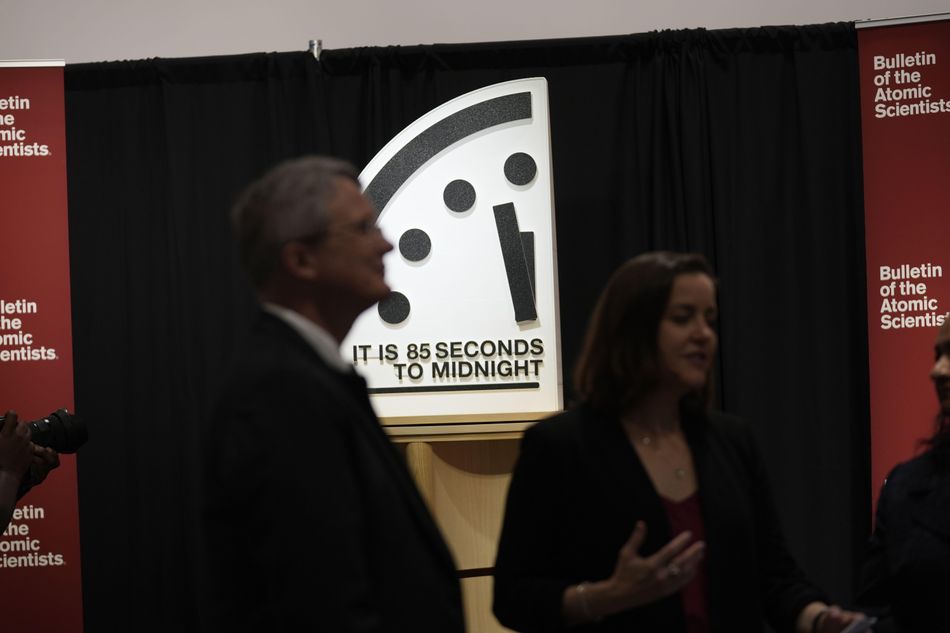
And now Rovelli has decided to spend some of that accumulated capital. He has two books out this year. The first, 85 Seconds to Midnight, published in June, is a short, furious history of nuclear weapons, named for the current, unprecedented setting of the Bulletin of the Atomic Scientists’ “Doomsday Clock”. The second, On the Equality of All Things, out in September, is a serene tour of the philosophy he has drawn from a lifetime in physics. If one book is an alarm call, the other is something to luxuriate in… a hammock, perhaps? Or at least that’s how it seems at first. What’s remarkable—and what became clear over the course of our conversation—is that Rovelli is making the same argument in each.
Let us start with the alarm. 85 Seconds to Midnight opens, mischievously, with a blunder: the Italian physicist Enrico Fermi’s 1934 experiment in which he split uranium atoms—which is to say, achieved nuclear fission—without realising he had done so. Fermi instead believed he had created new elements, heavier than uranium; Mussolini’s fascist government triumphantly named them “Ausonium” and “Hesperium”, after two ancient poetic names for Italy; while the chemist Ida Noddack, who correctly suggested that the nuclei had broken apart, was ignored. Fermi collected a Nobel prize partly for the wrong discovery. “Which is quite spectacular,” Rovelli says, with some delight.
When I ask whether opening with a mistake is merely a literary device, or whether Rovelli is saying something deeper about nuclear physics in general, he answers laterally—and laughingly. “It was a mistake on my part!” he says. “Because it was very badly taken in Italy. People jumped on me: ‘How dare you say something negative about our great scientist!’” Criticising Fermi in Italy, he suggests, is “like talking badly about Saint Francis or the Pope”. But the offence-takers had it backwards. “I didn’t want to say at all that nuclear physics was something already dark. It’s the other way around: there’s nothing wrong with mistakes in science. That’s how we learn.” He has written elsewhere, he points out, that Einstein made more mistakes than the average theoretical physicist—“mistakes of all sorts”—and that this in no way diminishes his stature.
What really perturbed Fermi’s—and Rovelli’s—countrymen, he reckons, comes later in the book: his observation that Fermi, practically alone among the giants of his generation, never publicly expressed a flicker of unease about Hiroshima and Nagasaki, despite having sat on the scientific panel that recommended dropping the bomb without warning. “They jumped on what I said at the beginning,” he says. “But what made some people nervous was what I say at the end.”
Mistakes, though, are the book’s real subject—not the fruitful mistakes of science, but the catastrophic mistakes of politics. The Manhattan Project, Rovelli suggests, was “a colossal investment” premised on the false belief that Hitler was closing in on a super-bomb. “There was a profound misunderstanding in the UK and US about what was actually happening in Germany,” he explains. In fact, Germany—then “the scientific superpower”, the home of Werner Heisenberg and quantum mechanics itself—had asked its physicists about the bomb and been told that it couldn’t be built before the war’s end. So, the Nazis didn’t really bother. Whereas the Americans spent billions, and still the Trinity test only happened after Germany’s surrender—and with the Japanese government making noises about a negotiated end to the conflict. Truman used the bomb anyway. Why? To keep the Soviets out of Tokyo, Rovelli argues, and to announce to the world who was now in charge. Or, as the book describes it, the bombings of Hiroshima and Nagasaki were “the scream of the gorilla beating its chest and telling the forest that it is the strongest”.
From there, the ledger of errors keeps gaining new entries. The Korean War, in Rovelli’s telling, was born of two intelligence failures—Moscow was convinced the Americans wouldn’t defend the south; Washington was convinced the Chinese wouldn’t defend the north—that cost millions of lives. Libya gave up its nuclear programme, trusted the west, and was bombed into chaos anyway; North Korea kept its bombs and remains untouched. (“Never trust the West,” reads one of the book’s flintier lines. For small countries, Rovelli writes, the bomb is simply “life insurance”; the danger comes from the big ones, for whom it is an instrument of domination.)
And what mistakes will happen in future? “The problem of atomic bombs is not the past; it’s the present,” Rovelli says. Today’s warheads are hundreds of times more powerful than those dropped on Japan, and there are many thousands of them. He gestures, loosely, at the city around us: “England would disappear in a moment, as a whole. In fact, it would be one of the first to be destroyed—like northern Italy—because there are American bombs here. So you and I would die first, to save the Americans, who would die a little later.”
And the moral of it all? “So much of the worst aggressivity comes from fear,” Rovelli says, “and very often from unjustified fear.” Fear, he adds, “is quintessentially irrational, because it’s reciprocal. Somebody is scared by others and becomes more aggressive; the others are scared in turn.” Nations, in other words, are gorillas in a forest of mirrors.
If you’re wondering how a physicist became so strident, it helps to know where Rovelli came from. Born in Verona in 1956, he was a child of the Italian 1960s and a student of the incandescent 1970s—a hippie, by his own description, who hitchhiked across North America, helped run a subversive Bologna radio station, co-wrote a book about the 1977 student movement that was printed in secret and against the wishes of the police, and was detained for refusing compulsory military service. “Everything is politics,” he recalls. “That was the slogan of the time.”
Physics arrived almost as an afterthought. “I was not thinking of becoming a scientist as a young man,” he says. “I was intellectually curious. I was doing this and that. When I met quantum mechanics, and the first applications of quantum mechanics, which were atomic and nuclear physics, it just sounded magical. I said: this is incredibly beautiful, I need to go into that.”
For Rovelli’s generation, however, the beauty of the atom came preloaded with horror—“the bombs were close to the minds of the people,” as he puts it, “and I was disturbed by that”. So when the time came to choose a field, he picked the quantum aspects of gravity partly as an act of conscientious objection. “I was convinced that, okay: here there is no application. What I’m going to do is of no use for killing people.” The most famous science communicator of the age chose his life’s work precisely because nobody could weaponise it.
The beauty of the atom came preloaded with horror
That work made his name among physicists; the writing made his name among everyone else. His career as an author, he says, begins with “my total shock when I understood general relativity for the first time”—the experience, recounted at the start of Seven Brief Lessons, of reading Einstein on a beach and thinking, in effect, “What the hell is going on here?” Millions of readers have since had that shock administered to them, gently, by his prose.
Which brings us to the hammock. On the Equality of All Things—its title borrowed from the Zhuangzi, the ancient Daoist classic—is Rovelli’s fullest statement of what he believes physics has actually taught us, adapted from a series of lectures he gave, and conversations he had, while at Princeton University in 2024. The lesson is not a list of particles. It is a way of seeing the world: as made not of things but of relations, “intertwining perspectives—which can only be described from within”.
When I ask him to summarise, he points back at me. “You’re a person, but you’re not understandable unless one thinks about your kids, your loves, your job, your culture—everything which is around you. You are constructed by this combination of things. If you strip everything away, what remains? It’s very little. It’s almost nothing. We are relations, in that sense.” This, he says, is precisely what Heisenberg and Niels Bohr—the pair whose 1941 meeting in Copenhagen is one of the most mythologised moments of 20th-century science—understood about atoms: that we know them only through their interactions with us. In one of the book’s most striking passages, he traces Bohr’s insights to an unlikely source: his fellow Dane, the tormented Christian philosopher Søren Kierkegaard, who declared that “truth is subjectivity”. As Rovelli writes: “Physicists rarely invent anything without first getting permission from a philosopher.”
None of which, he insists, tips us into relativism, where anything goes and nothing is true. Here the book is at its most practical and its most romantic at once—an observation I put to him, and which he takes as a compliment (“You recognise who I am!”). Rovelli’s running example is the sunset. Nicolaus Copernicus taught us that the sun doesn’t actually sink, so does that make sunsets an illusion? “Of course sunsets exist!” the book protests. “They are just the name of what happens every evening.” We simply have to adjust our concept of what a sunset is. The everyday image of the world and the scientific image are both true and both incomplete. “The most silly thing we could do,” he tells me, “is say one is right, one is wrong.”
At which point, Rovelli performs the turn that brings Equality much closer to 85 Seconds than it first appears. If reality is relational, he emphasises, so is geopolitics—and our refusal to think relationally is what’s killing us. “If we think in terms of countries, their own interests, their own identity, we are positioning ourselves badly for understanding and moving in the world,” he says. “If there’s a problem, we should heal the network. The obvious step is: how is my enemy seeing reality? And I think this is what is constantly missing—in the press, in political discussion and in the decision-making process. Which is suicidal, because it leads us to confrontation.”
He is scathing about our habit of reducing whole societies to a single person. “When you want to demonise something, you just say the leader is crazy. North Korea takes decisions—oh, because Kim is crazy. Things don’t work this way.” Russia’s invasion of Ukraine, he is careful to state, was “criminal, illegal, morally indefensible and an obvious mistake”—but he wants us to reckon with how it looks from Moscow, and with our own record. He reels off the countries attacked since 1945 by the United States and its allies—Italy and the UK included—and reaches, of all places, for scripture: “You look at the little speck in the eye of the other, and you don’t see the plank in your own.” Not bad, I note, for a man who agrees with the pope only selectively.
This is where the trouble comes in. Rovelli’s interventions—a 2023 May Day speech attacking Italy’s defence minister that briefly got him disinvited from the following year’s Frankfurt Book Fair, until the outcry forced a reversal; open letters against European rearmament; and now the first of this year’s books—have earned him ferocious critics, who hear in his plurality-of-perspectives talk an apologia for appeasement. How much of 85 Seconds is truly history? And how much is polemic?
“It’s both,” he says before setting out his method level by level. Level one: the facts, which he researched carefully—for the Korean intelligence failures, which he’d found in Chinese sources, he went as far as contacting a senior figure in Italian intelligence, who sent him documents and told him he was on solid ground. Level two: the narrative. “History is not objective. You can choose this fact and that fact—you are not lying, but you create a narrative, and somebody can create a different narrative. I’m very well aware of that. And I’m doing that.” Level three: the point. “Yes, of course, I’m trying to make a point.” It is, whatever else you think of his conclusions, a more honest account of how books like this work than many historians dare to give.
And his fellow physicists? Both books, I suggest, read like messages to his own tribe—85 Seconds a demand that they find their voices, Equality a rebuke to how they think. He accepts both charges. On the first, he notes he’s not alone: he cites David Gross, a Nobel laureate from the rival string-theory camp, as another scientist who is actively urging against nuclear escalation. On the second, he argues that theoretical physics has been led astray by “a superficial reading” of Karl Popper and Thomas Kuhn—fishing for exotic new theories rather than working patiently outwards from what we know—and has been “a little bit sterile” for decades as a result.
He knows how this sounds. “You remember [the comic strip] Calvin and Hobbes? When the teacher tells Calvin to write about other people’s perspectives, and he says: ‘What’s the point? I’m right, they’re wrong.’” He laughs. “It’s a bit arrogant. But I have been asking the same question myself.”
Our time is up; there is a car waiting to take Rovelli on to his publisher’s offices, then to the airport. He waves cheerily as he departs, as good-natured a prophet of annihilation as I’ve ever met. But then, that cheeriness is entirely in keeping with the arguments of both 85 Seconds to Midnight and On the Equality of All Things. Fear, he has spent many pages arguing, is what turns neighbours into enemies and mistakes into catastrophes; its opposite is not naivety but attention—to the other side’s story, to the network, to the sunset that still exists whatever Copernicus says. Eighty-five seconds is not very long. It is, Rovelli would insist, still time enough for us to change our minds.