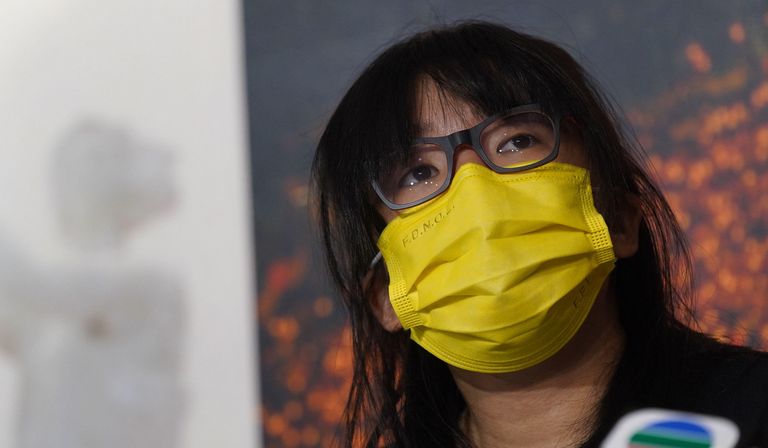
Held in a Hong Kong prison without trial for the past five years, Chow Hang-tung has had few ways to communicate with the outside world. So when her partner, the Chinese dissident Ye Du, proposed to her by writing a letter, she was forced to respond in kind. “We really need to speed up the process of ending this dictatorship, otherwise when will we ever see each other again?” she wrote.
In 2021, Chow was charged with “inciting subversion” under a Beijing-imposed national security law, which also makes the promotion of Hong Kong’s secession from China a crime. On 21st August this year, she was convicted. She now faces up to ten years in prison.
Chow’s verdict comes amid an accelerating crackdown in Hong Kong, as authorities recently expanded the reach of the national security law, giving the region’s chief executive expanded powers to reclassify any criminal case as a matter of national security. While most of the democracy movement within Hong Kong has been dismantled or driven underground, Chow has remained a rare voice of open defiance.
When she was a child, her mother would take her to vigils in Hong Kong’s Victoria Park marking the 1989 Tiananmen Square massacre. Later in life, organising this annual vigil would land her and two fellow activists in detention.
In 2007, Chow received a postgraduate scholarship to study geophysics at Cambridge university, specialising in seismology. When an earthquake hit the Chinese region of Sichuan in 2008, she was frustrated by what she saw as the government’s role in worsening the impact of the natural disaster. It was then that Chow turned her attention to human rights, retraining and qualifying as a barrister in the mid-2010s.
Back in Hong Kong, she advocated for labourers in mainland China and built connections with Chinese dissidents. During frequent visits to friends there, Chow gained a reputation for her bravery, as well as her capacity to drink large quantities of Chinese white wine.
She was sometimes criticised by fellow activists in the Hong Kong democracy movement for focusing on the rights of mainland dissidents over issues closer to home. But according to her friend, the activist Patrick Poon, Chow was “prophetic” in seeing how the experience of dissidents in China foreshadowed what was to happen in Hong Kong. While many of the movement’s leaders had fled abroad, he says Chow was determined to remain inside the region.
“What she saw and heard in mainland China made her realise more deeply that whether a society has freedom, rule of law and civil rights is not an abstract political concept, but directly affects the lives of every ordinary person,” her fiancé Ye Du tells me. He is barred from leaving China and has been placed under strict surveillance. The couple have not been able to communicate with each other since February last year.
One early morning in June 2021, police smashed down the door to her barrister’s chambers and arrested Chow. Despite the significant constraints of her detention, including limited access to legal resources, she chose to represent herself in court, sometimes using court submissions to turn the table on the legal system itself.
During her final submission, Chow questioned whether the judiciary had become a tool to facilitate the Chinese Communist Party’s continued rule. One lawyer remembers her telling a judge that the case was in fact “a trial on this law itself”. Later, as the verdict was read out, Chow smiled.
In the days before her conviction, I communicated with her through an intermediary. Though Chow, 41, sees few reasons to feel optimistic about the future of Hong Kong right now, she refuses to give up hope.
“No one can predict the future, but we should not lose our confidence in the people, who are where hope lies”, she says. “We should not underestimate the people’s resilience.”