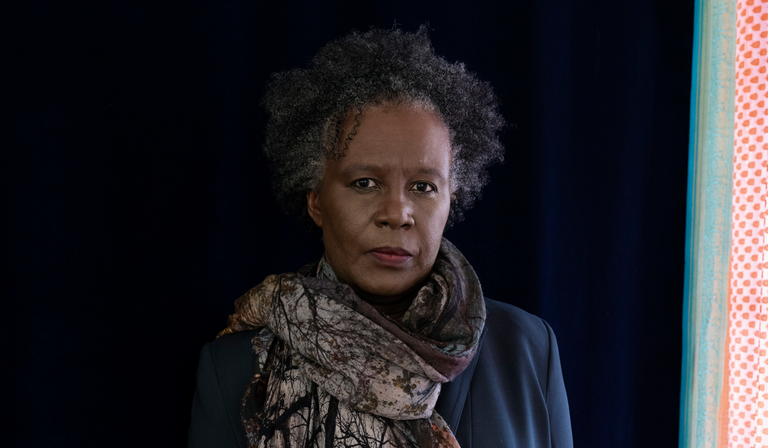
“I am not delusional,” laughs the poet Claudia Rankine, seated in the light-filled lounge of the Marseille apartment that is home for the summer. “This book won’t be for everybody. It is asking a lot of the reader, and I know it’s going to be the kind of thing where people say, ‘What?!’”.
Triage, Rankine’s first book in six years, certainly defies easy categorisation. Published in August, it blends poetry, narrative, memoir, criticism and photography as it presents two female characters—the unnamed narrator and “the theorist”—navigating the fissures in their friendship across time and space, as well as “the wreckage of our world today”.
The book reprises themes that have long preoccupied Rankine, whose dissection of race and its role in our lives in Citizen: An American Lyric (2014) and Just Us: An American Conversation (2020) led to critical acclaim. Yet for its author, who also teaches creative writing at New York University, its driving force is distinct to what came before.
“With Citizen and Just Us, there was a real sense of ‘You might not know, but this is what it [the situation in the United States] looks like’,” Rankine says. “The questions now are different because we know what it looks like [around the world]. We know climate change is here to stay. We know people are being murdered wilfully in Ukraine, Gaza and many places. We know people are being deported, children are being ripped from their parents. There is no failure of documentation in this moment.”
Born into a “very restrictive household” in Kingston, Jamaica, Rankine remembers “living in literature” as a child before moving to New York with her family. “If I told my mother it was homework,” she recalls of her voracious reading, “I could stay up as late as I wanted.” Today, the United States remains home, but racial politics are as fraught as ever, with the FBI as recently as five years ago deeming white supremacists the greatest domestic terrorism threat to America.
“Every book I’ve written has been about the takeover of white supremacy. It wasn’t like it was a secret,” observes Rankine, 62. “The only thing that [Donald] Trump has done is give white supremacy an overt leader, not an overt reality. The reality was always there.”
Born of exchanges with scholars and friends such as Judith Butler, Sarah Schulman and Homi K Bhabha, Rankine describes her eighth book as a “product of now” and a “performance of the difficult conversations we’ve been having”. She adds: “The question is: what are we going to do? Or even, more simply, what is there to do? How can we just sit by and let it all just go down in this way?”
If the limits of liberal politics and personal agency in a more atomised, volatile world are her subject matter, Rankine’s iconoclastic approach to form is as nuanced and fruitful as ever. “It’s almost as if I have been in training for this book,” she adds. Without her teaching background, “I wouldn’t have had the confidence to write it 30 years ago”. Her thinking while writing Triage was “‘By any means possible, at this point. Whatever you’ve got, this is your shot!’”
Given what she views as the entrenchment of white supremacy in the US, Rankine intends to spend more time in Marseille, which is home to the Racial Imaginary Institute, a self-described “multidisciplinary platform to examine the role and impact of race” that she co-founded in 2016.
“For my own sense of stability, for the first time in my life I feel like it might be important to have an alternative space. One never knows,” Rankine says of her French connection. “Everybody is in Marseille. It’s one of the few places in Europe where you walk down the street [as a person of colour] and you’re not the news. It’s also very alive. Things are still possible here.”