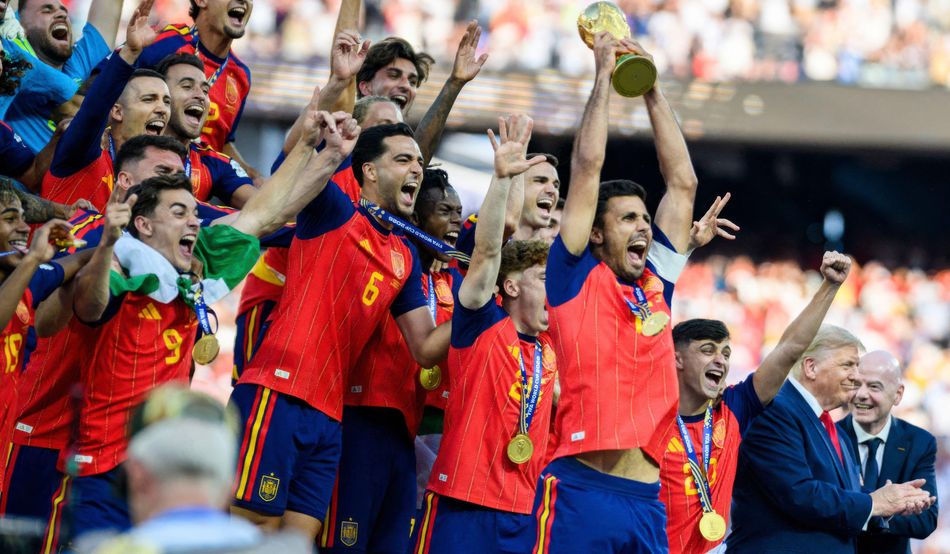
“Unprecedented, incomprehensible and unjustifiable.” This is how Uefa described Fifa’s suspension of the red card handed to US footballer Folarin Balogun, enabling him to play in the World Cup round-of-16 tie against Belgium (a game the hosts lost 4-1). The European football governing body was so outraged that its president, Aleksander Čeferin, boycotted the final between Spain and Argentina. His empty VIP seat became the defining image of modern football’s geopolitical fracture.
Balogun’s initial offence, a serious foul against Bosnia and Herzegovina, was punished by a red card and a one-match suspension. But then, following a phone call from Donald Trump, Fifa’s Disciplinary Committee unearthed a bureaucratic loophole in Article 27 of its code, allowing Balogun to be put under a year-long “probation’’ period and so clearing him to play against Belgium. Here was a perfect example of an administrative workaround to appease a world leader.
And yet, despite being the most brazen bureaucratic hindrance of the 2026 World Cup, it wasn’t necessarily the most notable. Operating under the guise of national security, the US militarised its borders against the tournament’s own participants. When US authorities refused entry to Somali referee Omar Artan, Uefa retaliated by pointedly appointing him to officiate the Super Cup final in August. Meanwhile, the Iranian national team was effectively exiled to a base camp in Tijuana, Mexico, and forced into gruelling cross-border commutes just to compete.
For the modern critic, all this may seem like evidence that Fifa has surrendered its soul to political cynicism, but the geopolitical theatre surrounding the World Cup is no break from tradition. In fact, such theatre is in the inherently chaotic tournament’s DNA.
Long before dynamic ticketing and state-owned oil sponsorships, politicians expressed great interest in the beautiful game, and they didn’t hesitate to get involved. The 1934 World Cup, hosted in Italy, was the perfect opportunity for Benito Mussolini to display his fascist aesthetic, and he left nothing in the competition to chance. Il Duce is believed to have met with Swedish referee Ivan Eklind before Italy’s semi-final and final victories. Eklind proceeded to overlook numerous Italian fouls, ensuring a propaganda triumph on home soil. He and his team also performed a fascist salute to Mussolini prior to the match.
In 1962, Brazilian striker Garrincha was sent off in the semi-final against hosts Chile, ruling him out of the final. However, following a petition from Chilean fans that was supported by Chile’s president, Jorge Alessandri—and after Esteban Marino, the Uruguayan linesman who reported the foul, conveniently didn’t show up to the disciplinary hearing—Garrincha was able to play in the match, in which Brazil won the World Cup for the second time.
Perhaps the most brazen display of state-sponsored match-fixing occurred in 1978. Host Argentina needed to beat Peru by four goals to reach the final. Prior to the match, the leader of Argentina’s military junta, Jorge Rafael Videla, alongside Henry Kissinger (who later claimed to have no memory of the event), visited the Peruvian dressing room. The players interpreted this as political pressure. In 2012, a Peruvian senator, Genaro Ledesma, told an Argentine judge that he believed the match was rigged as part of Operation Condor, a scheme which connected Latin America’s military dictatorships to share intelligence so that they could capture dissidents (and in which Kissinger was implicated).
Four years later, in Spain, political interference was no longer confined to the changing room. During a group stage match in 1982, France’s Alain Giresse scored a goal against Kuwait. The Kuwaiti players had stopped playing, claiming that they heard a whistle. Furious at the decision, Fahad Al-Ahmad Al-Sabah, president of the Kuwaiti Olympic Committee and a senior member of the royal family, entered the pitch and demanded the goal be overturned. The referee complied.
Today, with the action on the pitch more or less protected, whether via goal-line technology or VAR, geopolitical hostility has simply been forced off the pitch. The 2026 World Cup was a tournament of staggering carbon footprints, ridiculous ticket pricing and relentless political manoeuvring, but the tournament has always sat at the intersection of soft power and cynical commerce. The World Cup has never been a retreat from politics; it is its ultimate mirror.