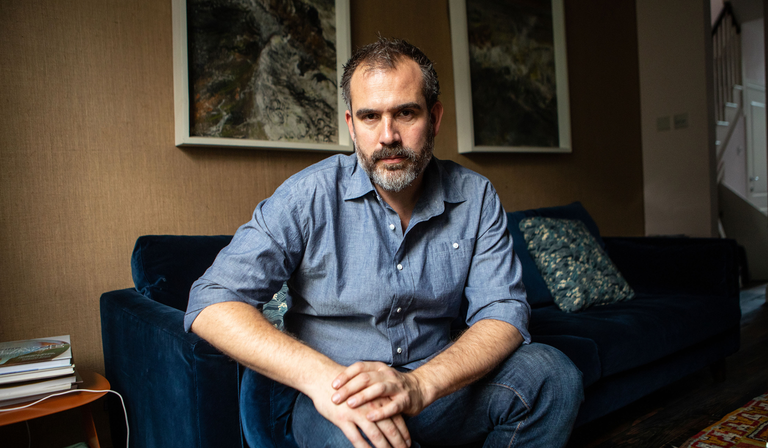
Dr Alexander “Xand” van Tulleken is running late, and his phone is out of charge. He rummages inside a holdall for a cable and produces a handful of bananas, scooped up from a dressing room at the launch of his book tour the previous evening. “The [theatre] offered to provide some food and I asked for some fruit,” he tells me. It’s a fitting choice for the health campaigner and presenter.
The host of CBBC’s Operation Ouch! and BBC podcast What’s Up Docs? is discussing his new book, Make Me Well, in a glass-fronted room inside his publisher’s offices, overlooked by the American embassy in Wandsworth, London.
He was first drawn to the wellness industry by a combination of midlife health scares, an irregular heartbeat during Covid, marrying his wife and the birth of their children. As he noticed a commercial explosion in supplements, wearable fitness trackers and private blood testing, “I wanted to feel good and the stuff I was seeing on social media was terribly appealing,” he explains. Often endorsed by scientists or fronted by influencers, the products felt credible and seductive. Yet something did not add up.
Though many wellness products claim to have roots in solid science, van Tulleken concludes that the multitrillion-dollar industry creates astonishing value—just not for people who buy its products. Many of the benefits dangled by companies selling collagen, high-strength vitamins, fish oils and personalised nutrition, he says, simply didn’t exist.
After 10 years working in the NHS, a master’s degree in public health, combined with spells of humanitarian work overseas, shifted van Tulleken’s focus from health as a private concern of individuals to the political choices which encourage or constrain healthy behaviours, and the importance of sound data. “What I really don’t like is the messing up of the scientific literature,” he tells me.
He is frustrated by companies and influencers playing on people’s anxieties and, as the co-presenter of a number of programmes with his identical twin Chris, van Tulleken often fielded questions (such as “should I take turmeric?”) that he could not answer. “If you ask, ‘should I take a statin or have a knee replacement?’, I can’t tell you off the top of my head, but I know which organisations will give good independent evidence,” he says.
In researching the book, van Tulleken found plenty of unusual practices. In China, he visited a factory that was willing to adulterate supplements with cheap ingredients for export. On another occasion, he submitted stool samples under different assumed identities to test a personalised nutrition app—and was puzzled by the differences in the microbiome scores generated for each profile, despite both “samples being taken from the same poo at the same time”. And when he dug into collagen studies on skin-ageing, those showing benefits were typically low-grade or industry-funded. Other research was selectively quoted.
But if the evidence about the supplements is lacking, why do investors put their cash into them? What matters, an investor explained to him, is not whether supplements work but whether they sell.
Van Tulleken also worries that the pressure to optimise our health as individuals distracts us from demanding action on the social origins of ill health: income inequality, chronic stress and pollution, leaving us with less time for each other and pursuits that give meaning to life. “If you’re worried about your health, a better position in the world is to worry about everyone around you,” he says.
Where does he find meaning? “I’m lucky. I have a job I love and my family.” He also has a pottery kiln—of which he is evidently proud. “Where are my best pottery pics?” he says, searching through his phone until a picture of a white ceramic plate bearing seven small bowls illuminates the screen. It is a ceremonial Seder plate for Passover, made for a friend, an expression of care. And it is in caring for each other, according to van Tulleken, that meaning is found. “That’s the best thing I’ve ever made”, he says.