In the autumn of 2015, the judges of the Booker Prize gathered to select their winner in a boardroom by the River Thames in London. Although I wasn’t a judge that year, unexpectedly I happened to be there too. At the head of the table sat Michael Wood, the recently retired professor of English and comparative literature at Princeton and a veteran of faculty infighting. Wood is a film critic as well as an academic. As the chair, he was the first to arrive, and he began by regaling his fellow judges with stories of how the Thames had featured on screen, from James Bond in 1999 all the way back to Alfred Hitchcock 70 years before that.
The Booker judges had been reading for eight months. Devouring a novel a day, then rereading the longlist and shortlist, had made them confident in their opinions. There were books they loved more with each reading; some that they hated. One judge refused to reread the bookies’ favourite, which in almost five decades of the prize was unheard of. Despite that, they started going round the table, making their presentations. Suddenly, one of them looked up: “Is there really anyone here who is not going to choose Marlon James’s A Brief History of Seven Killings?” The others quickly concurred.
Inspired by the attempted assassination of Bob Marley in Jamaica in 1976, James’s third novel contained dozens of different characters, with a chorus of distinctive voices that ranged from Jamaican Patois to Biblical heights. Wood told Booker’s dinner guests at the award ceremony a few days later that the book was “full of surprises”. The Booker judges predicted it would “come to be seen as a classic of our times”. No Booker winner has ever been selected so fast, though to ensure the impression of long and complex argument, Wood persuaded the judges to stay in the boardroom for two hours.
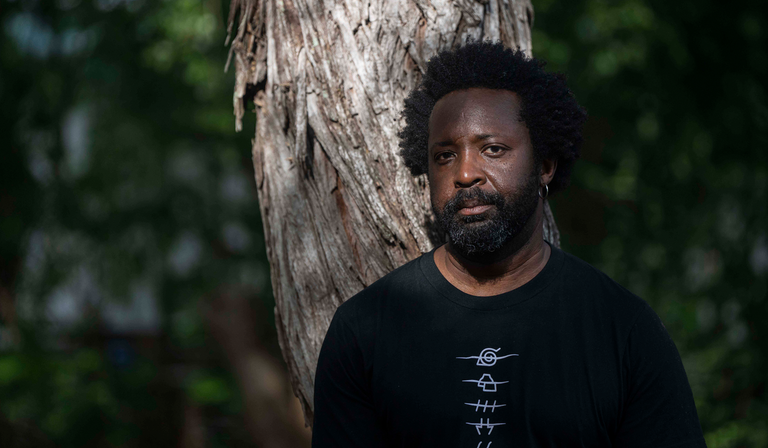
James was 44. Living in America, where he taught literature at Macalester College in the liberal state of Minnesota, he had only recently come out publicly as gay. Jamaica, where he had grown up, was still conservative, violent, homophobic and—as he describes it when I speak with him over Zoom—“hyper-sexualised”. Being gay was not something you told your family or friends about, let alone proclaimed in print. So it is hardly surprising that The Disappearers, his new book, a searing account of growing up as a gay man in a country that abhors homosexuality, has taken more than a decade—and huge physical distance—to write.
The Disappearers tells the story of a vicious homophobic attack on a group of young actors who are secretly rehearsing a new play set in a prison. The assault may or may not have happened in real life, but its aftermath, both physical and mental, is savage. Several of the men end up in hospital, one is left blind. Two of them disappear afterwards, never to be seen again.
Jamaica in the 1980s was full of secrets and haunted by the fear of Aids. The Caribbean setting is, of course, particular to the author, but the story could take place anywhere where homosexuality is abhorred: Iran, Nigeria, Pakistan or Uganda. James’s tale is as universal as it is personal. The “disappearers” are not just the dead, but the vanished, the vanquished and the quietly self-effacing who keep to the shadows, bleaching themselves into anonymity all over the world.
James has written the book in five parts. The central attack comes in a short section that begins almost 200 pages in. By then, the reader has got to know the cast and crew of the play, as well as their families, friends and enemies. When the assault takes place, you really care. It’s not so much communication that James’s writing offers as communion.
The cast does not formally sign up to the first rehearsal; they more just drift in unannounced, with no introductions and no first names. “Homos must be the only men who will send a fist all the way up your bottom and a tongue past your tonsils before they tell you what their parents call them.” That aside, who they are and what they are is obvious from their jeans (brown Levi’s 501s, “hard to find even in America”), their smell (cigarettes and “sex sweat”) and their skin (“darker than me, darker than the stage manager, but lighter than chocolate. Toffee? There’s another name for that which don’t sound like it come from a four-year-old. Caramel?”).
The details come from the diary written by Eddy Porteous, a student, actor, second son and all-round watcher of the others involved in the play. As the director explains to the group, “This is the kind of play that blows open the whole fragile myth of Jamaican male sexuality and homophobia.” Prison, he says, “is the ultimate male institution and yet masculine sexualities that could never happen outside in the normal world flourish in there all the time. Does prison make the gay, does gay make the prison, or do homosexuals just have a criminal nature because our very existence is a crime?” The love that dare not speak its name “speaks loudly behind bars”.
The young actors have been asking themselves questions like these all their lives. They were brought up in households where they’re accused of being “sissies” or “battyboys” (derogatory Jamaican slang; “batty” refers to buttocks). At school, the cool boys look down on them, or pretend to, and their older brothers behave as if they don’t know them. At home, they are regularly picked on by their parents, beaten or thrown out on the street.
On one occasion, a sign has been spraypainted with the words: “AIDS—KILL A FAGGOT”. It’s been put up by “somebody, some group, some mob [that] is lying in wait behind a wall somewhere, watching for me to catch fright so they will know to ambush me, beat me the fuck up, rape my ass with a baton or mop stick, flagpole, a whatever, and then do to me what they do to black people in the American south.”
Two months earlier, two boys had been pulled out of a public toilet after being accused of entering the same stall. They escaped to a pharmacy across the street. The owner locked the door, but that didn’t stop a mob gathering to bang on the glass and threatening to burn the place down. “The police didn’t arrive until an hour later, even though their branch was right across the street,” James writes in the book. “When they took the boys out of the pharmacy the police beat both of them in front of the crowd, breaking an arm, two ribs, one finger… knocking out three teeth, and splitting two lips before shoving the boys into the back of the van.”
“I want to cry like I’ve never wanted to do anything else in my entire life,” he goes on. “This country. This fucking country.”
James remembers his brothers teasing him at a very young age for being a “sissy”. As he grew older, he worked on passing as straight. “Being gay is a huge secret to carry,” he told me from his study in New York. “And I carried it for a very, very long time.” Desperate to alter his sexuality and fit in more easily with Jamaican society, he turned to the Evangelical church in his late twenties and even underwent an exorcism. “My demons were all internal. My demons were my family will never accept this. My mom is gonna say I broke her heart, and when she dies young the family will blame me. I will lose everybody if I come out.”
“One of the reasons this novel was… I’ve yet to find the adjectives to describe how I feel about it… is that I knew how to disappear, so it wasn’t hard for me to write about disappearing.”
Most of James’s novels are in the first person, so it’s tempting to assume that he has personal experience of the worst of the physical violence that he describes. It turns out that’s not right. “I didn’t have some anti-gay Gestapo coming after me. I never once feared for my life.” But others did. The attack at the centre of The Disappearers is said to have been carried out by people who were household names in Kingston, yet it has never been prosecuted.
Nearly two decades after leaving Jamaica, James’s life couldn’t be further from what he describes in his book. He teaches literature at Stony Brook University in New York, has a nice house in Brooklyn, where he lives with his partner, Nicholas Boggs, who has recently published an acclaimed biography of James Baldwin. He has money, he’s well-known. He gives interviews to The Strategist about the things he can’t live without: Momofuku Chili Crunch, Viktor & Rolf Spicebomb eau de toilette, Australian goat milk soap. And when he goes to parties in Jamaica, he’s often the only black man there, thanks to his artistic renown.
Yet the feeling of safety somehow eludes him. Violence continues to exert a hold. Last year he was asked to write a new foreword to Cormac McCarthy’s Blood Meridian to celebrate its 40th anniversary. Many people describe the book as post-apocalyptic; James calls it a “hellscape”. But that’s more of an aside. His main point is that Blood Meridian is not Armageddon. It’s not an ending. “That novel is America’s true beginning, because America was conceived in blood. America was conceived in violence.”
Jamaica was too, he says. “One of the things about former British colonies is that we never recovered from the Victorian era. We still have the British penal code when it comes to punishing homosexuality. It’s not our law. It’s theirs. A lot of colonial homophobia comes from the UK.” And it’s still there.
Some of the world has become more liberal. But much of it hasn’t. “Most of the characters I write end up either thinking violence is currency or think that violence is the only thing they have left to do.” The urge to violence runs deep, against gay black men possibly more than against many other people. Disappearing, for many of them, is still necessary.