The Turner Prize is a strange thing. After more than four decades, its role remains as unclear as ever. What is it trying to do? What audience does it serve? Too small to be representative of the art world beyond these borders, it is nonetheless not quite mainstream enough to stake a claim as a truly national prize. This lack of definition has been so consistent that I’m starting to think it might be by design. Judging by this year’s showing, at the Middlesbrough Institute of Modern Art, it might even be its core strength.
While four artists can’t tell us much about the health of contemporary British art on their own, there is a sense here, more than in previous years, that they can at the very least be indicative of certain—shall we say?—tendencies. Besides a marked absence of art that is too heavily moralising or didactic, there is on display an attempt to tap into “non-human forms of existence” (Marguerite Humeau); a critique of the power structures of bureaucracies and institutions (Tanoa Sasraku); and, perhaps gen Z’s favourite conceit, nostalgia (Simeon Barclay and Kira Freije). Anyone who has been following art in recent years will immediately recognise and understand these tendencies on walking through the door; what they might find a pleasant surprise is that, in the right hands, they are not all yet stale.
Going into the very first room, showcasing Humeau, we find ourselves facing a linen sheet through which we can see a sculpture of a prone white elephant. This is an eerie, cramped sort of space, exuding a ceremonial aura; sitting on a white platform, the elephant looks like an offering to an unseen god. Sitting around it are some ritualistic-looking icons and apparatus whose positioning implies a function in these mysterious proceedings. If here things feel naturalistic yet carefully managed, heading towards the second room we encounter three pieces that betray virtually none of the marks of a human hand at play: a log with a fungal growth running along it; in the centre, a plant-like object with, in lieu of leaves, more fruiting bodies arrayed around its stem, like the steps on some madcap spiral staircase.
It would be easy to dismiss these pieces as merely beautiful, just the kind of art you can imagine the rich buying up in droves to decorate their plate-glass offices, but it is a testament to Humeau’s skill that her ideas are not so easily glossed over. Like the primordial fungal forms she recreates, these are works that grow the longer you spend with them.
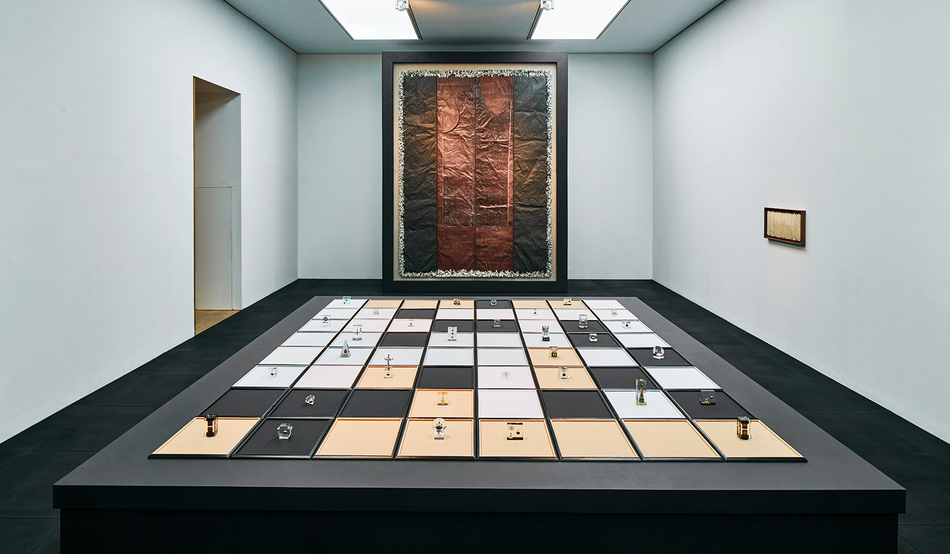
Next comes Sasraku’c room, at the centre of which is what I would perhaps consider the strongest work in the show: Watchlist (2025). On a large, imposing black table, spread out evenly across frames of coloured suede, is a grid of simple glass paperweights. Inside each is a brown liquid which you soon realise—from the postcard-esque text etched across some of the weights—is crude oil, and that these are tchotchkes commemorating notable oil fields, perhaps made as souvenirs for an executive’s desk. With this, the rest of the work’s symbolism falls into place: the suede represents the provenance of each oil—white for the Arctic, camel for the desert, blue for the sea, and so on.
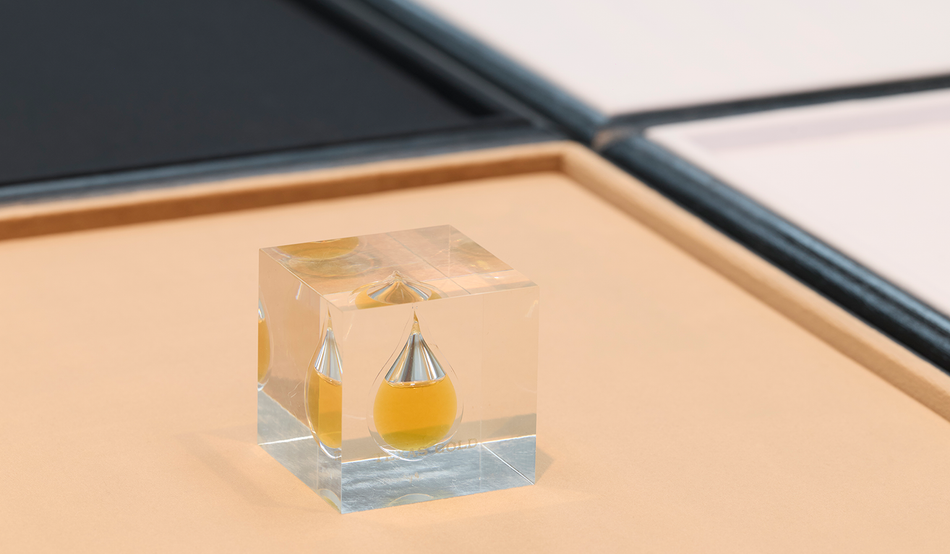
Some may find the work’s “critique” obvious, but only because they are taking it at face value. The real thrust of Sasraku’s work is that this is all meant to be a kind of para-exhibition: what matters is less the objects in front of you than the way they are framed and presented, the heavy, formal symbolism she imposes on them. The paperweights trivialise and make abstract a highly exploitative global practice; Sasraku’s framing restores, and makes even more grandiose, its significance. If Watchlist has any weakness, it’s that it is too good for the other works in the room, which become mere backdrop in its presence.
After Sasraku comes Barclay’s installation, which is, unfortunately, probably the weakest of the four. A large box made from scaffolding, with a set of balloons trapped against the ceiling, acts as the stage for a plodding, typical sort of nostalgia-trip video montage: there is old VHS footage, yes, and archival material, even some sodium streetlights! The problem is that the work takes the poignancy of this material too much taken for granted to make us actually feel anything, the setup reminiscent of something you might find in a shallower level of the Backrooms.
The weaknesses of Barclay’s work are only made more apparent by Freija’s installation upstairs, which likewise tussles with memory and decay. A room with mirrored walls plays host to a series of small, freestanding human figures, all made in the same somewhat ghostly style—thick wireframe bodies with clay hands, feet and faces. There is no clear demarcation between the figures, but each seems to capture its own isolated scenario: a man lying on a tatty sofa; another nearby huddled up on the floor spooning a dog; another still in the corner with his hands resting on his thighs, cringing with laughter as he is surrounded by deflated balloons made of glass. Each vignette is like a vague, half-formed memory, with the stories and details left to us to fill in for ourselves.
For all the intrigue these artists create as a coherent set, there remains the inevitable question: who is going to win? Or, more pertinently—as they’re not often the same thing—who deserves to? How you arrive at your own pick will depend on what you believe the judges are looking for. And if precedent tells us anything about a prize that has always eluded easy categorisation, it is that there is—mercifully—more than one answer.