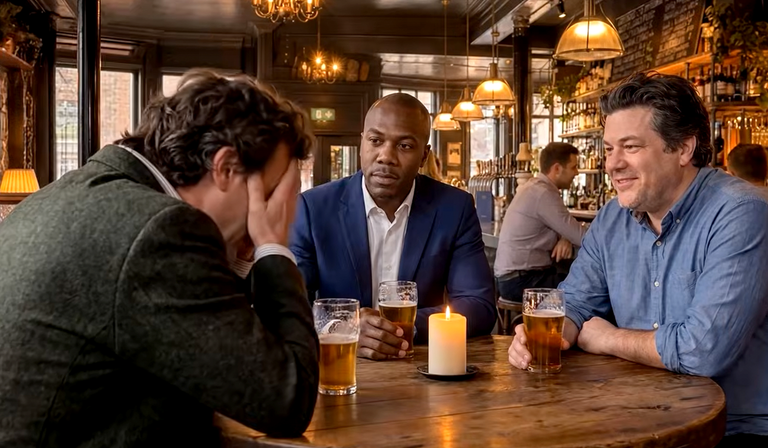
It gives me no pleasure to report that someone has launched what they are dubbing the first fully AI-produced sitcom. The show, called No Big Deal, was written and created by a man called Andrew Dickinson, and premiered on YouTube earlier this month. It’s a workplace comedy that follows a group of venture capitalists as they ineptly try to find the next big idea. And while it was written by a human being, all of the visual elements, including the actors, were generated by AI.
The show is terrible. Of course it is. I am grateful that there is only one episode available so far, because otherwise I would have felt it my duty to watch the whole series in order to write about it, which would have had a disintegrating effect on my soul. As it is, 24 minutes was more than enough. The script isn’t even that bad, in a sort of lightly edgy anti-woke way. You can imagine it being delivered by real actors and it sounding passable. There are decent jokes in here, things like a hapless businessman trying to pitch the concept of “skirtains”: curtains that can also be worn as a skirt. But it is not being delivered by actors; it’s being delivered by AI-generated facsimiles. There is an uncanny smoothness about their appearances, a flatness to the vocal delivery, and I think one of the characters is supposed to be French but the AI is warping the accent so badly you can’t really tell. All this takes place on sets that are unforgivably empty and bland, given that AI could have conjured up anything at all. Instead we get soft-focus, overlarge, underfurnished office spaces and pubs.
The staggering badness of this one foray into AI TV did get me thinking about where we’re up to with AI in television more generally. In some ways, this question feels like small potatoes, seeing as the news is currently filled with alarming headlines like, “Will AI kill us all?” But practically every industry in the world is now incorporating AI somewhere in its practices, and TV is no different. The answer is that, unsurprisingly, it’s being used for visual effects, editing and improving picture quality—all the back end stuff that has required computing power for decades, now with AI added to the mix. Industry reports suggest that it is also now being used in casting, research and development, and production scheduling. We are not, however, seeing many AI-generated actors on screen. For now. And when we do see them, it’s cause for unease and backlash, as with the use of the late Val Kilmer’s likeness in a film called As Deep as the Grave, which Kilmer was cast in before his death.
Will that hold? The advances in AI image production have been incredibly rapid. Perhaps you remember, merely three years ago, when AI was only capable of making terrifying, eldritch horrors like that video of Will Smith—or a morphing shape that sort of looked like Will Smith sometimes—eating spaghetti. AI video looks much, much better now, but doesn’t yet look real. That day is surely coming. And on that day, what will stop TV-makers using indistinguishably real-looking AI generated actors instead of human ones? For now, the answer is union protections, won by organisations such as Sag-Aftra in the US and Equity in the UK. How robust those will be in the future remains to be seen. In an era when we are constantly told that YouTube is the new television anyway, at least in terms of viewership, what legacy media like traditional TV studios are doing may matter less and less.
There was a Love Island-type series featuring hybrid human-fruit creatures, which, astonishingly, was hugely popular
The thing is, AI replacement of human actors is already happening, just not on traditional television per se. It’s happening in the realm of what are called microdramas or verticals: short-form narrative series designed to be watched on your phone, with baffling names such as 30 Days Till I Marry My Husband’s Nemesis. This is a gigantic industry, worth something like $1.3bn dollars, and there are those who tout it as the future of storytelling. People will watch AI-generated narrative content. There was the Love Island-type series on TikTok featuring hybrid human-fruit creatures, which, astonishingly, was hugely popular. In this realm, actors are being booted off jobs they’ve already booked in favour of AI replacements, according to a Business Insider investigation into the practice from earlier this year.
Dickinson apparently decided to make No Big Deal with AI in order to save money. Fair enough, in its way. It is very expensive to hire actors, film in real locations and pay all the people involved in making a television show. You can, plainly, now make a TV show with AI. But, as it stands, I would argue that those costs are still indispensable if you want to make a good one.
And I hope there is something irreducibly human about a great acting performance that AI will never be able to match. There was a clip going round on social media recently of Julia Roberts in Ocean’s Eleven. Her character, Tess, has just discovered, via her ex-husband Danny Ocean, that her new boyfriend, the nasty casino boss Terry Benedict, would give her up to get his money back, and she’s walking across the casino floor to leave the building. Perhaps it’s not the single most virtuosic performance of all time, but it’s illustrative. Roberts is hardly doing anything in this scene, other than walking. There’s no dialogue. But we read in her smallest facial expressions the train of thought she’s having: not only that she is angry and wants to leave her boyfriend behind, but that her ex-husband is the man she’s loved all along, and she ought to go to him.
Can AI deliver that kind of nuance in the twitch of a mouth, a glint in the eye? On the evidence of No Big Deal, not even close. Please, God, let it stay that way.