In September 2019, when Jack Godfrey and Ellie Coote began to work on what became Hot Mess (currently playing at the Other Palace theatre in London), the moment felt urgent: the biggest climate protest in history had just taken place and both were committed to trying to bring the climate emergency into musical theatre.
Almost seven years later, Hot Mess opened there to critical acclaim and in the middle of a brutal heatwave that, in another of nature’s jokes, also coincided with London Climate Action Week. But despite the mounting evidence of the severe consequences of climate change, 2019’s large-scale protests have not been repeated.
In his prison notebooks, Antonio Gramsci wrote about the essential role of culture in generating political change; but while European and US publics understand climate change as a serious crisis, it barely shows up as a theme in popular culture.
It is not for want of effort. Artists and writers have been shipped around the Arctic by philanthropists to encourage them to focus on melting ice. Today, climate conferences routinely include panels on culture. And Hollywood now has an annual climate summit at which entertainment professionals get together to learn and pitch climate stories, but the results are underwhelming.
Hollywood began by squeezing climate change into the disaster movie format, notably in Roland Emmerich’s The Day After Tomorrow (2004). Compressing long-term environmental changes into a few hours, it was not noted for its scientific accuracy, but it did connect natural disasters directly to climate change and stimulated a vigorous, if partisan, debate.
At the Glasgow climate conference (Cop26) in November 2021, 12 broadcasters and streamers from the UK and Ireland, including the BBC, Channel 4, ITV and Warner Bros Discovery, signed up to a Climate Content Pledge devised by BAFTA’s Albert project, promising both to reduce the carbon footprint of their productions and to promote climate storytelling in their output, to help viewers understand and take action. In May 2026 the pledge expanded to take in Banijay UK, Fremantle and ITV Studios—three giants which, between them, represent 65 UK-based production companies and more than 100 globally.
But despite the pledges, the impact remains marginal. The US-based non-profit consultancy Good Energy, founded by Anna Jane Joyner, and Dr Matthew Schneider-Mayerson, an associate professor at Rice University in Texas who studies cli-fi novels, have developed what they call the Climate Reality Check, popularly known as the Bechdel test for climate. Where the Bechdel test measures the representation of women in films by looking for a scene in which two female characters have a conversation about something other than a man, the Climate Reality Check seeks to measure whether and how the climate crisis is represented on-screen. A storyline set on Earth in the present or the near future passes the test only if it’s clear in the world of the story that climate change is happening, and if at least one character demonstrates that they know it’s happening.
It was a test that fewer than 10 per cent of the 250 most popular films released in the decade between 2013 and 2022 passed. For 2024’s Oscar-nominated movies, only three out of 13 eligible feature-length films did so—implausibly, one of them Barbie.
Another report that Good Energy commissioned found that just 2.8 per cent of 37,453 scripted television episodes and films released between 2016 and 2020 included any mention of climate change, even as a backdrop to other plots, and where extreme weather events featured in the plotlines, they were rarely connected to fossil fuels. Where climate change is directly addressed, as in Apple TV+’s 2023 series Extrapolations, critics have judged the results earnest but dull.
In theatre, too, success has been elusive. One early and well-received effort, The Contingency Plan, by the British playwright Steve Waters, encompassed two full-length plays, On the Beach and Resilience, both set in the UK in the near future, and featured an enlightened scientist battling an indifferent bureaucratic and political class. It opened at the Bush Theatre in April 2009 and was shortlisted for the John Whiting Award.
Greenland, a climate play collectively written by Moira Buffini, Penelope Skinner, Matt Charman and Jack Thorne, which premiered at the National Theatre two years later, fared less well: Thorne recently described it as one of the worst-reviewed plays the National Theatre has ever staged.
In contrast to Greenland’s didactic approach, Joe Murphy and Joe Robertson, authors of Kyoto, created a gripping and highly successful drama about the unlikely subject of the Kyoto Protocol negotiations—perhaps because their main character was not a heroic scientist but an outright villain, intent on sabotage on behalf of fossil fuel interests.
For Jack Godfrey and Ellie Coote, the daunting challenge was how to translate the climate story to musical theatre, giving the audience the fun night out that musical theatre promises, despite having climate change as the theme.
“We realised that we were both passionate about the climate crisis and aware that there wasn’t a musical that talked about these important issues. We thought there should be,” Godfrey recalls.
At the time, Godfrey was going through what he called his first, big, tragic break-up. “I’d written this sad, sad break-up song called ‘Used to Be’. The chorus went, ‘Why can’t we be the way we used to be?’
“I was cycling to work one day, singing this song in my head, tears rolling down my cheeks, when I thought, what if this song was being sung by humanity to the Earth? The break-up/planet-environment relationship metaphor came into my head.
“We started brainstorming the metaphor of a romantic relationship between Earth and humanity—what would the beats of the story be? How do they meet? Where do things go wrong?—trying to figure out if there was any potential for a show.”
It was an unlikely and dramatically demanding metaphor. “In the first conversations,” Coote remembers, “Jack was going, ‘Is this ridiculous?’ I was immediately arrested by the idea because it felt like a really interesting challenge. Looking at it through this lens opened up a new tonal way of talking about it.”
They pitched the idea at Beam, a biennial event for musical theatre, and producer Vicky Graham commissioned them to write it. They emerged from Covid lockdowns with a version that went on stage as a concert performance in Dundee in 2021, the year of Cop26.
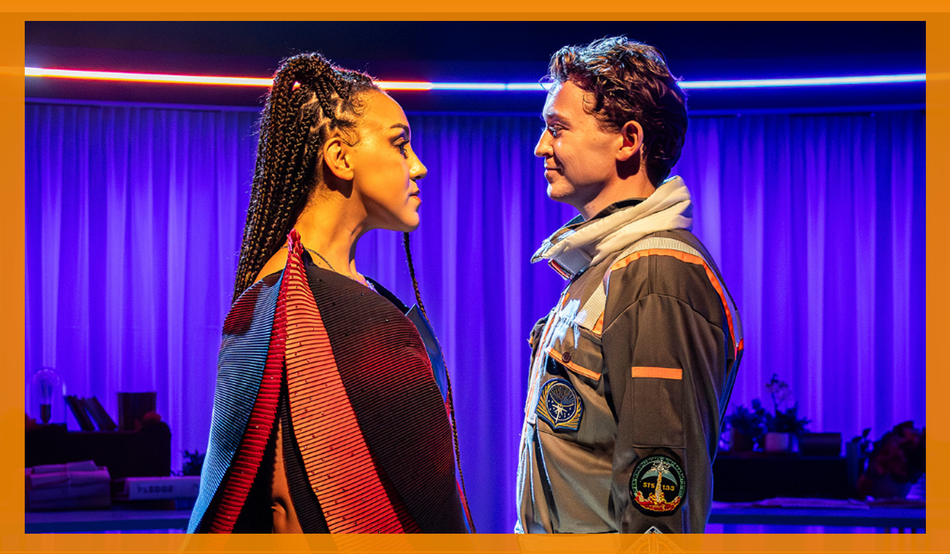
Five years later, after many revisions and a successful run at the 2025 Edinburgh Fringe and a first London outing at the Southwark Playhouse, Hot Mess is a critically acclaimed two-person show, full of witty one-liners and outstanding songs delivered by Danielle Steers, as Earth, and Morgan Gregory, as Humanity.
Godfrey and Coote admit there were many lessons along the way. “Once we accepted that this was going to be a real relationship between Earth and Humanity, it forced us to make it more of an out-and-out comedy. When you start the show in that absurd way, you have to go for it, to allow people to lean in and acknowledge the absurdity of it.”
They also grappled with how to end a story that, as yet, has no happy ending in sight. “We reached a point when we needed to take the pressure off because we don’t have the answers to the crisis. The way to do right by the show is to tell the story of the moment as impactfully as we can,” says Coote.
“We are not giving people homework, but it’s immeasurable how art impacts people. We want to give audiences the space and time to think and feel about the climate crisis, to sit in their feelings, however absurd and uncomfortable that might be, and to experience that together. It’s for them to process as much as is right.”