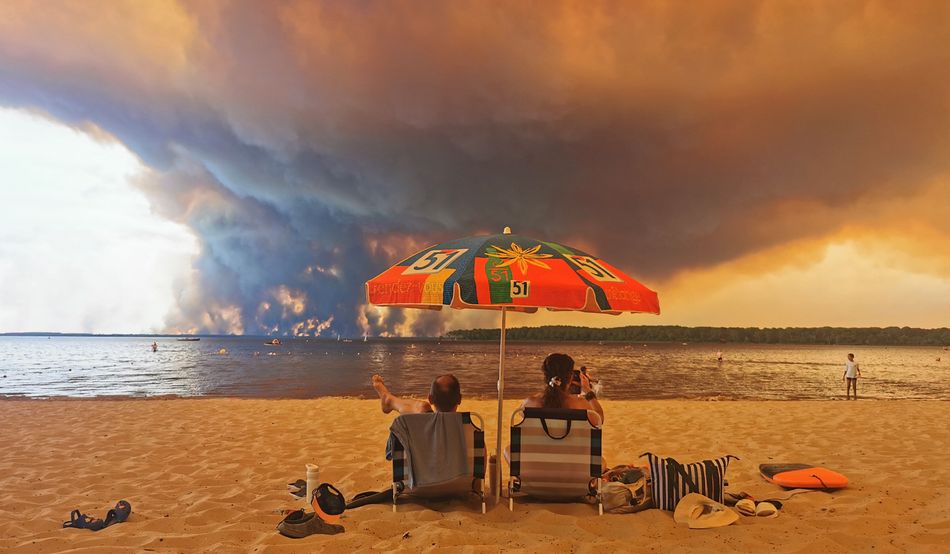
It’s the photograph of the summer. Maybe of the decade. Maybe of the Anthropocene. In July, as wildfires raged in Bordeaux, a middle-aged couple set up their sun loungers and parasol on the beach at Lake Lacanau. The man’s leg nonchalantly rests on his knee. The woman is seemingly reading her phone, or is it a Kindle, perhaps loaded with this summer’s must-read. A body board, beach bag and sandals lie casually next to them on the sand. People can be seen in the water. And ahead of them, on the far shore, the entire scene is shrouded by an apocalyptic smoke cloud. The man stares directly at it.
Wildfires tore through France, Spain and Portugal in mid-July, forcing more than 300,000 people to evacuate. President Emmanuel Macron called it the toughest situation “since the Second World War”. The blaze ravaged France’s famous wine region, burning more than 420 square kilometres—roughly four times the size of Paris—and came within 15km of the city of Bordeaux itself. The giant smoke clouds, such as the one the beachgoers watched from their sun loungers, turned into rare “pyrocumulonimbus”, capable of generating their own lightning, thus sparking new fires.
The heat was felt elsewhere, too. On 18th July, Salta in Argentina recorded its hottest night on record (26°C), despite being mid-winter. In Canada and the United States, wildfires covered a quarter more land than usual; Dust Bowl-like conditions are returning in parts of America. On 29th July, the British and Spanish governments issued a joint statement saying they agreed that, “… this summer’s wildfires demonstrated that climate change was now a national security emergency facing Europe and threatening our way of life.”
And yet, we now know that 2027 will likely be worse.
Next year, we will discover what happens when you throw a naturally occurring phenomena on top of self-inflicted, anthropogenic climate change. Despite last year being the third warmest year on record, it may have been kept “cool” by La Niña. But now El Niño has arrived.
Typically translated as “the Little Boy” in anglophone reporting, the full name of this phenomenon is El Niño de Navidad. Unlike in the UK and US, where Father Christmas brings children their Christmas presents, in parts of Latin America and central Europe it’s the baby Jesus, or El Niño de Navidad. In the 1600s, Peruvian fishermen noticed that every few years the seas became warm around Christmas time; El Niño de Navidad was bringing them the present of warm waters and plentiful fish. Unfortunately, 400 years of carbon emissions and deforestation later, it’s not such a welcome present.
El Niño and La Niña events are cycles of warm and cold water that run across the equator in the Pacific Ocean and affect global weather patterns. (La Niña, the cold part of the cycle, was only so named in the 1980s, as the opposite of El Niño.)
Under neutral and La Niña conditions, trade winds blow west along the equator, taking warm water from the Americas towards Asia and Australasia. As this warm water moves, cold water wells up from the deep ocean and replaces it in the East. This drives the Walker Circulation, a giant atmospheric loop spanning roughly half the planet that delivers clouds and rain to the west and cooler, drier air to the east.
Every two to seven years, El Niño reverses the flow. Trade winds stop, and without the wind to push it west, the warm surface water heads back east in the form of Kelvin waves: pulses of warm subsurface water that on heatmaps look like a giant tongue licking towards the Americas. When the Walker Circulation breaks down and warmer water shifts eastwards toward South America, an El Niño is declared. That happened in June this year.
So far, so predictable. Except that early forecasts suggest that this won’t be any ordinary El Niño.
Our oceans have already absorbed 90 per cent of the heat generated by anthropogenic climate change. Each year, they take up 23 zettajoules—or 23 billion trillion joules of energy—to be precise (up from 15 zettajoules as recently as 2021). Apparently, that’s equivalent to pouring 7.6bn mugs of tea into the ocean or detonating seven Hiroshima-sized bombs a second. No wonder this June was the warmest ever measured for the world’s oceans, at 1.17 °C above the pre-industrial baseline; temperatures off southern France and western Italy ran 6°C above average.
El Niño varies, with weak years and strong years. The 1877 El Niño has been described as arguably the worst environmental disaster to ever befall humanity, instigating famines that killed 3 per cent of the world’s population. But what happens when a very strong one arrives at a time when almost every human on Earth is effectively tipping a hot mug of tea into the sea every second? Climate scientists are running out of superlatives to use in answering that question.
This El Niño is set to surpass previous records by a “truly mind-blowing margin”, Zeke Hausfather, climate scientist at Berkeley Earth and IPCC author, has said. “I’m not sure folks have realized just how crazy the second half of 2026 and 2027 will be for global temperatures—on the back of a record-smashing El Niño event.” “Make no mistake”, writes Bill McGuire, climate scientist at UCL: “what I have taken to calling a hyper El Niño is building rapidly, and set to bring extreme weather mayhem and record-shattering global temperatures in 2027.” Even the normally sober Met Office predicts that this “… El Niño will cause a temporary spike in global annual temperature with the residual heat potentially making next year the hottest in the global series from 1850”.
As Hausfather wrote in mid-July, the speed at which this El Niño is developing is part of the cause for concern. “The models are forecasting something outside the envelope of anything we have ever observed… The 2026 event is developing faster than 1997-98, the previous gold standard for explosive El Niño onsets,” he said. Typically, a sustained 0.5°C rise in temperatures in the Eastern Pacific means we’re in El Niño territory—but by 30th July, temperatures had already risen by 2.1°C, crossing the “super El Niño” threshold, but too early to be considered its peak. On the same date in previous years, the two strongest El Niño events measured by satellite—1997 and 2015—stood at 1.6°C and 1.3°C. On his Substack, Hausfather wrote that “No prior year in the 45-year record has been anywhere near this warm this early.”
A House of Commons Research Briefing published this June asks “What might a ‘Godzilla’ El Niño mean for the UK?” Short answer: likely extreme weather in 2027, and risks for food security. The European Central Bank finds that a strong El Niño raises global food prices for as long as two years. While, on the back of international aid cuts, in particular the Trump-Musk dismantling of USAID, the World Bank warns that sub-Saharan Africa is the most exposed, with nothing now saved to cushion a bad harvest. To make things worse, the price of fertiliser also jumped 35 per cent this year due to Trump’s war with Iran and the shutdown of the Strait of Hormuz. El Niño arrives finding not just hot oceans, but also a hot mess of geopolitics.
But as those Peruvian fishermen knew, the peak will come later this year—and 2027 is the year when the impacts will come to a head. I’m not normally one for climate doomerism. But forewarned is at least fore-armed.
A 2025 Nature paper suggests: “super El Niño events may also provoke persistent or even irreversible changes in other components of the climate and Earth system… In extreme cases, super El Niño may trigger abrupt transition from a quasi-stable ice shelf front to catastrophic large-scale disintegration due to regional sea ice loss, contributing to sea-level rise.”
So, enjoy what’s left of this summer. I mean that sincerely, zero snark. Perhaps we should salute the sunseekers at Lake Lacanau for getting the deckchairs out while they still can. Bordeaux’s maximum June temperature is nearly 6°C higher than it was 50 years ago. The region has already recorded more days above 40°C in 2026 than during the 105 years since observations began. The truth is that this year’s long, hot, dry, burning summer will likely be one of the coolest summers we have for the rest of our lives.