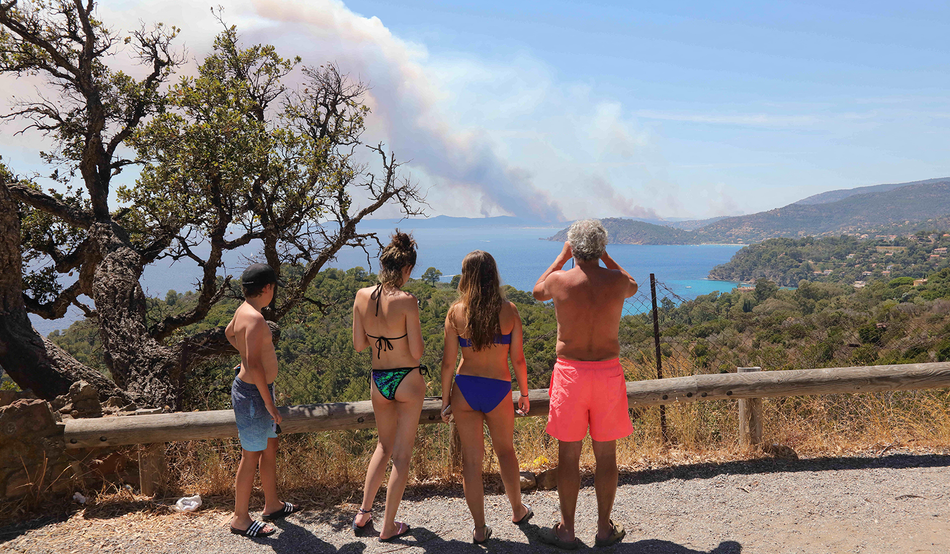
In its #ExploreFrance campaign the tourism development agency Atout France invites viewers to “dream big and live slow”. Alongside images of rolling vineyards, cyclists pedalling down dappled paths, and people sharing local cuisine, potential visitors are told that France is “where dreams come true”.
The reality, as of last week, is rather different. Savage and, in the words of President Macron, “completely unprecedented” wildfires have triggered one of the largest peacetime civilian evacuation operations in the country’s history, with nearly 250,000 people removed from their homes and holiday accommodation in the southwestern departments of Gironde and Landes. Sophie Brocas, prefect of Gironde, has urged tourists “not to come”. Spain was also severely impacted by the wildfires, with Prime Minister Pedro Sánchez attributing the outbreak to the “increasingly extreme impacts of climate change”.
Extreme temperatures have scorched the continent in one of the most destructive wildfire seasons in recent history. More than 370,000 residents and holidaymakers have been forced to evacuate across southern and western Europe since summer began. Driven by intense heatwaves and severe drought, dozens of simultaneous fires have burned more than 254,000 hectares. The sheer scale of the 2026 fire season, which has also triggered smoke and air-quality warnings, has severely strained national emergency services.
Europe’s tourism economy is often presented as the inevitable consequence of its beautiful coastlines, historic cities and rich cultural traditions. Yet publicly funded tourism agencies spend millions on advertising, influencer partnerships and international campaigns to attract travellers. Atout France is a public-private body that received a €24.66m public-service subsidy in 2025 (although its accounts do not specify how much of that core subsidy funded promotional activity), while the 2024 budget of Turespaña, the public body responsible for managing Spain’s tourism brand, exceeded €103m, with slightly more than one-third devoted to promotion. Italy’s national tourism agency, ENIT, allocated €19.37m to promotional activities and another €10m to marketing in its 2026 budget.
Greece is perhaps the clearest example of how public funds are spent to manufacture tourism demand. Between 2021 and 2023, the Greek National Tourism Organisation reportedly invested €34m in seven advertising campaigns across 35 international markets, alongside €30m in co-advertising with international partners. In April 2026, it launched a three-month TikTok and YouTube campaign across five European markets, with an estimated reach of approximately 19m users.
Southern European governments invest heavily in tourism because it is an essential economic pillar. Tourism supports jobs, businesses, public revenue and a substantial share of national income, giving governments a powerful incentive to keep visitor numbers growing. In 2025, France welcomed a record 102m international tourists, generating €77.5bn in international tourism receipts. Spain received 96.8m international tourists, who spent €134.7bn. Foreign travellers spent €56.7bn in Italy while Greece received 43.3m inbound travellers and generated €23.6bn in travel receipts. Greece is especially dependent on international demand: non-residents accounted for 83.8 per cent of all nights spent in registered tourist accommodation.
And the UK, of course, provides a great number of these visitors. According to the latest Office for National Statistics estimates, UK residents made 94.6m visits abroad in 2024, with Spain the most visited country with 17.8m visits, followed by France with 9.3m and Italy with 4.8m.
Across southern Europe—a region the European Environment Agency identifies as particularly exposed to extreme heat, wildfire and water scarcity—tourism remains heavily concentrated in the summer, with July and August the peak months. While Europe’s new climate reality threatens the survival of the traditional summer break, the answer for tourism boards is not to stop promoting Europe. It is to find ways to spend public money more responsibly.
For a start, national tourism agencies should disclose how their marketing campaigns contribute to visitor numbers during high-risk months. A meaningful share of promotional budgets should be redirected towards “shoulder-season” travel during autumn and spring and towards cooler, less congested regions without increasing overall tourist visits. With sentiment against mass tourism growing in visitor hotspots such as Venice, Florence, Barcelona and Mallorca, governments must also ask the bigger question of whether endless tourism growth is conducive to the public good. How much is too much?
In the most saturated and climate-exposed destinations, less tourism overall may have to be part of the answer
If tourist numbers are not carefully managed, encouraging more travel in spring and autumn may reduce exposure to the most extreme heat and wildfire risk, but it could also extend the peak season. Climate change may therefore redistribute European tourism rather than reduce it. The result could be longer seasons in the Mediterranean and new hotspots elsewhere, placing greater strain on local communities and infrastructure.
Tourism policy can no longer be judged by visitor numbers or revenue alone, but also by how it impacts environmental policy—including the relative cost of drought and wildfire management. Governments should track how many visits have shifted outside peak-heat months, how much tourism revenue remains in local economies, and the pressure placed on housing, infrastructure and public services by tourism activity.
In the most saturated and climate-exposed destinations, less tourism overall may have to be part of the answer. This would mean managing a transition away from a tourism model dependent on ever-rising visitor numbers. Governments could use current tourism revenue to diversify local employment, invest in housing for locals while restricting short-term rentals, and invest in water resilience, wildfire prevention and renewable energy. The measure of success should be resident welfare, secure year-round employment and respect for environmental limits.
The European Commission’s Transition Pathway for Tourism calls for a tourism sector that is more sustainable, resilient and less dependent on seasonal peaks. National tourism strategies increasingly echo these ambitions, committing to a more balanced distribution of visitors throughout the year. Yet in practice, all too often these commitments have not progressed beyond words on paper.
With their well-resourced operations, Spain, Italy, France and Greece already know how to shape tourism demand. The question is whether they will use this skill to build a tourism model that adapts to a warming continent and that serves, rather than diminishes and damages, communities that host tens of millions of visitors.