Christiane Jatahy, the director of A Trial – after An Enemy of the People, which opened this year’s Edinburgh International Festival, was born under the Brazilian military dictatorship of the late 1960s. And she lived through Jair Bolsonaro’s considerably more recent presidency, which picked apart protections for indigenous groups in the Amazon rainforest and helped accelerate its deforestation.
Defiance and rebellion define Jatahy’s work. In 2022, when she was awarded the Golden Lion for lifetime achievement at the Venice Biennale, the citation described her as “a harsh and acute observer of the violent cruelty of our world”.
Having already reworked plays by Anton Chekhov and August Strindberg, it seemed only natural that she should turn eventually to Henrik Ibsen’s 1882 drama An Enemy of the People, about Thomas Stockmann, a country doctor who loses his job and is cast out for whistleblowing about the pollution in his resort town’s water system, which threatens to shut down the tourism-based economy.
Working with screenwriter Lucas Paraizo and Oscar-nominated actor Wagner Moura to put the poor man on trial in an attempt to clear his name, Jatahy has woven an altogether modern tale about vested interests, political hypocrisy, sibling rivalry and family alienation. The townspeople, both victims of the pollution and pickers at the family scab, sit and watch—and occasionally make things worse.
Jatahy stages the trial that Ibsen never wrote, using a mix of video, onstage drama (in Portuguese) and occasional asides to the audience (in English). Eleven members of the audience are called up each night to sit at the back of the stage and act as a jury. They are told that they will decide whether or not the defendant is indeed an enemy of the people.
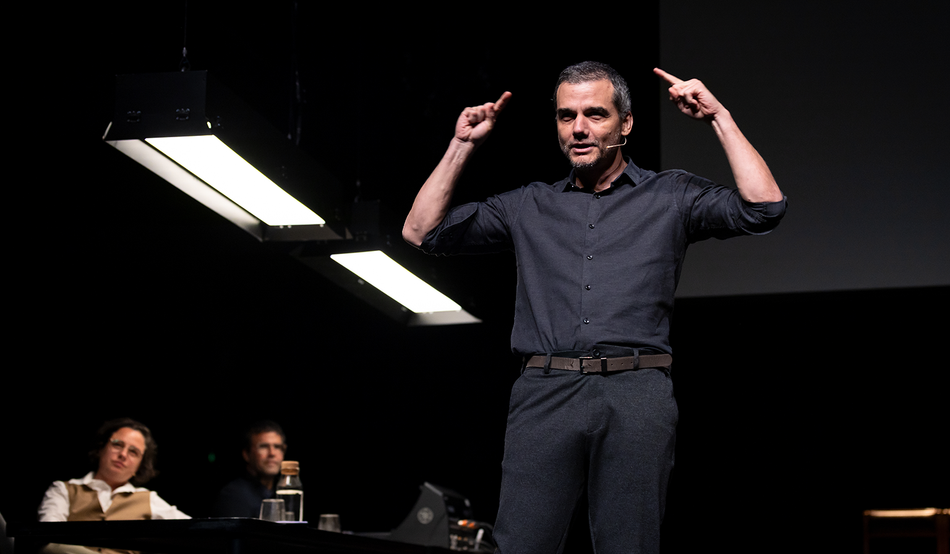
The effect is a mesmeric evening that is anchored by the three main characters. Moura—so good at inhabiting silence as the father on the run in last year’s masterly The Secret Agent—is here a shouty, opinionated and unwavering defendant of the truth: that the water is being polluted by hexavalent chromium, a toxic form of the heavy metal chromium, also known as chromium-6, which is leaking from a nearby tanning factory. He insists the spa resort must be closed even if it takes two years to repair and there is no public money available to do the work. Turning to the audience, with which he makes a charmed and very real connection, he cites Erin Brockovich (2000), in which the poison is the same hexavalent chromium, and Jaws (1975), in which, of course, a man-eating great white threatens to kill off a summer of swimming.
Moura is here a shouty, opinionated and unwavering defendant of the truth
Julia Bernat as Petra, Stockmann’s oldest child and spokesperson for the defence, is both fierce and brittle. Not surprising, given that she has lost her home after the landlord threw out the family; her two younger siblings are being cared for by her grandfather after they were beaten up at school; and her mother is already dead when the play opens, killed perhaps in part by a depression caused by Stockmann’s intransigent focus on the water pollution cause. When Stockmann and his brother Peter, the former mayor and prosecutor in the trial, resort to fisticuffs, Petra fights back against both, accusing them of disrespect and of behaving badly. “I don’t need to be defended or protected. That is just the hierarchy that you want to protect.” Turning to the audience, she tells them her outburst is personal, and not part of the defence at all. It is certainly heartfelt.
For all Moura’s mesmerising onstage presence, it is Danilo Grangheia as that brother who brings the play its real depth: creepy yet plangent, he makes a good case for himself as the saviour of the people, insisting that he has always tried to help his brother, ignoring his own bullying of the local newspaper editor and skating over his thin scientific report, which shows the water’s toxicity as being entirely within acceptable bounds. How many people do we know who claim to be the only grownup in the room?
“The truth is over,” Stockmann tells the jury in his final speech. “That scares me because that means there are no longer facts, there are only versions. All of this becomes just a staging. If my reality is so different from yours, then we live in different worlds.” Indeed. Look around you.
In the end, though, I don’t think the play was as subtle, ambivalent or even as ambitious as it might have been. I saw it twice—once as a member of the jury and once in the main audience—and quickly realised that the questions each night’s jury supposedly put to both prosecutor and defendant didn’t come from the jury at all; they were part of the script. There was no debate among the jurors when they went offstage, and the vote—8–3 on both nights, finding that the hero was not an enemy of the people—was both too obvious and too neat. So the jury, which could have had such an interesting role as representatives of the audience, turned out to be just a stage device.
“This is not a movie,” Moura said at the beginning of the play. “It’s theatre.” It was certainly dramatic, but not entirely persuasive.