The narrator of Ted Chiang’s short story “The Great Silence” is a parrot at the Arecibo Observatory in Puerto Rico. The bird watches as humans desperately seek life in other solar systems by using a huge listening device. Meanwhile, the bird wonders why, if humans are so desperate to communicate with other life forms, they don’t simply pay attention to those nonhuman creatures around them.
“Human activity has brought my kind to the brink of extinction, but I don’t blame them for it. They didn’t do it maliciously. They just weren’t paying attention.”
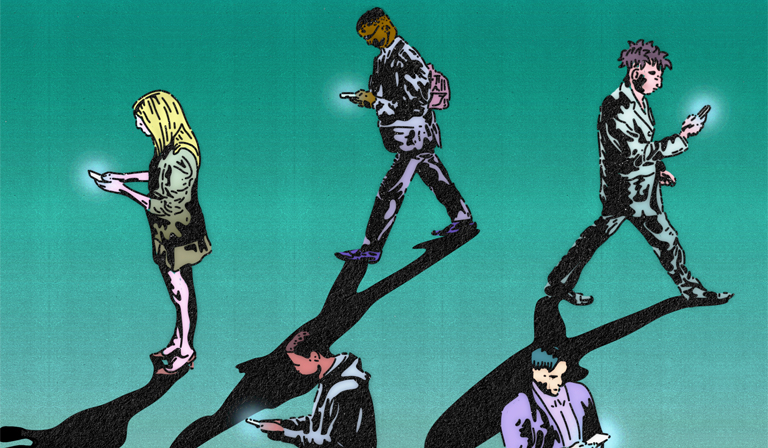
Not doing so has serious consequences—and not just for parrots. A growing body of research is making clear just how badly our attention has been shattered by addictive technology. Its impact can be felt on our physical and mental health, our social cohesion, even our politics. Governments, such as Australia’s, whose ban on under-16s using social media is now being emulated in the UK, are finally starting to pay serious attention to how we pay attention.
Two recently published books—Attensity! A Manifesto of the Attention Liberation Movement by the Friends of Attention and Overwhelmed: Ways to Take the Pressure Off by BBC Radio 4’s All in the Mind presenter Claudia Hammond—investigate the problem in vastly different ways.
We’ve all felt it. The way we’ve become complicit in our own brain rot. Drawn to endless feeds that induce envy, anguish and outrage about distant events we can’t control. Attensity!, though, makes a compelling argument that our addiction to apps isn’t so much a personal failing as a systemic one. “Something is seriously wrong,” the Friends begin. “It has to do with our attention, our essential ability to give our minds and senses to the world. This precious capacity has been channeled, captured, and commodified by an industry of immense technological and financial power. How? Call it human fracking.”
“Escape from these conditions,” they continue, “is not a matter of individual willpower. We need new forms of collective action and solidarity to confront this new kind of exploitation.”
The Friends are a collective of some 150 artists, activists and thinkers from across the globe whose goal is to create an attention movement. The book’s editors are Princeton professor of history of science D Graham Burnett, filmmaker Alyssa Loh and Peter Schmidt, programme director of the Strother School of Radical Attention in Brooklyn, New York. Their ambition is for the book to be nothing less than a Silent Spring for our time. The result is a paradigm-shifting work: eloquently clarifying problems, giving language to inchoate angst, then envisioning our potential salvation.
Overwhelmed, by contrast, is a practical guide that whisks the reader through the latest studies in psychology and neuroscience, collating 16 tips and tricks to take back control of our minds. It’s one of numerous books that reframe a collective problem as a matter of personal responsibility. This is its main failing. The internet, like the climate, is systemic—and so must be the solution. Where Overwhelmed tells you how to rinse your cans, Attensity! goes after the polluters: the tech companies, regulators and governments who got us into this mess in the first place.
Attensity! cites a raft of studies and statistics that are utterly sobering. Take, for instance, the fact that suicide attempts and feelings of persistent hopelessness among high school students have increased by a third over the past 10 years, while one in 10 American female teens reported attempting to take their own lives in 2024. The authorities are now starting to take notice: in January this year, Britain’s top doctors and medical experts declared a “public health emergency” due to harms caused by addictive technology.
The harms may be numerous and diverse, but they have in common “dissociation, toward severing and solitude”. In order to capture and sell our attention, our inner environments become fractured and polluted. This is how the authors devised the term “attention fracking”, which they define as the “subtle work of turning humans into money”. They continue: “Our desire for connection to others; our hunger to see and be seen; our native curiosity, and tendency to care—all these aspects of our most essential natures have been tapped as access points from which money can be siphoned into the pockets of private equity financiers.”
They’re right to be angry, but the target of their anger is misplaced. None of the world’s five biggest companies namechecked in the book—Apple, Alphabet (Google), Amazon, Microsoft and Nvidia—are funded by private equity. But it’s true that there is a Big Tech consensus around what scholar Shoshana Zuboff calls “surveillance capitalism”.
That these five companies are valued between $3 trillion and $5 trillion each shows just how lucrative it can be to monetise our attention.
There’s a parallel with the Industrial Revolution, another era when new technology led to rapid innovation, greed and previously unprecedented levels of human exploitation. But now the satanic mill is in our pocket—and what’s being targeted isn’t our physical labour, but our very souls.
This battle starts with attention itself, and how we define it—as qualitative or quantitative. Is attention a considered way of being in the world, or simply visual and durational, totted up in numbers and seconds? The researchers of the 20th century certainly weren’t paid to study the former in their experimental psychology labs. Instead, they looked at how long a person could stay focused on a dot on a screen, or whether they could monitor a radar screen while also hearing different instructions. Over time, these researchers found a type of human attention that could be quantified and measured using the tools they had.
Most social apps are designed to be as addictive as possible. This was a conscious decision made in the early days of social media, when it was realised that unpredictable rewards—the constant buzz of likes and comments—fuelled compulsive checking. Nir Eyal’s Hooked: How to Build Habit-Forming Products (2014) has an outsized role in creating this culture of psychological dependency as a business model. Startups and established firms quickly moved from metrics such as the total number of software installations to “engagement” and “retention” to better measure “habit formation”.
When people did complain, they were cast as Luddites or told it was a personal problem
Few seemed bothered about the consequences of peddling addictive tech to the masses, not even to children. When people did complain, they were cast as Luddites or told it was a personal problem: just put down your phone. States and regulatory bodies in large part enabled the greed of Silicon Valley elites by abdicating their public service responsibilities.
Jonathan Haidt’s The Anxious Generation (2024) explores what he called the “great rewiring” of childhoods. He cites, for example, the Adolescent Brain Cognitive Development study, which followed nearly 12,000 American children, aged nine or 10, for three years. It found that a rise in social media use was “associated with greater depressive symptoms a year later”.
The damage doesn’t stop at childhood. Stanford psychiatrist Anna Lembke’s book, Dopamine Nation: Finding Balance in the Age of Indulgence (2021), makes the case that smartphones are the hypodermic needles of our age, delivering constant dopamine hits with their bright colours, flashing lights and engaging alerts. The addictive model requires a constant amping up: louder, brighter, faster, more outrageous content to keep us scrolling until we live in a fantasy world of AI-generated, attention-seeking content.
Once the zone is flooded with garbage, lies, propaganda and disinformation, it can be hard to know what’s true any more. This affects not only our mood but is extremely dangerous societally because, without an understanding of truth, we become fodder for whatever wannabe dictators game the system. Tyranny gains ground when we’re not paying proper attention.
Tech companies want us to think this is all inevitable and natural. But it’s not, and the Friends of Attention say so, emphasising that it’s just a quirk of circumstance, a result of human action and inaction. It’s not natural, it’s not inevitable and we should fight it while we still can.
Dr Irene Pepperberg is an animal psychologist who spent more than 30 years paying attention to grey parrots—especially an African grey named Alex. Through her studies on cognition and communication, she discovered that not only could Alex learn the words for shapes and colours, he also understood them as concepts.
Humans have lived alongside parrots for thousands of years, so why did we only recently accept the possibility they might be intelligent? Could it be that Dr Pepperberg paid attention differently as a woman? The dominant belief among the academic fraternity had been that man was separate and superior to the rest of nature. But as women gained entry, they studied creatures with the kind of attention a mother might give to a child. Various new understandings were made about animal intelligence and behaviour.
Admittedly, men can do this work as well: the primatologist Frans de Waal made many discoveries about the social behaviour and intelligence of chimpanzees and bonobos from paying this sort of attention. But there is nevertheless a gendered element to attention and it’s worth noting how a very tiny subset of men—often computer programmers with minimal emotional or social skills, who believe so much in the power of numbers and code to parse life—control most of the world’s Big Tech companies. It’s their ideas about attention that dominate. For them, humans are primarily understood as a series of numbers measured in relation to machines.
It’s a modern version of Frankenstein in which the male scientist, craving the life-giving power of the female, builds his own creation from non-living tissue, energised with electricity. There is no love involved—and that’s why the creation is monstrous. With the advent of AI, we can expect fewer gods than monsters among us.
There is no love involved—and that’s why the creation is monstrous
This is all to say that how we pay attention determines what we see—or, crucially, what we don’t see. There’s a vast gulf between task-oriented attention to a machine and mindful, loving awareness of another being. Shifting that definition ought to be the first stage of the resistance.
When new forms of mass exploitation arose during the Industrial Revolution, so did new forms of social solidarity: the labour movement and trade unions. Later, when imperial nations and then multinational companies found new ways to exploit physical environments, the environmental movement was born.
“The protection of the psycho-sensory environment needs to be made as urgent and compelling as our natural environment,” the Friends argue. And it’s in outlining a fightback that Attensity! fully gets into its stride. “Once we’ve realized that a vampiric media economy, feeding on the lifeblood of our humanity, is not inevitable, then we will sweep ourselves to a new world.”
The new world arises from collective action that starts with reclaiming human dignity: “We humans are more than that which can be quantified and optimized.”
Then there are the practical steps: practising the kinds of attention that are not engineered to maximise digital advertising revenue. You’ll have seen many of them gaining popularity: the analogue detox; reading real books; visiting museums and galleries; in-person gatherings to party, play board games, compete at sports or simply cook together. For the Friends, finding this type of healthy attention means you have become an attention activist.
Pepperberg’s attention to the African grey parrots was holistic and emotional. She formed close bonds with the birds, caring for them throughout their lives in an almost maternal manner. Rather than depleting those who engage in it, this form of attention brings out the best in people, their relationships and the world around us. Why not aspire to this highest form of attention?
On the evening before Alex died, he said to Pepperberg, “You be good. I love you. See you tomorrow.” It’s this sort of relationship that we’re in danger of losing if we don’t pay attention to our attention.