If you were to go no further than the first few rooms in this tightly curated show at the Royal Academy, you would maybe ask yourself how Richard Dadd could have earned himself such a retrospective. Born in 1817 in Kent, but by the age of 17 living just a stone’s throw away from the National Gallery, Dadd was by all appearances an ambitious if not wholly conventional artist. Not long into his time at the prestigious Royal Academy Schools, where he was taught by JMW Turner and Edwin Landseer, he acquired a reputation as an able painter of stately portraits and all the right scenes from Shakespeare.
If this is where the story ended, and Dadd carried on making the same kind of work for the rest of his life—as polite society seemed enthusiastic for him to do—then we might have described him as an “accomplished” artist and never thought any more about him.
But this is not where it ends. In 1842, a recent graduate still scaling to the heights of his potential, Dadd was invited by the lawyer Thomas Phillips to accompany him to Egypt and the eastern Mediterranean, in the expectation that he would produce a series of works as a memento of the trip. This was supposed to be Dadd’s Grand Tour, his first trip abroad, but for reasons unexplained he found the journey overwhelming. On his return to London, he developed symptoms of psychosis and killed his father after mistaking him for the devil. He was admitted, at just 27, to Bethlem Hospital, better known as “Bedlam”. He would remain in hospital for the rest of his life, with painting becoming his principal—and often only—occupation and consolation.
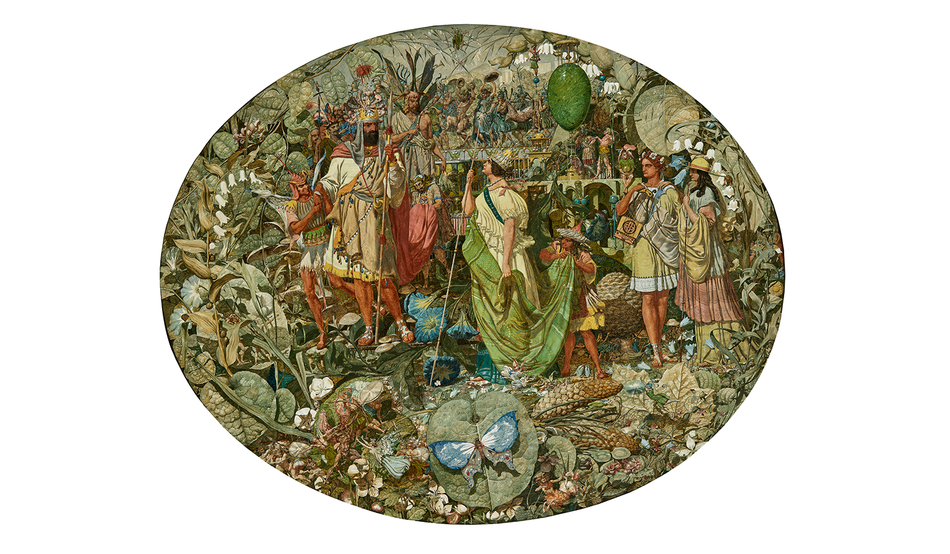
Just like the common name of the institution that held him, Dadd’s work from this point onwards exhibits many of the traits that we might consider synonymous with the mentally unwell. A meticulous, obsessive attention to detail; a fixation with the dreamlike and fantastical, particularly fairies; a recurrence of swirls, circles and mirrored images. His best-known work completed at Bethlem, The Fairy Feller’s Master-Stroke (1855-64), which took nine years to complete, is an extraordinary case in point. Within a forest clearing, we find the fairy queen standing atop the elongated brim of an old man’s hat, watching with her regal entourage, as one man with a hatchet sets about splitting open a nut to fashion into her new carriage. Surrounding them, amid the lush, veiny, fleshy foliage, is a whole cast of fantastical folk gathered to watch: a hunched looking goblin; a princely, red-coated gentleman and his doted-upon princess bride. It is bursting with so much detail it takes a while for all this to sink in; there is more in this picture than seems possible within such a small stretch of canvas. When he was moved to Broadmoor and forced to leave the picture behind in Bethlem, Dadd painted the same scene again, from memory, in watercolour, titling it Songe de la Fantasie: except for its faded palette and the addition of a thin swirling line radiating from its centre, it is an eerily perfect copy.
Yet just as evident are examples that prove Dadd was far more than the template for an archetype. What with his academy education and grounding in classical subjects, he was by no means an “outsider” in the order of Henry Darger or even Henri Rousseau. His interest in fairies predates his hospitalisation, originating in his paintings of A Midsummer Night’s Dream, and throughout his time in hospital he remained acutely aware of his exclusion from events in which he once envisioned a part for himself. In the satirical series of watercolours “Sketch to Illustrate the Passions”, this awareness emerges with a dry sense of humour: Sketch to Illustrate the Passions. Insignificance or Self-Contempt (1854) shows a portly middle-aged artist in a big coat cleaning his shoes outside a flat advertised for a “single gentleman”, clutching his oversized, marbled portfolio under one arm. (Apparently, the artist resembles an aged Turner.) This, combined with his musings about the foundational place of classical antiquity in contemporary society, suggests that Dadd was never just trying to paint his way into a fantasy world—“what lies what fallacies pictures are,” as he wrote in the margins of one book—but still yearned to say something about the real world in the here and now.
This sentiment is perhaps not just innate to the work but evoked by curatorial design, just as the subtle gaps the exhibition leaves in Dadd’s biography also hint at a wider intention. After Dadd’s admittance to Bethlem there is not much further comment on his mental state, only the implication that by the time he was moved to Broadmoor his condition had improved because he was then allowed to request any books he wanted from the outside, and to take on more complex work, such as producing backdrops for stage productions or fabricating his own picture frames. There is also no mention of the mental illness that afflicted his siblings: George, who was also admitted to Bethlem around the same time; Maria, who was admitted to an asylum in Scotland; and two others, usually unnamed, who were deemed to be “insane” by the end of their lives.
Would Dadd have made the same work anywhere else?
Given the perennial, usually misplaced, questions about the nature of creativity and its relationship to neurodivergence, the goal here is clear: to get us to consider the merits of Dadd’s work as the output of an artist rather than mere Victorian curio, as it was in the past. All the same, it is impossible to separate our judgement of his work from the circumstances that gave rise to it, particularly if we take it as given that art is shaped not just by individuals but by place and time. Would Dadd have made the same work anywhere else? Is his art the product of an artist, or of institutionalisation itself? Would he have been able to draw on such an extraordinary depth of memory had the heavy curtailment of his daily life not necessitated it as an important resource? Keeping in mind that Dadd was not just admitted for psychosis but as a murderer, it may be that, in the end, this is all meaningless conjecture; perhaps it was impossible for things to have turned out any other way.
Another of Dadd’s favourite recurring themes was identical twins, who often crop up in unexpected guises. In 1865, he was commissioned to make some letterhead illustrations for the “Society for Improving the Conditions of the Insane”. His answer to the brief was two sets of miniature roundels to be made into engravings, showing a man and a woman before and after receiving their treatment. In the first, the patients are alone, in rags and deranged; in the second, they are so thoroughly “healed” that they have become the mirror image of the doctor and nurse attending them, right down to their haircuts and clothes.
The asylum system of the 19th century promised that there was always a way back to an ill-defined, perhaps problematic, normality. But it was this very path that Dadd, atypical in more ways than one, was never going to find.
Richard Dadd: Beyond Bedlam is on display at the Royal Academy until 25th October