Gunther von Hagens, the German anatomist behind the popular Body Worlds exhibitions, died on 24th July at the age of 81. People who work with the dead know more than most that it is better to celebrate a person’s achievements while they are alive, rather than lament them after they die. Accordingly, in July 2025, the Journal of Plastination published an 80th birthday tribute to the founder of the Institute for Plastination. It began, “Gunther von Hagens has never been one to follow convention.” This was an understatement. For Von Hagens, life was a pageant of controversies.
He was born Gunther Gerhard Liebchen on 10th January 1945 in Nazi-occupied Poland. Days later, his family fled the invading Soviet forces and settled in what became East Germany. Gunther’s first serious act of rebellion came when, as a young medical student, he tried to escape to the west. He failed and spent two years in a Stasi prison. In 1970, the West German government paid a ransom of 43,000 marks (then around $12,000) for his release, as one of a cohort of political prisoners.
As a free man in West Germany, Gunther completed his medical studies in Lübeck, where he met his first wife Cornelia von Hagens. In a break from tradition he took her surname, and all the aristocratic connotations that came with it. Von Hagens received his doctorate in 1975 from the University of Heidelberg and then went to the Anatomical Institute of Heidelberg, where he worked for many years as a teacher and technician.
From 1977, Von Hagens developed plastination, a new technique for preserving bodies. Unlike older methods where specimens were placed in fluid (either alcohol or a water-based solution called Kaiserling III), plastination preserves biological tissues by replacing the body’s fluids with liquid polymers like silicone rubber, polyester or epoxy resin. As well as increasing the durability of specimens and making them easier to use, plastination enables whole bodies to be posed into amazingly lifelike forms.
To start with, the plastinated bodies were for the sole use of medical schools. It was at the invitation of the University of Tokyo’s Takeshi Yoro in 1995 that the first Body Worlds display was opened to the public, celebrating the centenary of the Japanese Anatomy Association. When one of his colleagues questioned the ethics of showing specimens to non-specialists, Yoro replied, “Why not? You’ve been looking at such corpses for 30 years. Why not let the general public see the same thing?” Over the next few years, millions would visit Body Worlds in venues across North America, Europe and Asia.
In 2002, in front of 500 people and a Channel 4 camera crew, Von Hagens conducted Britain’s first public autopsy in 170 years
The revolution hit a bump when people started to wonder where the bodies came from. The Body Worlds party line was that all bodies on display came from consenting donors. This doesn’t appear to have been the whole story. In 2004, German magazine Der Spiegel reported that at least two out of nearly 650 bodies at Von Hagen’s centre in China had bullet holes in the skulls. An email to Von Hagens from the centre’s manager, Sui Hongjin, clearly stated that these two people had been executed. Von Hagens asserted he had given clear instructions to his Chinese colleagues that executed people were not to be used. Despite this, he was forced to return seven bodies to China, all of whom had similar injuries.
None of this deterred him. In the past 20 years, Von Hagens and his second wife Angelina Whalley curated further iterations of Body Worlds, with exhibitions focusing on particular organs such as the heart and the brain. More than 50m visitors have viewed the bodies of former human beings, perfectly preserved and posed as though alive.
Technologically, Von Hagens certainly advanced the craft of specimen preservation. Philosophically and politically, though, there is not much new here and many aspects of his storied career ring historical bells.
As an anatomist incurious about the source of his specimens, he evokes Robert Knox, the Edinburgh doctor who in 1828 blithely accepted corpses from the murderers Burke and Hare despite clear evidence that most of those people had not died natural deaths. In 2004, Süddeutsche Zeitung told of how Von Hagens had approached Alexander Sizonenko—formerly a basketball player for the Soviet Union and, at 7ft 10in, one of the world’s tallest men—offering him a fee and pension in exchange for being allowed to preserve his body after death. (The offer was declined.) This story has striking parallels with that of Charles Byrne, famed in the mid-18th century as the Irish Giant, whose body was stolen by the anatomist John Hunter. Against Byrne’s explicit wishes, his skeleton remains in London’s Hunterian Museum, having been removed from display in 2023.
In 2002, in front of 500 people and a Channel 4 camera crew in a former brewery in east London, Von Hagens conducted Britain’s first public autopsy in 170 years, following that by the anatomist Richard Dugard Grainger on the body of the philosopher Jeremy Bentham in 1832. As per Bentham’s instructions, his body was de-fleshed and his skeleton padded and dressed in his own clothes. A modelled wax head completed the auto-icon of Bentham—like plastination, a lifelike reproduction of a body preserved using the most advanced techniques of the day.
Bentham pioneered the liberal beliefs that Von Hagens would share. In line with his doctrine of utilitarianism (and vehement dislike for the Church), Bentham believed dead bodies were most useful for what they could teach doctors and surgeons. His writings on this topic informed the Anatomy Act 1832. However, as the historian Ruth Richardson pointed out in Death, Dissection and the Destitute (1987), under the act the new supply of corpses for surgeons and medical students would come from the urban poor whose loved ones could not afford to claim them: “What had for generations been a feared and hated punishment for murder had now become a punishment for poverty.” Power remained with those who held the scalpel.
Von Hagens knew which end of the scalpel he was on. As a tribute marking his 80th-birthday recounts: “As he performed the autopsy, an audience member demanded he remove his hat as a sign of respect. He gestured to Rembrandt’s The Anatomy Lesson of Dr Nicolaes Tulp hanging above him [in the painting Tulp wears a hat] and replied, ‘it is a respect to the people in whose tradition I feel myself.’ The crowd erupted in applause.”
Von Hagens’s self-expressed mission was education, but the vibe of his exhibitions is clearly more sideshow than school. At the Plastinarium at Guben in eastern Germany, a key exhibit is a giraffe climbing a tree. In Body Worlds, some of the specimens look just like anatomical Venuses—models depicting pregnant bodies that were also highly sexualised. Then there were the notorious male and female bodies plastinated and posed by Von Hagens in 2009 as though they were having sex. Following public fury, Von Hagens insisted that the two individuals had consented to a display designed to confront society’s greatest taboos: sex and death.
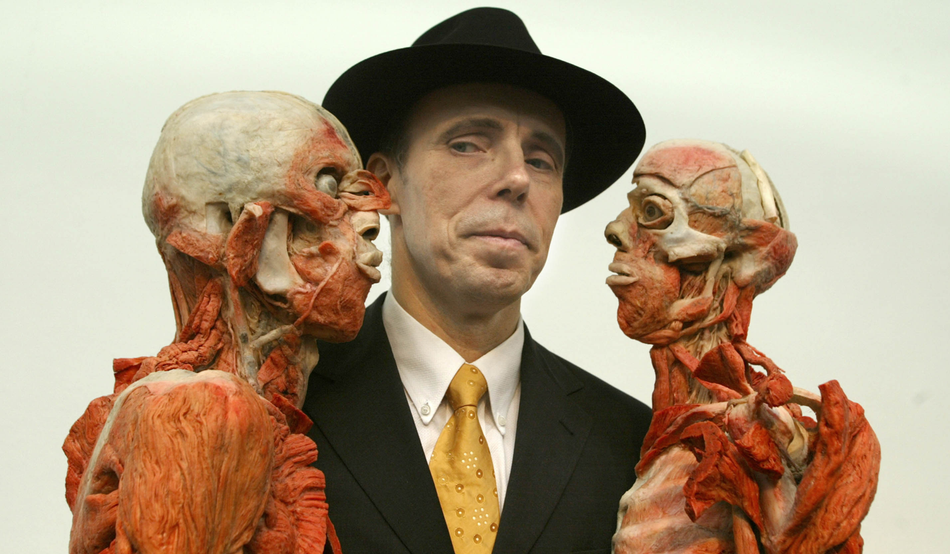
Von Hagens was a man with an eye on his legacy. He acquired and displayed the door of his East German prison cell. He cultivated a strong personal brand. It’s hard to imagine him without his trademark black fedora. Luckily for us, we might not have to.
In what is probably the least controversial move in a long, highly controversial career, Von Hagens’s estate has announced that his body will be plastinated and displayed. While his legacy is not yet clear, one thing appears certain—Gunther von Hagens will be around to watch it unfold with his own eyes.