Who’d be a woman in 2026? Fillers, Ozempic, motherhood, non-motherhood, the 5 to 9 after your 9 to 5, “hair botox”, splitting bills, Hinge, protecting your peace, emotional labour, body positivity, body neutrality, Retinol, egg-freezing, working it out on the remix… The digital age can feel like a minefield of questions, decisions and pressures, trivial and significant, personal and political. Meanwhile, men seem to lather up cheerfully with their £2.99 all-in-one face, hair, beard and body wash before toddling off to start wars.
Yet even with the most cynical mindset regarding, say, the extent to which the Kardashians have caused women to despise their own bodies and spend all their hardwon unequal income on correcting them, might we see what can so easily look like dystopia in a different light? Because, as a woman myself, I can speak to the fact that, often, what’s difficult is less the pressure to be a certain way and more the pressure to choose what way to be. Is that boundless choice not what our mothers, grandmothers and great-grandmothers have been striving for all along?
Two new books have very different perspectives on the same landscape. One is Girls® by Freya India, a gen Zer exhausted by the relentless demands made by social media of young women and determined to show the world its traps and snares lest another generation wastes their lives—and money—on an endless, pointless performance of girlhood that leads to detachment, depression and disassociation. The other, Good Slut, is by Zoe Strimpel. Born in 1982, she is both resolute in her assertion that “this is the best time to be a woman in the history of the West” and highly perturbed by the attempts of the “new feminist right” to row back on the advances of the sexual revolution. Each book touches on familiar contemporary and feminist themes—career, sex, bodies, self, money—but at the heart of both are age-old, universal questions about the meaning of choice and freedom.
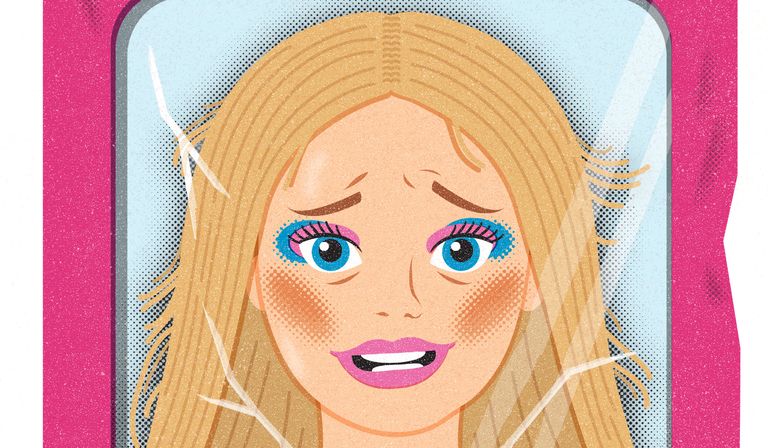
India’s Girls® certainly paints a grim picture of what it was like to grow up as social media became a fixture of mainstream culture. By the time she was in her early teens, she and her peers were being rated for their looks by boys online. They would check Snapchat every morning at school for new filters that smoothed their skin and warped their features, to the point that editing pictures of themselves—which they felt obliged to post consistently—became so routine that the unedited versions disgusted them.
“Sometimes I would accidentally hit the undo button, see the real me flash up, and feel repulsed,” India writes. “My face and body were unbearable, in ways I had never even noticed before but now could not unsee.” By 2021, India says, 85 per cent of girls had altered photos of themselves online—hardly surprising when they were being pushed videos by TikTokers explaining how to stop using your facial muscles so as not to get wrinkles, or the Instagram “FIX ME” filter that gave you plastic surgery in all the areas it deemed necessary.
Seemingly in opposition to this overly sanitised, airbrushed, unreal world, there was also something altogether too real for young minds: porn. India writes that “many of us watched violent porn before we even had a first kiss, before even holding hands with a boy”.
The result of all this—which, delivered in a stream of statistics and matter-of-fact first-person commentary, enough to freak out even the most hardened digiphile—is a feeling of being trapped and sealed off from real-world connection, from spontaneity and community, from the things that enduringly matter. India is less concerned with offering alternatives than laying out quite how impactful digital culture has been on her generation; she hints at, rather than specifies, her enthusiasm for marriage over “hook-up culture”—but a loose ideological alliance with the likes of Strimpel’s apparent arch-nemesis Louise Perry, a strong voice of the “new right feminists”, is detectable through her lamenting the high prevalence of divorce (and India has appeared multiple times on Perry’s podcast Maiden Mother Matriarch).
Strimpel is pro-choice, obviously—but universally pro-options
In stark contrast, Good Slut is a strident argument against the idea that things are currently bad for women, as well as an impassioned critique of the people who perpetuate that idea. Victimhood, Strimpel argues, is a vicious cycle. She is pro-promiscuity, pro-divorce, pro-girlbossery, pro-single motherhood, pro-money, pro-Tinder, pro-having it all. “Pro-choice”, obviously—but universally pro-options. “In being allowed to act on their desires, needs and curiosity—‘individualistic’ or not, ‘selfish’ or not, ‘healthy’ or not, ‘natural’ or not, culturally produced by capitalistic greed and so-called vested interests or not—women have real space in which to be full human beings; they are motivated, capable, ambitious and independent,” she writes. But “already women are deciding it’s either not liberty at all, but capitalist patriarchy, or that we’ve had too much and all that freedom is bad for us.”
Perhaps we, the generations who have never known life without the contraceptive pill or no-fault divorce, take it all for granted. Yet Strimpel is also lucky, on the individual level which she so privileges, to be able to exercise these freedoms, not to feel enslaved by the very forces of capitalism and the free market which she identifies as facilitating them in the first place. India is not blind to the “empowerment” that her generation has inherited, it just doesn’t feel as though they are truly empowered, since they spent most of their childhoods comparing pictures of themselves to other girls on a tiny screen. “How has a generation of girls and young women given more power and opportunities than ever before ended up so fragile and risk-averse?” she asks. “And how is it possible that a generation of women promised the freedom to be whoever we want, with more ways to express ourselves than any before, is falling apart?”
Well, she thinks she has the answer: “Every experience of girlhood is intruded upon by the market,” says India. But “Freer markets, freer women” is Strimpel’s blunt assertion of why neoliberalism and its individualistic ethic does not deserve its status as a scapegoat for all ills. Freedom begets freedom; the more women feel sexually free, she argues, the more likely they are to bring that sense of freedom to the workplace, the economy and “other domains of ambition”. Women’s ability to be part of the market, by this account, is perhaps the most crucial advancement of the feminist cause that there has ever been. It means women are no longer relegated to the home or the family unit; they can survive alone. In the 18th, 19th and 20th centuries, Strimpel observes, “professional horizons were severely limited and this entrenched their powerlessness, boredom, subservience and misery.” India, perhaps predictably, laments that she and her peers wasted a childhood on the “all-consuming” feeling that they must, at all costs, “become a girlboss”.
Yet, more broadly, India is not talking about finding success in whatever field they choose, but primarily about women—and girls—marketing themselves. Social media has made us into products as well as customers, creating a bizarre and new exchange of value. The experience of being active on social media somehow compresses the sense of being an entrepreneur, consumer and object into one disorientating cloud of ambition, narcissism and perfectionism, which blends with others’ clouds and ends up with whole weatherfronts of demand and specificity. In which context, the answer to her question is clear: “the freedom to be whoever we want” is compromised when we are treating ourselves as a commodity to be consumed in a market which undeniably has existing preferences—and not just a marriage market or a career market, but an everything market. A market for the whole plethora of human diversity and experience, in which you must single yourself out as uniquely worthy of investment. Sure, we’re free in that we could technically go in any direction—but when there are so many criteria at once, we pay the price of overwhelm. It is quicker, easier and more immediately rewarding simply to go along with what market forces demand.
The effect—as anyone who has been on Instagram or seen recent developments in celebrity plastic surgery will observe—is that many young women and girls end up becoming clones of each other, which, I’m sure Strimpel would agree, is not very liberal at all. India is right that self-realisation online, no matter how innocuous its intent, leads inevitably to advertisers shoving certain products, mental health diagnoses and “aesthetics” in your face (a 2020 report suggested that teenagers scrolling through Instagram would see an advert every 10 seconds). You become more of that thing to the point that, eventually, you become categorisable as a neatly boiled-down type—this is, in turn, both an easier persona for brands to advertise to and an easier product for you to sell to others. We are, she says, “on a conveyor belt headed for some final, standardised product”, a common version of which is visible for all to see via what the New Yorker writer Jia Tolentino described back in 2019 as “Instagram face”.
Strimpel is resolutely optimistic about online consumerism: “Browsing, choosing, rejecting or buying stuff is one exercise of private fantasy, offering a feeling of mental freedom, the ability to range freely away from the oppressive watchfulness of certain gender regimes” (though she does admit that “for young women in particular, social media has amplified negative force fields, from glamourising eating disorders [to] promoting under-achievement”; that Instagram reels and TikToks make us “slide down into a solipsistic rabbit hole that blots out real-world offers and opportunities”). But is the “feeling of mental freedom” the same as actual freedom, if women and girls are encouraged to pour their souls into the databases of tech companies, only to be fed back a prepackaged identity?
As well as those feminists pushing for the traditional bonds and structures of family and motherhood, Strimpel rebuts those on the left who lament that nobody can be free until everyone is free; that the system is rigged against us; that capitalism benefits nobody but those at the very top. She is right that some feminists may take for granted how much capitalism has given us, but, a posteriori, it is difficult to argue that the digital climate in which women currently operate does not reinforce historically patriarchal standards. Strimpel references John Berger’s Ways of Seeing, in which he observes that women split themselves between being surveyor and surveyed, understanding the way in which men will see them and adjusting their behaviour accordingly.
On my own social media, where there is a constant stream of women blowdrying their hair, applying makeup and parading their bodies for review, I struggle to see how this is not still true—and not still troubling. I also find it difficult to understand how spending hard-earned cash, and valuable time, on products and rituals to make ourselves more palatable and visually pleasing to men is “an exercise of private fantasy”. Is it not evidence that women are still under enormous pressure to change themselves, whether that is directly for the benefit of men or to increase our value in the more nebulous and febrile digital market?
I find it difficult to understand how spending hard-earned cash on products to make ourselves more palatable to men is ‘an exercise of private fantasy’
Compared to domestic abuse and access to safe abortion, this is superficial stuff, of course, and many of the themes may look from the outside like the trivial, circular concerns of the terminally online. But, as India points out, it also means girls are “harming themselves, starving themselves and killing themselves” when they cannot meet the required standards.
One modern trend of which neither author approves is the “tradwife”: women who surrender themselves to domestic servitude, cooking, cleaning and looking pretty for their husbands. While India objects on a conceptual level, not digging in beyond using the label to demonstrate both the pervasiveness and fickleness of online trends, Strimpel rejects it ideologically; it is so obviously regressive that we needn’t even explain why (“Read: sex doll,” she writes). What is interesting is how the tradwife embodies a new reality for women in which they can create a kind of independence through the act of performing their own womanhood. Because tradwives, as we know them from Instagram, aren’t simply being tradwives—they are posting about it and, if they have large followings, monetising it. Being an influencer, or even having a medium-sized social media presence, is a way of commodifying the self; often it is specifically a commodification of the state of being a girl or a woman (just look at the language of the online trends: girl math, girl dinner, clean girl, hot girl). That the version of womanhood that tradwives choose to perform is itself regressive feels almost incidental when you consider that they are doing it in the first place: their identities, lives and choices are put deliberately centre stage, their breadwinning husbands relegated to the background.
Throughout history, women have not been able to opt out of the demands placed on them without risk of exile, financial ruin or being burned at the stake. Our ability to function as individuals with dreams, preferences and individual habits, to be able to indulge our sexual and intellectual curiosity, shouldn’t be taken for granted.
And yet: how can we ignore the fact that the same forces that have given rise to such autonomy have also enabled a world in which one in six teenagers claims to be on TikTok or YouTube “almost constantly”, and where a generation is growing up disconnected and nihilistic? I’m not sure it is possible to interpret girls’ ability to self-realise online as free choice when we know that social media is deliberately, chemically addictive, and when those same girls are often also intensely insecure and vulnerable. I’m not sure that what look like freedoms—hookups, selfies, professional ambition—always feel like them when the pressure to do them right, in front of a watchful audience, feels almost crushing.
It’s easy to see why a generation of young women is seeking meaning and connection in old institutions. It is not only marriage that interests gen Z; there has also been an upwards trend in organised religion among the young, too. But Strimpel is right to be wary of regression. It’s all too easy to look back misty-eyed, without taking into account why we fought so hard to be able to opt out of those exact institutions.
We have to hope there is a middle ground between the current climate of hyperindividualism and the subservient housewives of the 1950s; I certainly intend to live a life in which I keep both my screentime and unhealthy people-pleasing at a minimum, while still enjoying the benefits of both communal bonds and the conveniences afforded us by consumer capitalism. I think most of us are still figuring out precisely what that looks like. In the meantime, perhaps we women could stage small rebellions. I might just pop to Boots tomorrow and choose the £2.99 all-in-one.