It will be a history essay question for decades to come: “Outline the causes and consequences of Israel’s strategic defeat in the Gaza war”. There will be bits on the failure to eliminate Hamas. There will be chunks on the intoxicating—but hyperbolic—notion that Iran’s Islamic Republic, Hamas’s principal sponsor since the 1990s, would go the way of Marcos’s Philippines (1986) or, less good—but from Israel’s point of view good enough—Saddam Hussein’s Iraq (2003), or Gaddafi’s Libya (2011). Points will be made about how Israel’s onslaught on Gaza raised a generation of traumatised men, women and children who were not necessarily going to reject terror.
There will be passages about how the war postponed, perhaps forever, a deal between Israel and some of its key Arab neighbours, above all Saudi Arabia. And how the Gaza war encouraged the world to cast a more probing eye at the conduct of Israel’s forces in the Strip, and at Israel’s illegal occupation of the West Bank and the despicable behaviour, aided by some Israeli ministers and soldiers, of a significant proportion of the 700,000 Jewish settlers who live there.
Beyond all of that will be the calamitous collapse of support for Israel in parts of the world that were once sympathetic. A 36-country Pew Research Center survey, conducted earlier this year, tells us what is already evident from the marches against the Gaza war—the left and the young are more hostile than the old and the right. But pro-Israel sentiment is withering away all over the world. Critically, that includes the United States.
For a lot of Israelis in 2026 there is, for the time being, not much more than shoulder-shrugging about the hostility. This apparent indifference is not only to be found among fans of Israel’s prime minister, Benjamin Netanyahu. There’s a widespread feeling that a lot of the noise about the country’s right to exist, and defend itself, has been pro forma. Israelis of all sorts, though not Arab-Israelis, will often say that most of the rest of the world has been disproportionately critical, and they will have a point or two. The UN has condemned Israel far more than any other country, and although the 1975 General Assembly resolution equating Zionism with racism was revoked, it took 16 years to do so, and left its profound mark—expressing a lack of an understanding as to why, for a great many Jews (like me), a Jewish state might seem like a good, even necessary, idea.
Israelis will also point out that Europe in particular has a lot to answer for. Jewish ghettos, centuries of pogroms, and the Holocaust are all European inventions that led to the creation of the Jewish state in 1948, the displacement of hundreds of thousands of Palestinians—and for that matter, hundreds of thousands of Jews living in neighbouring Arab countries. They will say that Israel has to exert huge military force because large parts of the Arab world have never unconditionally recognised its legitimacy, and it can never afford to be beaten on the battlefield, because one defeat and it’s all over. So, this substantial part of Israeli public opinion might well believe it’s not worth spending too much time fussing over European displeasure. As for the rest of the world, there is even less at stake if you believe, as some Israelis do, that many countries would be relieved, even euphoric, if Israel just disappeared.
But not many Israelis would dare to adopt this “who cares?” tone about the US. For Israel, what the US says or does matters far more than any other country. And Netanyahu will be judged to have smashed the bonds of sentiment between the US and Israel, and to have unleashed US policies that risk crippling the Jewish state. He won’t be around to survey the full extent of the wreckage—he might even be gone after the Israeli election on 27th October—but he is the principal architect of this unfolding disaster.
The evidence is everywhere. The polls are extraordinary, more or less uniform, and have been going one way. From an Israeli perspective, the recent bunch are terrifying. According to one April survey, 60 per cent of US adults have an unfavourable view of Israel—around 20 percentage points higher than before the Gaza war began in October 2023—and 28 per cent hold a very unfavourable view.
Of course, some non-Jewish communities in the US are still supportive of Israel, above all white evangelical Protestants. And—one more crumb—the headline poll findings suggest a majority of Republicans have not (yet) turned against Israel (58 per cent held favourable views, according to Pew’s 2026 poll). But even that is unlikely to last much longer, because the younger you go among Republican voters, the worse it gets. Most Republicans aged 18-49 have negative views of Israel, too.
As for the Democrats, the party of choice for the overwhelming majority of American Jews for most of the last century, the situation is more serious. A recent NBC News poll found that roughly two-thirds of Democrats sympathised more with the Palestinians, while only 17 per cent sympathised with Israelis. More specifically, about half of Democrats believe Israel has committed genocide in Gaza.
Gaza is the driving, throbbing cause for the left wing of the party. It’s in part a totemic issue, a shorthand to characterise the Clinton, Obama and Biden Democrat eras as sell-outs, with the party judged to have been too cosy with the rich and powerful and too low on radical energy. But it is also, of course, a response to what’s going on, still, in Gaza and in the West Bank.
Until the Gaza war, most Democrats of whatever faith not only had no problem with Zionism but were strongly supportive of the whole idea. US Jews themselves were, indeed are, comfortably located on the liberal wing of the party. Jews were central to the creation and leadership of American organised labour and then the civil rights movement in the 1960s. A majority of US Jews has consistently backed progressive causes—women’s rights, better health provision for the poor and more.
Jews have been a major source of financial support for many Democratic candidates, but that was not particularly about Israel. It didn’t need to be. Republicans too have long been strongly in favour, so a candidate’s position on Israel was not a point of difference when choosing who to back.
Indeed, bipartisan support for Israel in the US has deep historical foundations. American diplomacy played a crucial role in the UN 1947 partition resolution which set the stage for the creation of Israel the following year. President Harry Truman was the first world leader to recognise the state of Israel, and Israel was the key American ally in the Middle East for the duration of the Cold War.
There are more than 7m Jews in America—far more than anywhere else outside Israel. But Israel has also been a hefty moral cause in America, rooted in an overwhelmingly sympathetic response to the Holocaust, and two thousand years of antisemitism—far more so than elsewhere (with the exception of Germany, for obvious reasons). And Israel’s democratic culture, manifestly imperfect as it may be, carries a lot of weight in America, where politicians and commentators often deploy the argument that Israel is “the only democracy in the Middle East”. So, Israel has not only been an ally, with hard-wired military and intelligence cooperation, but some sort of ideological soulmate. No other country sees Israel the same way. At least not since the 1967 war, when Israel began its occupation of neighbouring land.
All of this is in the US’s cultural, political and institutional memory, though the path has not always been smooth. In 1956, Dwight Eisenhower compelled Israel (and the UK of course) to withdraw from Suez; in the 1980s there was a big spy scandal when Jonathan Pollard, a US citizen and intelligence analyst, gave the Israelis top-secret information about US intelligence methods and sources. (He was in prison for nearly 30 years.) In the early 1990s, President George Bush Sr froze aid for a while in protest at the expansion of Israeli settlements and there was an obvious froideur between Barack Obama and Netanyahu on a range of issues. But none of this ever really threatened the fundamentals of the relationship.
Trump’s relationship with Netanyahu is delaying an inevitable shift in American policy
This has never been a symmetrical affair. Israel needs the US more than US will ever need Israel. US support has been of monumental importance—spiking shortly after 7th October at $12bn a year and standing at just under $4bn now. And it’s not only money and arms. A 2008 law requires the executive branch to notify Congress if sales of weapons to other Middle Eastern countries put at risk Israel’s qualitative military edge.
This has never been a symmetrical affair. Israel needs the US more than US will ever need Israel. US support has been of monumental importance—spiking shortly after 7th October at $12bn a year and standing at just under $4bn now. And it’s not only money and arms. A 2008 law requires the executive branch to notify Congress if sales of weapons to other Middle Eastern countries put at risk Israel’s qualitative military edge.
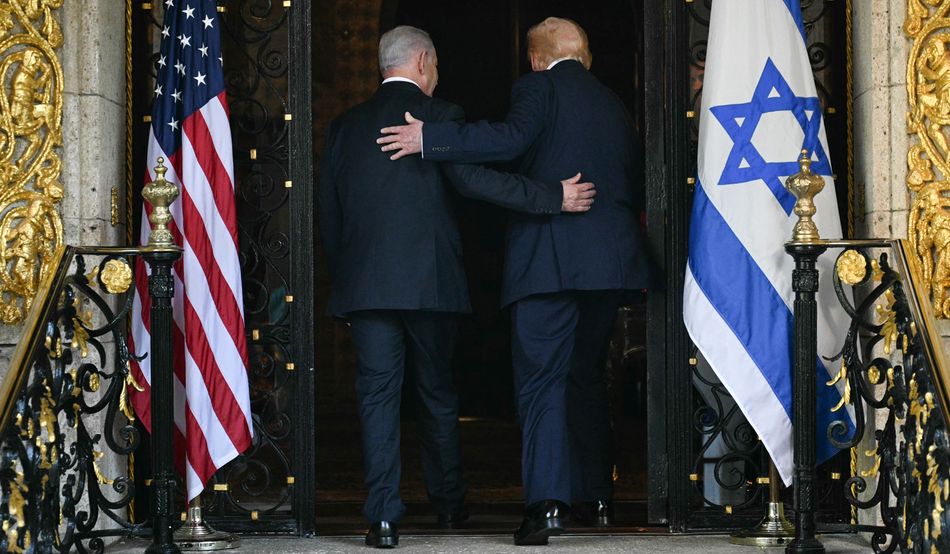
For now, Trump’s relationship with Netanyahu is delaying this inevitable shift in American policy. But Trump is not forever. Whenever the Democrats are next in charge, they are going to be a great deal less sympathetic.
In fact, they already are. In April, 40 out of 47 Democrat senators voted to cut off the export of certain sorts of military hardware to Israel. Three months later many Democrats in the House, almost a majority, voted to eliminate aid to Israel. This was probably to make a point, given that they knew the resolution would be defeated, but still. Even Nancy Pelosi, as venerated a Democrat elder as you could find, was in favour, as was the minority whip Katherine Clark, one of the top three in the current House Democrat leadership. Seth Moulton, Democrat congressman for Massachusetts, and until recently a solidly pro-Israel voice, gave a flavour of the argument in July, explaining why he supported cutting aid to Israel: “We simply cannot continue to condone Netanyahu’s actions that are against our moral conscience and our own national security interests by perpetuating the status quo.”
Both in April and in July the Republican majority in Congress and the Senate made sure nothing would happen. But the writing on the wall is writ large enough—and one of those who knows what’s coming is Netanyahu himself. His response to the July vote was to amplify a theme he’s been peddling for a while, that within 10 years Israel could manage without US help. After all, Israel has a big defence sector and US aid is only a fraction of its defence budget. Still, a great deal of Israel’s equipment is American and will continue to be. That’s a lot of spare parts and updates. Further, the economy has been much weakened by numerous conflicts. An arms boycott would do great harm; the weakening of the intelligence relationship would be a catastrophe. What Netanyahu wants is a defence partnership between Israel and the US with greater integration of their defence industries. Dream on.
In Democrat primaries those demanding that the US should reduce its support for Israel now, or eradicate it, are doing strikingly well. Some candidates are using the hostility of the American Israel Public Affairs Committee (AIPAC), the biggest pro-Israel lobbying group in the US, to burnish their credentials. In Michigan, AIPAC spent $30m in a Democrat Senate primary to back Haley Stevens, a pro-Israel candidate, but she lost to Abdul El-Sayed, who roundly and loudly attacked both American support for Israel and AIPAC’s role in the election.
The Democrat leaders in the Senate and House, Chuck Schumer and Hakim Jeffries respectively, are clear that they want rid of Netanyahu. Schumer has said that Israel’s prime minister is an obstacle to peace. Jeffries has called Netanyahu’s government far right and has talked of “a major reset” of US-Israel ties. But they are not yet proposing anything clear or decisive. To an increasing number of Democrats they look as if they are all talk and no action, engaged in tippy-tappy manoeuvring while clinging to traditional positions.
That is not going to work when the Democrats are next in power. Joe Biden combined decades of commitment to Israel with a barely concealed loathing for Netanyahu. Now the former president is the subject of withering contempt from large chunks of his party for not having used American power to impose real constraints on the Israeli government. The Biden position is dead.
What might happen the next time the Democrats are in charge? Restrictions on arms sales will be first up, along with far more regular and explicit condemnation of the West Bank occupation. West Bank settlers will face sanctions. They won’t be allowed to travel to the US or hold American bank accounts (Biden had imposed limited sanctions against a small number of extremist settlers; Trump removed those as soon as he took office). The diplomatic cover the US has always provided will erode. There will be plenty of voices demanding trade sanctions, and companies will come under pressure to get rid of investments in Israel. It won’t all happen at once, but what were once radical, unpopular policies are now far from being taboo.
One weighty presidential aspirant, someone who might be seen as bang in the centre of the Democrat mainstream, has already put down a marker. In July, Rahm Emanuel, Obama’s chief of staff for two years, mayor of Chicago for eight, and Jewish, went to Tel Aviv. His father had served in Israel’s 1948 war of independence. He is far from anyone’s idea of a radical progressive.
Speaking at Tel Aviv University, he hurled thunderbolts: “Over the last five years, Israel has evolved from being lauded as the start-up nation to becoming, in Prime Minister Netanyahu’s words, a modern-day Sparta… You have turned from being known for your technological prowess to being considered primarily a territorial pariah.”
The American-Israel alliance, he said, “cannot stand or survive as it has been”.
Netanyahu had previously called Emanuel “a self-hating Jew”—an absurd assertion. But many Israel advocates resort to that trope, joining it to the accusation that other critics are either antisemites, or, at best, are witlessly giving succour to antisemites. Of course, there has been plenty of antisemitism to go around. The age-old vile stuff about bankers and influence and the crucifixion and manipulation of the world has been given propulsive force by Gaza. The American Anti-Defamation League, which monitors antisemitic incidents, told me that those related to Israel or Zionism are now a much larger part of the mix.
Sooner or later pretty well every Democrat running for office will say that Israel is committing genocide in Gaza
At the best of times—so not these—it’s not easy to patrol the borders separating vehement anti-Netanyahu criticism (count me in), with anti-Zionism (count me out), and antisemitism. For a lot of Jews, the fact that there are many Islamic and Christian states, but only one Jewish one, makes it galling to have Israel’s right to exist under heavy attack. I feel this myself.
But here’s an example of how Netanyahu has changed the equation. Once upon a time–actually any time before the Gaza war—anyone who said, particularly in the US, that Israel was guilty of genocide or war crimes would have been dismissed as a likely antisemite. Those days are gone. Sooner or later pretty well every Democrat running for office will say that Israel is committing genocide in Gaza. For some it will be opportunism. For most it will probably be what they think. As for university campuses they are quieter now, but there are plenty of stories of Jewish students feeling intimidated and shunned.
I resist the conclusion that most demonstrators against the Gaza war are antisemitic. But whatever they are, those protests will be deeply embedded in their memories; the slogans, the chants, the sit-ins, the clashes with the university administrators, the solidarity, the friendships. The heady anthropology of dissent will buttress the burning ideology. And the campus protesters are going to end up being the Democrats’ activist core and its leadership.
It’s very hard to see how this trend could reverse. A new prime minister will help, but not for long unless there’s a huge shift in Israeli policy. The two-state solution is now a non-runner in Israel. Most Israelis are not particularly sympathetic to the West Bank settlers, but their presence is now a horribly large fact on the ground and nobody has a plan to get them out. The Democrats—and not just the young ones, the protesting ones or the radical ones–will want much more than any Israeli government will give them. Matt Bennett, a key White House staffer in the Clinton era, very much on the moderate wing of the party, now at the centre of an important Democrat thinktank, and also Jewish, told me that “pro-Israeli Democrats are facing an extinction event”.
The Republicans, meanwhile, may look increasingly like the natural home for US Jews who want the old certainties of the Israel-America relationship to survive. But it’s not likely to go well there, either. Trump’s phenomenal ability to have tens of millions of people support him no matter what he says or does is enough to keep at bay the large part of the Maga movement that’s had enough. Tucker Carlson, former media pin-up boy for the entire Trump project, is the most celebrated exponent of this position. “Both sides are enraged by people serving Israel. What? Nobody cares about Israel. Just shut up about Israel,” he said on the Shawn Ryan Show, a right-wing podcast, in November 2025. The following month, at the Doha Forum, he said “America has no overriding strategic interest” in its alliance with Israel. And it’s hard to see, say, a President JD Vance taking the Trump line on that relationship.
In Israel some of the veterans of the 1990s negotiations between Yitzhak Rabin’s Israel and Yasser Arafat’s Palestine Liberation Organisation, brokered by the Americans, now think there’s no chance of progress unless there’s a change of course in the US. An old contact and friend, Uri Dromi, ex-pilot and deeply embedded in the Rabin camp, told me that “only outside pressure, preferably from Democrats in America, will force Israel to pull out from most of the settlements and thus save Israel from becoming a state from the Jordan [river] to the sea, which will be either Jewish or democratic—not both.”
Israel has always felt pressure from abroad, but it has always had a benevolent and essential America at its side. That 80-year era is coming to an end. The consequences for Israel will be enormous.
This article originally contained an erroneous reference to Nancy Pelosi’s husband being Jewish. He is, in fact, Catholic. We regret the error