“We are cutting it close. We need you.”
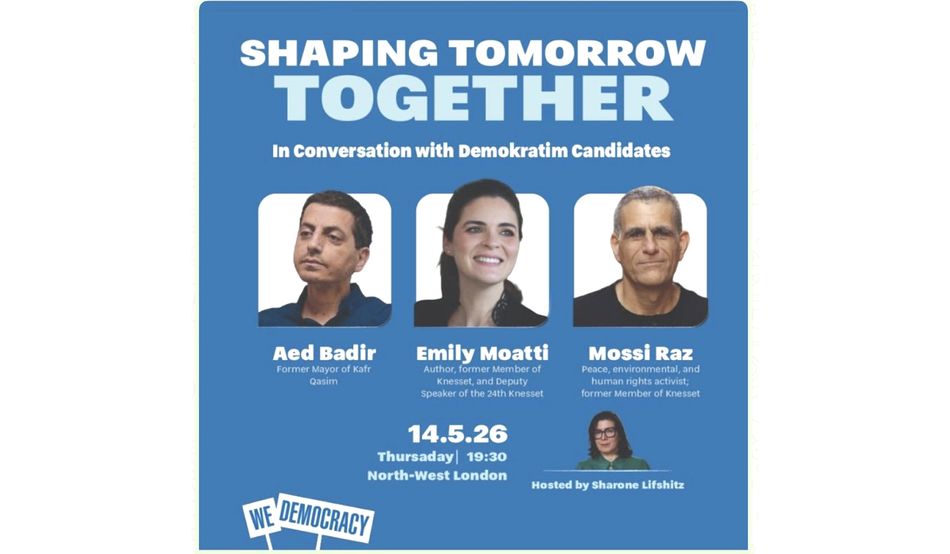
It is a rainy May evening and 13 Israelis have come to a community centre in north London to hear from candidates running in the primaries of a new political party, the Democrats. The outfit is a merger of Labour, which once dominated the Israeli establishment and has haemorrhaged support since the 1990s, and Meretz, the left-wing Zionist party that in Israel’s last election didn’t pass the electoral threshold to enter parliament. Currently polling between nine and 10 seats, the Democrats are what remains of the Zionist left as an electoral force.
Israelis will go to the polls on 27th October, in what many describe as an election of existential significance. Given how tight the race is, the Democrats (and the opposition bloc of which it forms a part) need every seat they can get—and think there are between five and seven to play for in diaspora votes. Since the 7th October 2023 Hamas attack, emigration has been at an all-time high, with close to a million Israelis now thought to live abroad. Given that Israeli citizens can’t vote from overseas, the candidates are here to convince the men and women sitting on blue folding chairs to fly home come election day.
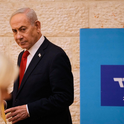
The May meeting was convened by We Democracy, a group set up in 2020 by Israelis living in Britain. We Democracy is “not supporting a party, but it’s ‘not Bibi’,” its founder, Jenny Kananov, a petite, quietly formidable woman, tells me. Kananov is using the nickname Israelis have for Benjamin Netanyahu, who has been in power, almost continuously, since 2009—and who at the last election, in 2022, formed a coalition with far-right and ultra-orthodox parties to stay in power. Netanyahu, a right-wing populist with a talent for social media, short-term survival tactics and sowing division, has been on trial for fraud, bribery and breach of trust since May 2020.
One of the Democrats’ candidates is Mossi Raz, 60, a former Meretz member of the Knesset, Israel’s parliament, who was also head of the Israeli NGO Peace Now. He shares a worrying statistic for the left: in a poll of first-time Jewish Israeli voters published in February, 59 per cent preferred Netanyahu’s bloc of right-wing and religious parties. Seventy-five per cent of respondents described themselves as right wing; 80 per cent as religious.
The Democrats’ first priority is to change the government, says Raz. Critical to this, he adds, is integrating Israel’s Palestinian and Arab citizens—who make up 20 per cent of the population and are excluded across society—into the election campaign, the government, the Knesset, “into everything”. Of course, a solution to the Israel-Palestine conflict is also crucial, he says, because “without it we don’t have a future”. Not that this will be achievable on the first day of a new government, admits the man who spent decades in the Israeli peace camp.
A few days earlier, at the same venue, I had come to see the Palestinian political activist Samer Sinijlawi address an audience of mostly Jewish Londoners. At 15, Sinijlawi spent five years in an Israeli jail, during which time he became fluent in Hebrew. His approach is one of forgiveness and empathy, married with pragmatism and a belief in the viability of two states. There is also a touch of Palestinian self-criticism and virulent opposition to Mahmoud Abbas, president of the Palestinian Authority, who has held power since 2005. (When legislative elections were last held in 2006, Hamas won and took over Gaza, while Abbas’s Fatah retained control of the West Bank.) It’s comfortable listening for this audience.
Under Israel’s proportional representation system, the Democrats will likely join a coalition with parties of the centre and the non-Bibi right to unseat Netanyahu. “Nothing can be worse than the current coalition,” says Sinijlawi, “Anything will be better. Will it be better to the extent that it can change dramatically the situation in the Middle East? I have no idea… It depends on what kind of coalition; it depends if there will be a change on [the Palestinian] side, if that change will bring a leader that will understand that he needs to do his best to make the prime minister of Israel his best friend.”
––––
The taxi is going fast on the quiet road from the airport to Tel Aviv. It’s after 3am on Tuesday 9th June. The 17-hour flare-up between the United States and Iran that delayed my flight seems to be over. The previous day, Israeli strikes killed 18 people in south Lebanon and in Gaza. Three days earlier, Israeli soldiers shot dead a seven-month-old Palestinian baby in the West Bank.
I am here to speak to as many people as possible—voters, lawmakers, advisers, pollsters, Israelis and Palestinians, Jews and Arabs—about the coming election, so I ask the driver whom he will vote for.
He tells me he stopped voting for Netanyahu’s Likud party when the prime minister went on trial, supporting various centrists instead. Now, bitterly disappointed by the alternatives, he is back with Bibi.
“Netanyahu is the lesser of all evils,” he says. “In what other democracy does a leader go to court three days a week? And they say this is a dictatorship.” He adds that Netanyahu “is the only one who really wants [Israel] to win”.
––––
Kafr Qassem is a small Palestinian town 20 minutes east of Tel Aviv by car. On 29th October 1956, Israeli border police killed nearly 50 Palestinian citizens here, including 23 children. A wartime curfew had been imposed that day, on the eve of the Suez crisis. Some of the town’s residents had been away. When they returned, not knowing about the curfew, they were shot.
I interview Aaed Bader, 46, one of the Democrats’ Palestinian candidates, who a month earlier I had seen speaking in London. We meet in a petrol station café at the entrance to Kafr Qassem, where he grew up and used to be a deputy mayor. Now a comms director for a human rights “action tank”, he is hoping to gain a place on the Democrats’ Knesset list.
Bader has the air of a man who’s spent a lifetime in politics and knows how to get things done. He is neat, has short, salt-and-pepper hair, and a phone that buzzes constantly with calls and messages, which he is gracious enough to ignore while we talk. He shows me TikToks of the Democrats leader, Yair Golan, 64, a former general who became a national hero on 7th October after rescuing survivors from the Nova Music festival, where 378 Israelis were killed and 44 taken hostage. Now Golan is seen as the figurehead of the mainstream left.
Most Palestinian citizens who vote in these elections will do so because of what has happened to Arab society, Bader says. He is referring to a major uptick in violence under the current government, much of it linked to organised crime. On 28th June, five Palestinian citizens were killed in separate car bomb and shooting incidents in four different towns. A senior official told the Haaretz newspaper that “the worst thing is nobody in the police or the system cares anymore”.
“Write this down,” he says: “My Arabness is a part of your Israeliness”
But Bader is also referring to repression more generally. Since 7th October, Palestinian citizens have lost jobs or been arrested for expressing sympathy with Palestinians in Gaza. “Write this down,” he says, before repeating a phrase I first heard him say in London: “My Arabness is a part of your Israeliness.”
Bader is focused on raising Arab voter turnout. For this reason, he would like at least some of the Arab parties—there are four: the religious conservative Ra’am; the Palestinian nationalist Balad; secular Ta’al; and Hadash, a merger of the former Communist party with other groups and the only officially Jewish-Arab party in the Knesset—to join on one list. Historically, this has increased the Arab turnout. Two weeks after we meet, Standing Together, the Jewish-Palestinian coexistence group, launches a new party called A Place for Us All, in direct challenge to Hadash, and to the Democrats.
Bader chose a path of mainstream Zionist parties because he sees how he can change things from inside the Jewish mainstream. During the 12-day war with Iran last June, Kafr Qassem set up an emergency command centre in the town with council leaders from neighbouring Jewish local authorities, as it has done at other times of crisis. Why does he smile as he tells me about this? Because, unwittingly, his Jewish counterparts have helped him make a point to young Palestinians who feel marginalised by, and systematically excluded from, Israeli society: “that we share a fate with Jews”.
––––
At a Tel Aviv bar, four candidates in the Democrats’ primaries are about to address party members. Bader, here from Kafr Qassem, is the only Palestinian. Standing behind the bar, he repeats his phrase about Arabness being a part of the gathered crowd’s Israeliness.
“Most of our problems are religion-state related,” says Naor Narkis, 37, a newbie whose pitch centres around one of the greatest points of tension among Israelis: the extent to which religion and state should be separated. “If there will be another primitive religious government, we will be finished,” he had told me out on the pavement. “Okay, religion-state,” says a man at the bar, but “what about the occupation? War? Equality?”
Their disagreements reflect divisions within a shrinking left. Ron, the bar manager, presses the candidates on the left-wing bona fides of Yair Golan: “It’s hard for me to vote for a party led by a general who sees through a gunsight.” Whatever Golan’s beliefs, the Democrats would likely join a government dominated by the parties of the right and the centre, where the pull towards the Israeli consensus will be hard to resist. Some party members have formed a bloc against the occupation, to get candidates vocal on this issue onto the Knesset list.
The crowd claps loudly when Emilie Moatti, a former Labour Knesset member and a novelist, says that “the most important issue is the conflict”, that “the occupation must end”.
“A seven-month-old baby was killed,” she adds. “Even if we don’t feel it, it corrupts the soul.”
––––
The man in black is telling me that I “think wrong”. We are just inside the security entrance of the Knesset in Jerusalem, on a hot Wednesday afternoon. Across the quad, the parliament building lies low under a blue sky. The man is 44, lives nearby, is here for a tour, and would prefer to remain anonymous. The yarmulke on his head is the small, black knitted kind.
In Israel’s last election, he voted for the Jewish Power party led by Itamar Ben-Gvir, the public security minister in charge of the police since 2022. Ben-Gvir has numerous criminal convictions, including for supporting a terrorist organisation and inciting violence, and is a disciple of the extremist rabbi Meir Kahane, who peddled Kahanism, a racist, Jewish supremacist ideology. Kahane’s political party, Kach, was outlawed in the 1980s. As minister, Ben-Gvir is accused of having politicised the police, and he championed a death penalty law for terrorism-related offences that, as written, only applies to Palestinians. The man in black thinks Ben-Gvir should be the next prime minister. Or Netanyahu.
“I would pay them all to go so we will have quiet,” he says, referring to Palestinian citizens of Israel and Palestinians living across the West Bank and Gaza. He comes closer, stands over me, talking more animatedly as the sun blazes overhead. “Only we can live here,” he says. “And I’m gentle.”
––––
Naftali Bennett and Yair Lapid launched their new election vehicle, Beyachad (Together), in a hotel in Herzliya, a seaside town north of Tel Aviv. Bennett is a right-wing former settler leader and tech millionaire; Lapid is leader of the opposition and the centrist Yesh Atid (There is a Future) party. They might seem far from an obvious match, but theirs was the winning ticket that managed to unseat Netanyahu in 2020 after a political deadlock—four elections in two years. The pair cobbled together a majority—in the 120-seat Knesset, 61 members (MKs) are needed to form a governing coalition—with the support of conservative Islamist Mansour Abbas, the charismatic leader of Ra’am. It was the first time in decades that an Arab party was included in a government coalition. For this, many right-wing voters will never forgive Bennett.
In the video from April, they stand at identical lecterns, as Bennett pledges “professional government”: an inquiry into the failings that led to 7th October; an eight-year limit to the tenure of future PMs; and legislation requiring everyone to serve in the military. “We will look after the land of our nation and not give a centimetre to the enemy,” he said.
“Gadi, our door is open also for you,” he added, looking straight into the camera. This was a direct appeal to Gadi Eisenkot, a former IDF chief of staff and minister in Netanyahu’s government, who now heads his own moderate right-wing party, Yashar! (Straight!). Eisenkot’s 25-year-old son was killed while on reserve duty in Gaza, in December 2023; his 19-year-old nephew died in combat the very next day. The following November, another nephew was killed. At the time of writing, Yashar! is seven seats ahead of Bennett and Lapid in the polls, level with Netanyahu’s Likud.
Naftali Bennett and Yair Lapid promise professionalism, but not peace
“Our nation needs unity like it needs air to breathe,” Lapid continued. His point was that, to win the election, the centre has to get behind Bennett—a right-winger, yes, but, by Lapid’s account, a fair, liberal and law-abiding one.
They stand, Lapid said, for “everyone who believes in democracy, who believes in the deep Jewish foundation of the state, believes in the values of Zionism and our right over this land”. Since October 2023, the opposition has voted with Netanyahu’s government on myriad security matters, from war with Iran to the banning of Unrwa, the UN agency that supports Palestinian refugees, only seriously objecting to the government over its handling of efforts to release the 250 people taken hostage by Hamas.
Asked three times whether Beyachad would rely on the support of Arab parties again, they responded with three variations of “no”. “We will only rely on Zionist parties. The Arab parties are not Zionist so we won’t rely on them,” said Bennett.
Bennett and Lapid promise professionalism, but not peace. The political theorist Shai Agmon makes the following comparison: “Imagine the most centrist Labour or Democrat politicians, like Starmer or Biden, not saying anything on the subject of the economy. British politics is about [the economy].” But that is what Israel’s mainstream political parties have done on the conflict with the Palestinians (not to mention the other fronts: Lebanon, Iran, Yemen).
––––
The benches in the Knesset visitors’ gallery are upholstered in orange. I sit down as Moshe Gafni from the ultra-orthodox United Torah Judaism faction makes a case for the proposed Basic Law: Torah Study, which would enshrine Torah study as fundamental to Israel’s Jewish heritage, and recognise people who study Torah as performing a service for the state, much like those who do national service.
Gafni invokes “children and young men in Warsaw during the Holocaust studying Torah in a shelter”. Next, Ze’ev Elkin, speaking for the coalition, reiterates that “Torah study is a fundamental value in the Jewish people’s heritage,” but clarifies that the bill’s comparison between those studying Torah and IDF service must be removed for it to pass.
Ultra-orthodox Jews have been exempt from military conscription for studying Torah since Israel’s founding. Now, after nearly three years of constant war and amid a military manpower crisis, this matter is tearing the country apart.
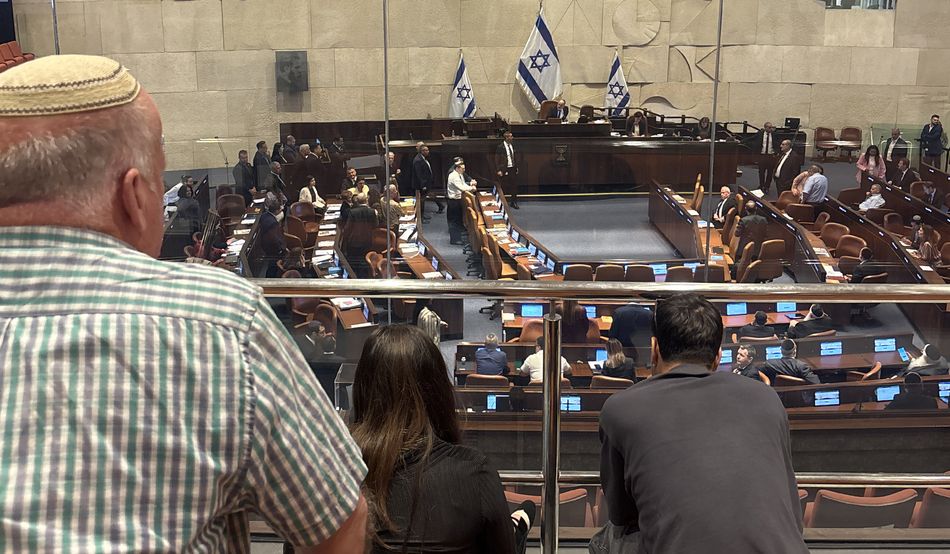
Sitting at the end of one of the rows in front of the lectern is Lapid. A few seats up from him, another Knesset member has been shouting his opposition to the bill throughout; the deputy Knesset speaker is threatening to have him removed. Lapid strides to the front.
“In the Warsaw Ghetto, people did not receive a stipend to study Torah. In the Warsaw Ghetto, they took up arms and staged an uprising on behalf of the Jewish people,” he says from the lectern. “This is a bill for funding draft-dodging.” He practically spits out: “This is not a bill about Torah, it is a bill about money.”
Shouting and interruption from the floor is a constant. More lawmakers are removed by security guards as the MKs’ votes are taken. I watch as Tally Gotliv, a Netanyahu loyalist who twice refused to go to police for questioning over having revealed, on X, the identity of a secret service agent, flits around the plenum. She is chatting with Ben-Gvir when the deputy speaker calls her out for interrupting the proceedings.
Only four coalition members oppose, and MKs from the Arab parties and Hadash are absent from the vote. The bill passes its preliminary reading, 56 to 43.
––––
After lunch, the lawmakers’ canteen is quiet. Across from me, waiting to be called to vote, is Shelly Tal Meron, 47, a Yesh Atid MK, who typifies the Israeli centre. Her blonde hair is pulled back in a half-ponytail and her navy suit is dotted with big gold buttons. The government is trying to “steal horses”, she says of bills, such as the Torah Study law, that are being pushed through before the Knesset dissolves ahead of the election. She is focused on another bill, which would increase government control over the media. “Most of my interviews are about that,” she says.
Called to vote, Tal Meron excuses herself. When she returns a few minutes later, she confesses she has barely slept for a month, due to her efforts against the media law. It’s the fourth week that she has been “living in the Knesset”.
From Hungary “we understand only a right-winger can win”
Netanyahu formed an “extremist” government with “fascist ministers”, she says. “I call it ‘feeding the monster’.” She wants British readers to know there is a “normal, liberal, democratic” public in Israel, that the government and the people are not one and the same. Since 7th October, Israelis have been through “perhaps the worst three years in our history”, she says. “We are licking
our wounds.”
Those who want to unseat Netanyahu watched carefully when the conservative Péter Magyar triumphed over Hungary’s far-right leader for the past 16 years, Viktor Orbán, in April. From Hungary “we understand only a right-winger can win”.
I wonder if she can understand how the Gaza war’s grim statistics—more than 73,000 Palestinians and some 2,039 Israelis killed—might influence the sympathies of an outside observer. The former Israel Air Force captain does not trust Hamas’s figures, though she admits there were “faults and mistakes” in the army’s conduct, and that the war went on too long. (In January, the IDF accepted the Gaza Health Ministry’s official death toll.) What might she say to a voter like the Kahanist I met that morning, who told me Israel would always be at war?
“It makes me very sad to hear that worldview,” she says, later adding “We will always need a strong army.”
––––
Ofer Cassif, the sole Jewish MK of the far-left Hadash, is eating lunch when I walk into his wood-panelled Knesset office. I tell him I don’t mind, but he packs it away after a few more bites. A television facing his desk shows the plenum. Around him are political heroes: an embroidery of Che Guevara; a Nelson Mandela poster; busts of Marx and Lenin. Poetry for the Many, a verse anthology collected by Jeremy Corbyn and Len McCluskey, is on display.
Cassif is one of the only lawmakers—certainly one of the only Jewish ones—to have called Israel’s onslaught in Gaza a “genocide”. When Donald Trump addressed the Knesset last October, Cassif and Hadash’s former leader, Ayman Odeh, were kicked out for protesting with a sign reading, “Recognise Palestine”.
Cassif is dismissed as a radical leftist. Nevertheless, he believes that, by telling “the truth”, he has helped to shift the mainstream debate. Gilad Kariv, a rabbi and Democrats MK who speaks against West Bank annexation, for instance, “wouldn’t say the things he says now if we hadn’t paved the way”. The price of this truth-telling for Cassif has been suspension from the Knesset for a cumulative 10 months since 2022. “People think I’m extreme, but I think [Israeli] society has
become extreme.”
Suspensions aside, the 61-year-old has been in the Knesset for seven years. It’s very different now from when he first entered. Coalition MKs such as Tally Gotliv act like “bullies, sitting on committees shouting you down”. There are some MKs in Likud, even in Yesh Atid, with whom he isn’t on speaking terms. “The English government should know that this [Israeli] government is no different to Oswald Mosley. The opposition, the moderates, are like Enoch Powell.” He compares the government to India’s Narendra Modi, Argentina’s Javier Milei, our own Nigel Farage—but Israel’s illiberal, right-wing populism has its very own flavour.
What happens if Netanyahu wins? A more interesting question is what happens if he loses
Cassif doesn’t think Israel has had a democratic election since 1967, when it occupied the West Bank and East Jerusalem, but he thinks this year’s vote will certainly be undemocratic. The general discourse is illiberal, violent. Like many of the people I speak to, Cassif fears that Netanyahu will do anything to stay in power, from disinformation to electoral interference, all the way up to simply refusing to go. Several interlocutors point out to me that, unlike most of the election polling, polls by the pro-Netanyahu Channel 14 consistently show Likud and the Netanyahu bloc in a strong position, with a clear route to winning. There might even be bloodshed. “The [US] Capitol riots will be nothing” compared to this, he says.
He does think the government will lose if the election goes ahead, though, because “the nation is sick of them. Most don’t care about Palestinians, but they do care about everything else.”
––––
Back in Tel Aviv, over coffee served in red and white espresso cups, Dan Meridor, an elder statesman of the liberal Zionist right, is explaining why these elections are critical. Israel is “leaving its path”, he says. Certain shared values—like belief in rights and the justice system—have gone. Netanyahu has “legitimised Kahanism”.
The 79-year-old was finance minister in Netanyahu’s first government, resigning in 1997. I come across something prescient Meridor is cited as saying at that time. He described Netanyahu as seeking to “control the budget department in the Treasury” and trying to eliminate “the legitimate centres of power that provide checks and balances to the government”. Meridor doesn’t recall saying this, but tells me: “I saw these tendencies then, but [Netanyahu] still accepted the system.” As soon as the prime minister faced criminal charges, says Meridor, he turned against that system. Meridor is referring to Netanyahu’s attempts to weaken the rule of law. Netanyahu’s “ideology is always second
to himself”.
What happens if Netanyahu wins? Meridor suggests that a more interesting question is what happens if he loses. “Would it stop what is happening in the West Bank?”
––––
The visitors get out of the minibus and children surround them immediately. Some chase the visitors around, running over the dust and stones. It is dry here, and hot. Emanuel Yitzchak Levi, 31, in bright green galabia, brown furry hat and glasses, is leading some of the kids in a game. “One, two,” he calls out in Arabic. He claps twice, “three, four,” and they clap twice with him. When he gets to the number 10 he shouts “Burtuqali!” instead—the Arabic for orange.
We are here to visit some of the Palestinians who fled Ras Ein al-Auja, one of the last remaining shepherding communities in the southern Jordan Valley, 10 kilometres north of Jericho in Area C of the West Bank. On 8th January, 26 families, including 59 children, were forced to leave amid a campaign of harassment by settlers. In December last year, settlers established an outpost only 200 metres from Palestinian homes there. Urgent appeals to the UN, diplomatic missions and joint statements didn’t stop the eventual displacement. Now the families are scattered.
We are in a fenced-off bit of land, near the border with Area B. There are two houses here, one white and small, the other of sand-coloured brick, with an imposing terracotta roof over a cool terrace, and an entrance framed with dark pink flowers. Eliana, a member of Bnei Avraham (the Sons of Abraham), a movement of religious left-wing Jews, explains that these houses belong to some relatives of the Ras Ein al-Auja families, and that some are staying here. Bnei Avraham did “protective presence” with the community, staying over in shifts to guard against settlers. The movement was started by Jews who grew up on the settler and religious Zionist right, and became disillusioned with it. They are here this morning with circus performers to entertain the children.
The settlers have definitely “got worse” in the past two years
A coach arrives as the activities are about to begin. “Not more left-wing Jews,” jokes one of the activists. It is a tour organised by Looking the Occupation in the Eye, which also does protective presence.
Under the dark pink flowers, I speak to a 50-year-old man forced to leave Ras Ein al-Auja. In February, Israel’s high court ruled that the state had to make it possible for the residents to return, but that has yet to be facilitated. Given the ongoing proceedings, he wants to remain nameless.
My interlocutor used to herd sheep, but had to sell them. He couldn’t take them out to graze because of the harassment. “It hurts inside,” he says. On his phone, he shows me a photograph of three of his children before they left (he has 10; the eldest is 30). His eight-year-old daughter keeps asking when they will go home, he says.
The settlers have definitely “got worse” in the past two years. They were always loitering “between the houses”, and with the cooperation, tacit or direct, of Israeli soldiers. Bezalel Smotrich, another far-right coalition member and a settler, is finance minister and has governing responsibilities over the West Bank as a minister in the Ministry of Defense. He has pursued annexation by stealth, while Ben-Gvir has armed settlers.
In Ras Ein al-Auja, the settlers would blast music at full volume so the children couldn’t sleep. They took over the local water source. “I had tears in my eyes,” Yaeli, one of Bnei Avraham, says of the day the community was forced out: “It was like my grandmother having to run away in the Holocaust.”
“Next time in Ras,” says the 50-year-old man, when it’s time for us to go.
––––
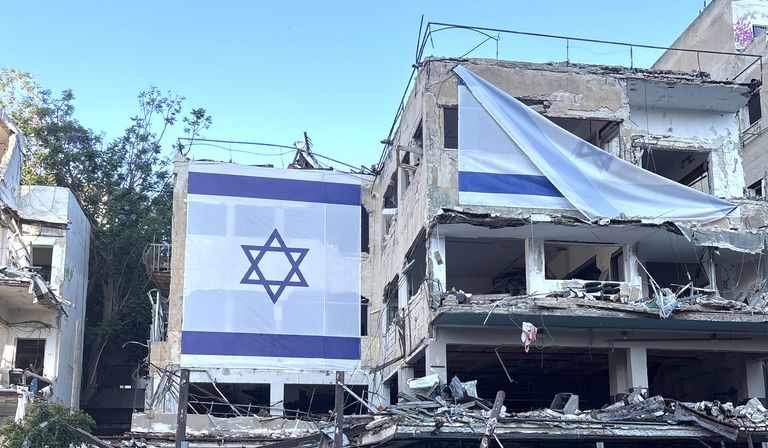
Pinsker Street runs parallel to the sea. I walk along it, down to where it hits Allenby, past old buildings, some falling apart, some remodelled: a typical Tel Aviv street. Then I see it: the site where the Iranian missile hit. There are a few damaged apartment blocks. The fronts are gone from two of them and, inside, you can still see some furniture amid
the rubble.
It is a shock to come across this, here at the end of the street. A beautiful, late afternoon light shines on one of the buildings. Israeli flags hang from some of them. I spot things in the debris: a black office chair, a grey sofa, a brown armchair, a suitcase.
––––
In the Carmel Market, not long before I leave for the airport, I stop to buy two pretty, blue “evil eye” keyrings. It is early morning, and the stallholder, a woman with dark hair tied back in a bun, is setting things up. I figure I might as well ask who she will vote for.
“Only Bibi. Bibi is the strongest leader in the world. The world isn’t scared of us, but it’s scared of Bibi.”
Hagit, 52, doesn’t believe in any of the other leaders. Bennett “isn’t right-wing, he’s a liar… he will form a coalition with the Arabs.” Golan is “terrible”.
“Maybe they will get one over on him. Don’t believe the polls,” she says of Netanyahu. “We saw what they did to Trump.” Still, after his judicial reforms, she thinks Bibi will be okay. A lot of people who work in the market will vote for Netanyahu, she says. It’s “not just us, many people support Bibi”.
But “not you”, she says. “I can see it on you.”