Amid a stalled Gaza ceasefire, with the Israeli army conducting deadly strikes and Hamas still governing, Palestinians in the Strip are living through a continued humanitarian crisis. But, somehow, in recent weeks the situation has gone from bad to worse: rats, cockroaches and the like have taken over everything in a frenzy. In the displacement sites where nearly two million Palestinians still live, no tent or even room is enough to ward the vermin off.
Fear is no longer linked only to what falls from the sky, but to what crawls from below. It is a constant companion: in checking bedding, in looking under objects, in being wary of every corner.
Fatima al-Jaabari, 46, sits on the edge of a tent set up in front of her home in the west of Gaza city, which was destroyed in the war. Her days pass sluggishly, as she performs her basic tasks: cooking over a fire, cleaning utensils with cheap dish soap. But when night approaches, she tells me, “the suffering intensifies”.
“The rats and mice have devoured us, destroyed us,” says al-Jaabari. She points to the ground, where the soil looks ordinary, but in fact conceals something else. “They come out from under the tent and attack us viciously; we no longer know how to sleep.”
“I’ve started worrying endlessly about the night,” she adds. “I used to be afraid of the dark for no reason; during the war, I was afraid of it because of the shelling, but now I’m afraid because of the rats.”
The UN estimates that about 1.7m people, or 354,480 households, are still living in displacement sites. In the tents, there is no separation between inside and out.
Trying to laugh, Fatima recounts her own experience, though her laughter comes out broken: “I went out to fetch a winter dress and found nearly ten mice inside the bag, all of them just born. They’re multiplying right here among us… Even my little daughter’s Eid dress was eaten by the mice, and the joy of the holiday turned to shock on the child’s face.”
The pests are most active at night. “They spread out among our beds, over our bodies, and if they get hungry, they bite us,” she says.
In April, the UN found that of the 1,600 sites where displaced Palestinians are living in Gaza, in more than 80 per cent residents had said they frequently saw pests or rodents. Nearly two-thirds of sites reported skin infections or rashes.
The charity Save the Children has estimated that, given that 47 per cent of Gaza’s population are children, some “680,000 children—about two-thirds of all children in Gaza—are living in displacement sites plagued of rodents or pests.”
Saeed al-Qassas, 52, told me that his seven-year-old son had “contracted a skin infection that caused blisters and inflamed pimples on his skin. The doctor said it was from the mice or insects.”
Al-Qassas sleeps in the single room that remains of his house. Rubble lies all around him, as if the room survived by chance, or its collapse has merely been postponed. He recounts waking up “in a panic… from a bite on my foot. I was sleeping with a battery-powered flashlight on in the room. I screamed in terror and saw a mouse running away.” Then he found three more mice near his son.
“I spend dozens of shekels every day on sticky traps to catch the mice. Each trap costs three dollars,” he says. His efforts don’t last long. “The mice have bankrupted me; I can’t bear to pay any more to catch them."
Sacks are no longer a safe means of storing goods or food. Abdullah Dababsh tries to stay awake, keeping an eye on his goods. “A lot of my goods get ruined after the mice eat them at night. They scurry among the merchandise… They’ve even eaten the paper wrappers on the canned goods.”
“I woke up one morning to find large holes under the tent’s floor tiles,” the 40-year-old recalls. “The street tiles I had laid by hand suddenly collapsed. I found small tunnels under the tiles, from which several mice had escaped.”
He tries to prevent the rodents’ attacks. “I placed broken glass shards around the tent to deter the mice and rats, but that didn’t provide a permanent solution—the crisis continues,” he says, adding: “Gaza has become a small jungle after the war.”
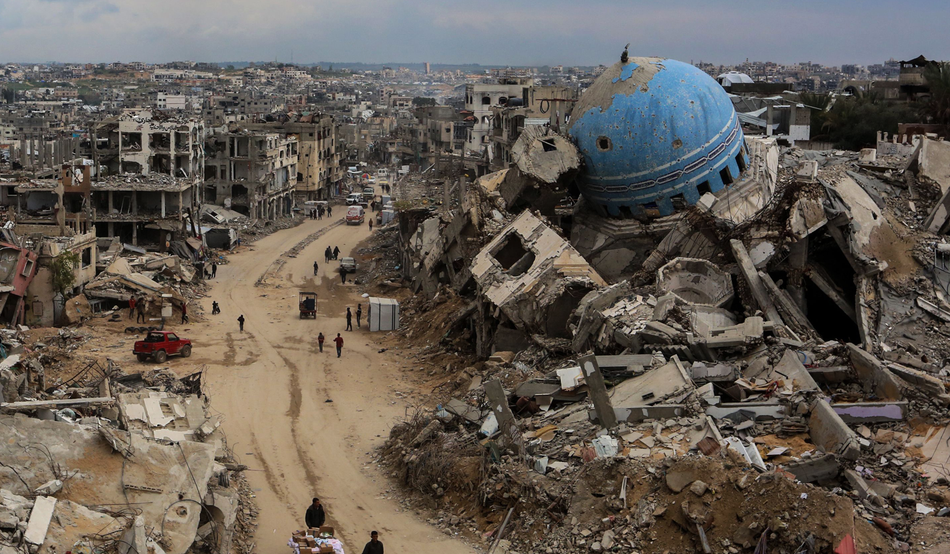
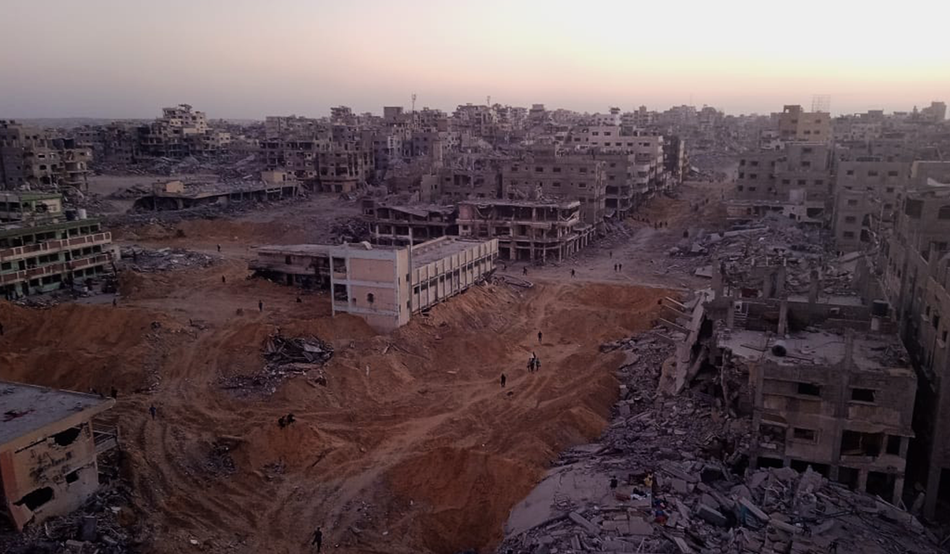
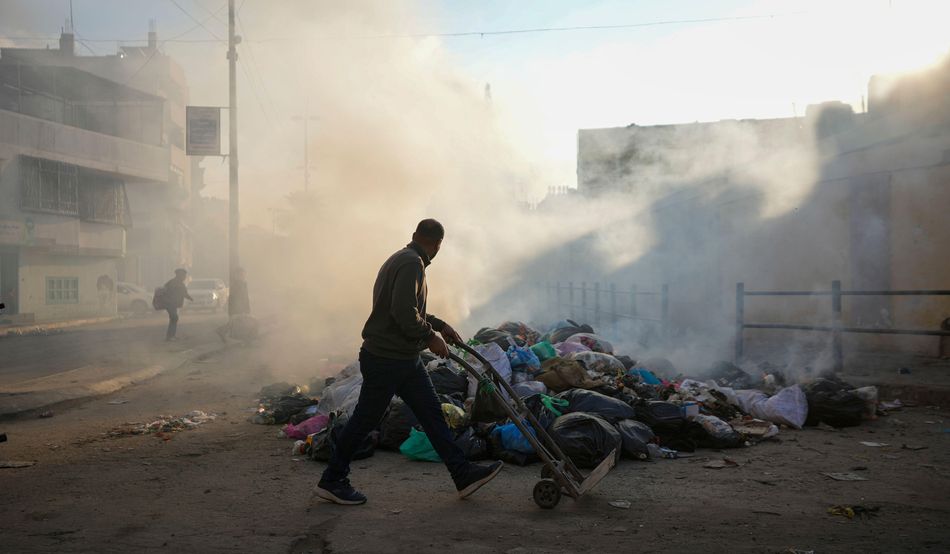
Popular committees have been forming in an attempt to address the crisis in Gaza, as rubbish builds up and sewage spreads among the rubble and tents, and amid a lack of support from the municipalities, as well as Israeli restrictions on the entry of insecticides and rodenticides. Last month, efforts against the infestation did, finally, increase. On 7th May, the Israeli army said it had allowed such pesticides into Gaza, and the following week the UN said it had brought pesticides into the Strip. The UN Development Programme launched a “pest control campaign”, as well as waste removal efforts, on 17th May, with activities in 1,700 locations.
In the background, the rubble remains a direct cause of what is happening, as vermin thrive in areas destroyed in the war. The Israeli army has renewed its strategy of so-called targeted assassinations, killing the new leader of Hamas’s armed wing on 26th May. The following day, on 27th May, on the Muslim festival of Eid al-Adha, Israeli strikes on Gaza city killed at least 10 people, including up to five children. With no clear solutions in sight, the question remains: how long can people adapt to a situation that is getting worse, day by day?
Correction: The image on this piece was replaced on 29th June as we believe the original image was created using AI rather than being an authentic photograph. Prospect apologises for the error.