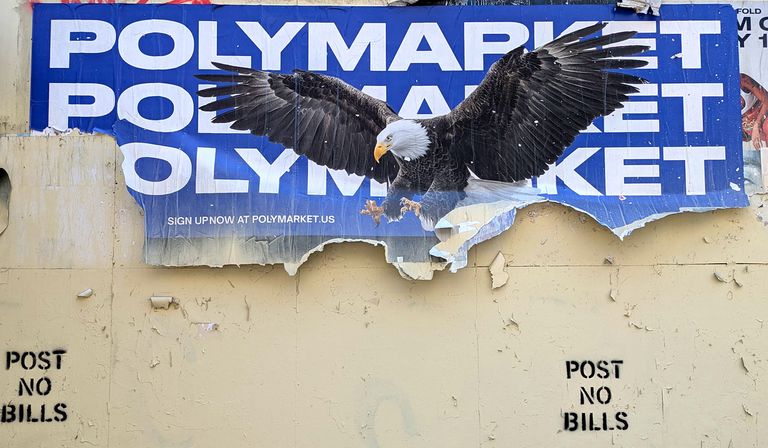
“Post no bills.” A formerly impressive but now shuttered building in downtown Los Angeles has those three words stencilled, again and again, around its perimeter, to ward off people who might paste adverts on its otherwise inviting wooden boarding. Of course, those words are ignored. Seven or eight feet off the ground, there are posters hawking nightclub evenings, new R&B albums, streetwear worn by members of the Kardashian clan. All are tatty at their bottom edges, as though the piss-fumes and reflected heat from the street below are making them rot.
But only one poster looks as though its bottom edge has been torn deliberately, in great, leaping handfuls. It has the word “POLYMARKET”—all caps—cascading down it, and a very American eagle swooping in from the righthand side. If you looked very quickly, you might think it was for a fashionable party to celebrate the 250th anniversary of the world’s grandest republic. But it’s not. Polymarket, which peddles a very 21st-century form of gambling, is vying to be the biggest prediction market in the world. The volume of trades made on its US exchange rose fourfold, from $50m a day to $200m, between May and June this year. Whether on LA’s streets or social media apps, it is fast becoming unavoidable.
Polymarket is not entirely unrelated to the United States, though, on the occasion of its semiquincentennial. The platform rose on a series of predictions made by its users about Donald Trump winning the 2024 election. It has risen further with the Trump administration’s—let’s say—relaxed attitude towards regulating this line of business. And now it’s even part of the family: Donald Trump Jr has sat on Polymarket’s advisory board since his firm, 1789 Capital, made a “double-digit millions of dollars” investment in August last year. Outside that, the story involves cryptocurrency, the war in Iran and even Volodymyr Zelensky’s dress sense. There are, in fact, few things more #America250 than Polymarket.
Which is why it’s also controversial. There are those in California, including Mark Zuckerberg, the head of Meta, who want to emulate Polymarket’s growing success. But there are others, such as the poster-grabbers of LA, who would tear it all down. Polymarket, specifically, and prediction markets, in general, have become another political battlefront in what is, culturally speaking, a war-torn country. They are the world’s
problem, too.
But first: what even is a prediction market? As with so much that’s going wrong in 2026, it started off with a good and noble idea. In the late 1980s, a group of economists at the University of Iowa reckoned that market mechanisms could do a better job of predicting the results of the 1988 presidential election—or of any election—than polling companies. So they established the Iowa Political Stock Market. Participants could effectively buy shares in either George HW Bush or Michael Dukakis as the eventual victor, making money from their investments. The final share price would, in theory, reflect the chances both men had of winning.
That theory is fairly easy to summarise: among informed observers, the trends towards or away from one candidate or another are likely to have some weight behind them. What’s more, when cold, hard cash is involved, those observers are likely to be even more careful about the decisions they make. And so, whereas an opinion poll tests a public who might be deceptive or just plain uncertain in their answers, a prediction market makes an expert community reveal what it truly believes.
This was, at least on the surface, borne out in practice. The Iowa Political Stock Market outperformed major pollsters, including Gallup and Harris, in 1988—and, in a new incarnation as the Iowa Electronic Markets, has done so in elections since. Others followed. Perhaps the most notable example was the Policy Analysis Market (Pam) established in May 2001 by Darpa, the big-brained research wing of the US Department of Defense, and helped along by Robin Hanson, a professor of economics at George Mason University, who has become academia’s greatest proponent of prediction markets. This market was designed so that analysts could bet—and thereby forecast—geopolitical events. Originally, it was focused on eight Middle Eastern countries—including, in that most fateful of years, Saudi Arabia, where most of the 9/11 hijackers originated from.
However, in 2003, Pam was strangled before a single trade could be placed, after a pair of Democratic senators, Byron Dorgan and Ron Wyden, suggested that it might be used for betting on such events as assassinations, coups and, indeed, terror attacks. They called this “morally repugnant”. In its report about the retired admiral in charge of the programme standing down, the New York Times described Pam as a “terrorist futures-trading market”.
For his part, Hanson has gone on to advocate even more vociferously for prediction markets. He has since developed his idea of “futarchy”—a form of governance that blends old-fashioned democracy with the new-fangled forecasting possibilities of the internet age. In a podcast interview in 2021, he described his project thus: “The question is, could we give people more direct, better incentives to actually tell the truth and figure out the truth, so that when we had a meeting and people raised hands and we made a decision what to do, we would be doing it on the best knowledge we could have?”
The problem with this history, so far, is that it’s all concerned with the common good. The Iowa markets were a nonprofit experiment in hardcore economics. Darpa’s Pam was an attempt to refine the decision-making processes of US legislators. Hanson’s futarchy aims to improve democratic participation. But, soon enough, others of a less utopian mindset started asking a different question: can we make megabucks out of prediction markets?
An answer, of sorts, had already come in the early 2000s, when companies such as HedgeStreet and Intrade allowed consumers to invest in prediction markets and win big (or lose hard). But these early-moving firms often fell foul of a regulatory regime that didn’t know whether it was dealing with financial instruments or straight-up gambling; in any case, regulations were tightened after the crash of 2008.
It wasn’t until relatively recently, in 2020, that anyone really bothered to try hurdling the barriers in the way of mainstream prediction markets. That year, one of two new big players, Kalshi, announced it had officially registered as a “contract market” with the US Commodity Futures Trading Commission (CFTC). This meant that it could trade in “event contracts”—which is to say, predictions about whether or not something will happen.
The second new big player of 2020 was Polymarket. It did, in fairness, have something of Hanson’s utopian zeal: its founder, Shayne Coplan, was an adherent of futarchy and had once written to the professor to express his support. But it also had something more: Coplan had spent his teenage years coding and learning the ways of—and getting rich from—cryptocurrency.
By 2020, while most other people spent Covid lockdowns fussing over their sourdough starters and yoga positions, this 22-year-old could bring his skillset to bear. Polymarket was built in Coplan’s Manhattan apartment and launched in June 2020. At that stage, it was a more freewheeling alternative to Kalshi; its contracts weren’t rubberstamped by the CFTC but were instead managed automatically by blockchain technology, while all deposits and payouts were in crypto. The Young Turk had arrived.
For all its technological sophistication, however, the standout quality of Polymarket—and of other prediction markets—is its simplicity. All of its markets ask a binary, yes-or-no question, such as, “Will Trump resign before 2027?” You buy shares according to the outcome you expect, where the share price reflects current probabilities. So: if “No” is priced at $0.95 (as it is for this particular question, at time of writing), then it means the market reckons there’s a 95 per cent chance of that outcome. If your prediction is eventually proved correct, whatever you originally paid, each of your shares is automatically worth $1. All incorrect predictions are worth $0. Much like a traditional stock market, you can buy and sell your shares at any point. What’s not to like?
‘Will the missing submarine be found by June 23?’ read the market for a tragedy in which five people died
Quite a lot, as it happens—certainly from the perspective of the regulators. The CFTC fined Polymarket $1.4m in 2022 for running an unsanctioned trading platform and, in a bigger blow, effectively banned it from the US until such time as it could comply with the law. The press release announcing the news came with a quote from the commission’s acting director of enforcement, Vincent McGonagle: “All derivatives markets must operate within the bounds of the law regardless of the technology used, and particularly including those in the so-called decentralized finance or ‘DeFi’ space.”
What about operating within the bounds of taste and decency? From the beginning, that has not apparently troubled Coplan and Polymarket. One of its most famous early markets—in a way, the one that made its name—concerned the disappearance of the Titan submersible, on its way to the sunken wreck of the Titanic, in June 2023. “Will the missing submarine be found by June 23?” read the market prompt for a tragedy in which, it was eventually discovered, five people were killed. This sparked controversy not only over which bets should be paid out—parts of the submarine were found, although it was mostly obliterated—but also over the crass morbidity of the question itself.
It was like the Darpa story once again—except this time, because Polymarket was a private company, no one could force its closure.
Controversy has dogged Polymarket ever since, much of it related to the Trump administration. In fact, many of the key moments in Polymarket’s history are also key moments in Trump’s second term, starting with his very election. This was when an anonymous investor from France, the so-called “French whale”, bet big on Trump defeating Kamala Harris—contrary to the “toss-up” narrative of most pollsters—influenced, in part, by data he specially commissioned from YouGov. That investor eventually more than doubled his stake of $80m, winning an additional $85m.
Then there was the incident of Zelensky’s suit (or was it?). This was a market that opened after the Ukrainian president was attacked for wearing his trademark military fatigues, rather than something more formal, for a meeting with Trump in the Oval Office in February 2025. “Will Zelenskyy wear a suit before July?” came the question. When, in June that year, Zelensky wore a smartened-up outfit to a Nato summit, consisting of a black jacket and trousers and a matching black shirt, many Polymarket participants thought they were quids in—not least because various sources, from the BBC to the outfit’s designer, had already described it as a suit. But Polymarket resolved differently: after consulting with an outside dispute-resolution system for blockchain contracts, it was decided that Zelensky’s attire was not a suit in the traditional sense. Millions of dollars shifted on a sartorial judgement.

This year, there has been the war in Iran. Nine Polymarket accounts thought to have one person behind them were found to have won more than $2.4m on bets related to Trump’s military interventions in the country—from the date of the first attack to the announcements of ceasefires. Which sounds very fortunate for that gambler-investor, until you discover that he (or she) has a win rate of 98 per cent across their bets, even though many of the probabilities were much lower than that. “Luck alone cannot explain those numbers,” said Nicolas Vaiman, the CEO of the data analytics firm that discovered the discrepancy.
So what can explain it? Separately, a US special forces soldier has been charged with—though pleads not guilty to—using classified government information to allegedly win $400,000 by betting on Nicolás Maduro’s removal from office, just hours before the former Venezuelan leader was captured by US special forces. An Israeli Air Force crew member who was questioned by state prosecutors in similar circumstances is said to have told his interrogators: “The entire squadron is on Polymarket, the entire air force is betting.”
These are not aberrations. They cut through to the bone of the notion that Polymarket is a fair, free and accurate marketplace for predictions. To what extent were its bullish forecasts for Trump’s election victory a function of—to use the title of a James Surowiecki book that has been influential in the rise of prediction markets—“the wisdom of crowds”, or of one mega-investor using privileged information to swing everything his way? Or, in the case of Zelensky, who gets to decide the truth when a yes-or-no proposition is more accurately resolved as a maybe? And as for any instances of possible insider trading, well… that would be insider trading.
The upshot is a prediction market that may not be all it promises. Polymarket boasts that its crowd-sourced predictions are “accurate more than 94% of the time an entire month before an outcome is definitively known”—but this appears to trace to research into the accuracy of its markets just four hours from their closure, which is when you’d expect them to be pretty darn certain. A Prospect analysis of almost 7,000 markets from the past year-and-a-half on the platform, each with more than $100,000 in trading volume, found that those already trading a month before their closure called the outcome correctly just 81 per cent of the time. Impressive—but certainly not perfect.
And these headline numbers gloss over those predictions that are just way off. For instance, a week before the assassination of Ayatollah Ali Khamenei on 28th February in a US-Israeli assault, a market titled “Khamenei out as Supreme Leader of Iran by February 28?” gave the probability as just 2 per cent. Polymarket’s participants truly don’t have crystal balls.
Then there is the little matter of the company’s—in fact, the industry’s—ties to the Trump family. As well as being on the advisory board of Polymarket, Donald Trump Jr is a “strategic advisor” for Kalshi, which creates quite the recipe for conflicts of interest. It is striking that, during his father’s second term, the environment for prediction markets has become rather more favourable. Although Polymarket drew significant sums from American cash-pumps before the last election—including $45m in a May 2024 investment round led by Peter Thiel’s Founders Fund—it was only in 2025 that it was allowed to return to the US after gaining regulatory approval from the CFTC. It is that return which has spurred the firm’s recent astonishing growth. Polymarket’s latest formal valuation, in October 2025, put it at $9bn.
And so the rich get richer. What’s new? Except the Polymarket story does not stop there. Its cross-border structure makes it a cross-border conundrum: countries including France and Germany have already banned it; others will have to grapple with this novel amalgam of gambling and trading—and decide which, if any, regulations it contravenes in either area. These concerns haven’t gone away in the US, either. Different states have different approaches to gambling—especially to the vexed issue of sports betting—so how do they handle a platform that’s dressed up as a financial marketplace which can be accessed by anyone over the age of 18, in a country where online flutters are mostly restricted to those over 21? As it happens, at time of writing, almost half of Polymarket’s events relate to sports.
(Intriguingly, notwithstanding its more forgiving approach in recent years, the CFTC may have got involved again—in June, a source told the Wall Street Journal that the commission is “in the midst of a continuing investigation into Polymarket”.)
Besides, there are only going to be more entrants to this lucrative contest. In June, the New York Times reported that Mark Zuckerberg had tasked his Meta underlings with adding a prediction markets app to the company’s offering, following an abortive attempt, called “Forecast”, in 2020. Provisionally named “Arena”, this app would not, apparently, see money trade hands at first—but “would probably rely on a video-game-like points system instead”, according to the NYT. Not that this is particularly reassuring. Given the way in which Meta’s existing platforms, from Facebook to Instagram, have monetised our very attention, it is still likely to make a healthy profit.
Perhaps the greatest risk, however, is not to our wallets but to our minds. Prediction markets have always sold themselves as a better source of information than pollsters and even the media. Polymarket and Kalshi still make the same claim—but they are also subverting the ideal. Among Polymarket’s current markets is one that’s had $64m pushed through it, asking, “Will Jesus Christ return before 2027?” The probability of him doing so stands at just over 2 per cent. Low odds, to be sure—but do they have any basis in anything? Who are the ecumenical scholars feeding into these numbers? Or are these just idle bets laid by people with more money than sense?
The problem is that an increasing number of people regard Polymarket’s predictions as a gold standard for the knowledge economy. The platform has 1.7m followers on Elon Musk’s X (of course), to whom it presents literal speculation as news. “BREAKING,” read one post in March, “a trio of UFOs appeared to be ‘chasing each other’ over New York City this past weekend.” Naturally, it’s running more than 100 markets related to UFOs.
So, again, we return unavoidably to Trump. UFOs are one of the preoccupations of his second administration. Jesus, too. Where we’re at now is the vice president, JD Vance, suggesting, as he did around the time of that Polymarket tweet in March, that aliens are actually demons buzzing our planet. Put that on a poster—or, indeed, a birthday card. Happy 250th to the United States of America.