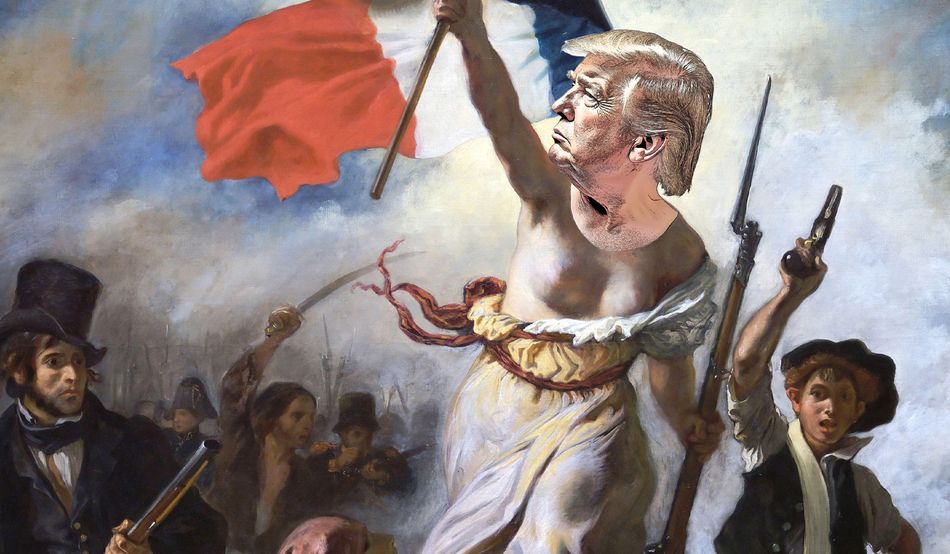
Since Donald Trump’s return to power, the safeguards built into American democracy, already under strain, have broken down even further. Ahead of his taking office, a Republican majority on the Supreme Court had ruled that Trump was broadly immune from prosecution, and that a constitutional provision barring insurrectionists from office didn’t apply to him. Everyone understands that impeachment is currently impossible and oversight from a Republican-led Congress practically nonexistent. Institutions such as law firms, universities and the media have broadly fallen in line, offering few barriers to authoritarianism.
In response to this democratic backsliding, however, ordinary US liberals have rallied. Over the past nine months, tens of millions of Americans have taken to the streets in some of the largest mobilisations in the country’s history. Meanwhile, an emerging new media is urging resistance to Trump’s Maga movement.
None of this just happened spontaneously. For over a decade, there has been a debate on the anti-Trump side of US politics over whether the New Right can be placated, or must simply be opposed. For liberals to fight back, first they had to decide that they should.
Liberalism has a different meaning in the United States than in the United Kingdom, encompassing most people who are left of centre (although the term “democratic socialist” has become more mainstream on the left flank). Its values include both individual rights and the common good, progress and freedom. US liberals have usually supported feminism, LGBT+ rights, progressive taxation, universal (or at least expanded) health coverage and environmental protections. They also earned a (not entirely undeserved) reputation for being overly concerned with civility, decorum and the status quo. One of the central projects of Obama-era liberalism was restoring a sense of national unity and coming to bipartisan “grand bargains” with Republicans on contentious issues like the national deficit and immigration.
Today, leading US liberals call for implacable opposition. Protesters tell masked federal agents “you’re going to have to kill me.” They call for sweeping institutional reform and “Nuremberg 2.0” for immigration agents and the right’s political leadership (and, now, also for US officials believed to be responsible for war crimes against Iran). How did this “resistance liberalism”, as some refer to it, emerge?
During Trump’s first term the response of US journalists to these stark warnings was a sort of awkward silence
Over video call, I spoke with many of the writers and thinkers most associated with this new, aggressive American liberalism. The first step to fighting rising authoritarianism, they told me, was recognising it as such. The language used to describe Trump has been a point of considerable contention since he first ran for office. Resistance liberals insisted on blunt language, even if it was jarring for others. Trump’s rhetoric was not “racialised”, it was “racist”. The movement was not “populist authoritarian right-wing”, it was “fascist”. Andrea Pitzer, a prominent liberal commentator, already argued as early as Trump’s first term that the phrase “concentration camps” (she is also an expert on their history) could accurately describe some of the infrastructure being built for US “immigration enforcement”. This wasn’t, she says, about throwing ugly words around for the sake of it, but helping people to adapt to a new reality. “When you don’t provide coherent ways of understanding what’s going on, that can work against your side.”
Most of those raising the alarm when Trump first ran for office were liberals, but not all. There were also socialists, the odd libertarian, and a few Republicans who decisively broke with their party over Maga and have since thrown their lot in with the liberal-led resistance. Bill Kristol, a long-time fixture of US conservatism, is the most prominent example. “Churchill had more in common with the more militant members of the Labour party than he did with Chamberlain and his people,” Kristol tells me, “in terms of fighting, standing up against fascism abroad, and to some degree at home.” The situation in America is not wholly dissimilar: “It’s more a matter of how alarmed you are,” he says.
For the most part, during Trump’s first term the response of US journalists to these stark warnings was a sort of awkward silence. They covered events in strained, euphemistic language. Michael Tomasky, another early trenchant critic and now editor of the New Republic, says that “our mainstream reporting brothers and sisters treated him like a normal candidate… It was partly muscle memory and partly that there were no rules established for covering a candidate like Trump.”
While the early anti-Trump movement stuck with its unapologetic terminology, many centrist commentators (both centrist liberals and the centre right) saw this as an overreaction. Resistance liberals were portrayed as “hysterical”, Pitzer recalls, dismissed as irrational and overly emotional. The “resist lib”, therefore, became at once a faction on the anti-Trump side of US politics and a sexist caricature. Terms like “wine mom” or “pussy hat liberal” (named for the hats worn by protesters inspired by Trump’s boast about “grabbing women” by their genitalia) are still used to convey a similar sentiment.
In any case, the argument went, liberal democracy wasn’t really at risk from Trump’s rise in US politics; people were just sick of “woke”. The idea, as the American journalist Robby Soave wrote in Reason, a libertarian outlet, in 2016, was that “smug, entitled, elitist, privileged leftists jumping down the throats of ordinary folks” had “inspired a backlash that gave us Trump”. Owing to this logic, many politicians and commentators, including some Democrat lawmakers, called for substantive moderation on issues like immigration and trans rights in order to reach voters who had supported Trump.
This response—which resistance liberals termed “reactionary centrism”—amounted to a demand to “accept a certain amount of this intolerance”, as Pitzer puts it. That didn’t work as a political strategy, she says, as “all that you do is reinforce the authoritarian strain that rises up.” Instead, you needed to offer an alternative “positive vision” of society.
Fascism cannot be appeased; this is a core assertion of resistance liberalism. Voters in the 2020 Democratic primary to decide who would challenge Trump for re-election were increasingly convinced by this. They would accept some moderation on “normal” issues or the tone or aesthetic of a candidate, but they were not interested in giving up the rights of minority groups to placate the New Right.
Joe Biden, the eventual winner, was no one’s idea of woke, but he didn’t cave to demands that would have alienated voters further on the left, or LGBT+ and antiracist groups. Indeed, he treated bad-faith gotchas about trans people, which many a recent centre-left leader has had to nagivate, with a genial contempt. “How many genders are there?” one woman asked him on a campaign stop. “At least three,” the then septuagenarian candidate snapped back. “Don’t play games with me, kid.”
As a consequence, when it was time to oppose the sudden democratic backsliding of Trump’s second term, the resistance did so united. The Democratic party had entered the Trump era internally divided after a very contentious series of primaries in 2016 between Hillary Clinton and socialist Bernie Sanders. Biden also beat Sanders in 2020, but he proved coalitional in victory, adopting—and ultimately, as president, passing—much of Sanders’s egalitarian agenda, including historic investments in infrastructure and clean energy. Even in the face of real internal tensions over Gaza, the leadership of the socially liberal and democratic socialist factions remained loyal to Biden (though he was eventually replaced as the 2024 candidate by Kamala Harris, after much division within the party).
Resistance liberals think the opportunity for an easy compromise has come and gone
The fact that different groups opposed to Trump still exist under the banner of one party is a significant accomplishment. This was by no means guaranteed, as the recent fragmentation of the UK Labour party and the British left shows. Kristol, whose somewhat unusual vantage point on all this comes from having started outside the Democrat team, tells me that US “liberals have done a good job of being at once militant, but also a big tent”.
When Trump returned to power in 2024, the administration presented his brand of authoritarianism as a fait accompli. But a victor is only victorious if the vanquished consider themselves so. Resistance liberals didn’t. “A lot of seeds planted in that first Trump administration… are bearing fruit now,” says Pitzer. People who had been primed to oppose him since the women’s marches or the 2017 Muslim ban (when Trump stopped entry to the US for people from seven Muslim-majority countries) had the muscle memory of activism.
Resistance liberals are truly committed to liberal values such as individual rights, democracy and a pluralistic society. They think these can only be saved through a knockdown, dragout fight across all levels of society and that the opportunity for an easy compromise has come and gone. They know that victory will go to the side that wants it the most. This is the foundation on which the opposition to Trump has been built.
Since Trump’s re-election, with major outlets such as the Washington Post, New York Times, and CNN no longer meeting the moment, a change in the media was urgently needed. The Post’s decision to pull an endorsement of Kamala Harris (at the request of owner Jeff Bezos) proved a particular flashpoint. More than 200,000 subscribers cancelled in protest.
Many readers have simply gone elsewhere. Adam Gurri, the editor-in-chief of Liberal Currents (a publication I contribute to), says that it increased its following by an order of magnitude after Trump’s return to power. “We felt that there was an opportunity, because liberalism had become complacent intellectually in the United States,” Gurri tells me. Liberal Currents recently crowdsourced half a million dollars to transition into a major publication. Kristol launched his own platform, the Bulwark, in 2019. “A few of us just said: you know what, let’s do a website and see what happens.” It’s now one of the leading politics newsletters in the US. “The heart of it has always been the tough-minded critique of authoritarianism,” says Kristol. Shikha Dalmia lost her job at Reason for being too anti-Trump. When she launched her own, the UnPopulist, it quickly took off. “We are bringing new people into the political conversation,” she tells me.
The mission of today’s New Republic, Tomasky says, “is to oppose this incipient fascism… And… to push the Democratic party to be as bold as it can and should be.”
“I don’t obsess over numbers,” he adds, while noting that print circulation had increased and online readership was up “dramatically” since Trump’s re-election.
At the start of Trump’s second term, many (myself included) worried that liberals who wanted to fight Maga couldn’t compete with mainstream media. But now, the average American is being exposed to many more voices calling him a fascist and telling them that they are living through an age comparable to the civil rights movement, or even the Civil War.
“We were right, that helps,” Samantha Hancox-Li, an editor at Liberal Currents, says when I ask how this rapid media realignment occurred. This is a common sentiment. “You can only make so many predictions that come true and have people still deny that what you’re saying is fact,” adds Jesse Dollemore, host of Dollemore Daily, a news and politics YouTube channel with over 1.3m subscribers. “Now that he’s [Trump] proven to be worse than our worst nightmare, we’ve got moral credibility,” adds Dalmia. “We’ve got the scars and the bruises.”
This is a useful, if somewhat sobering, lesson from the US: initial warnings will be ignored at best, dismissed at worst. The opposition has to keep at it, laying the foundations and creating the record that it will build on when things start to fall apart.
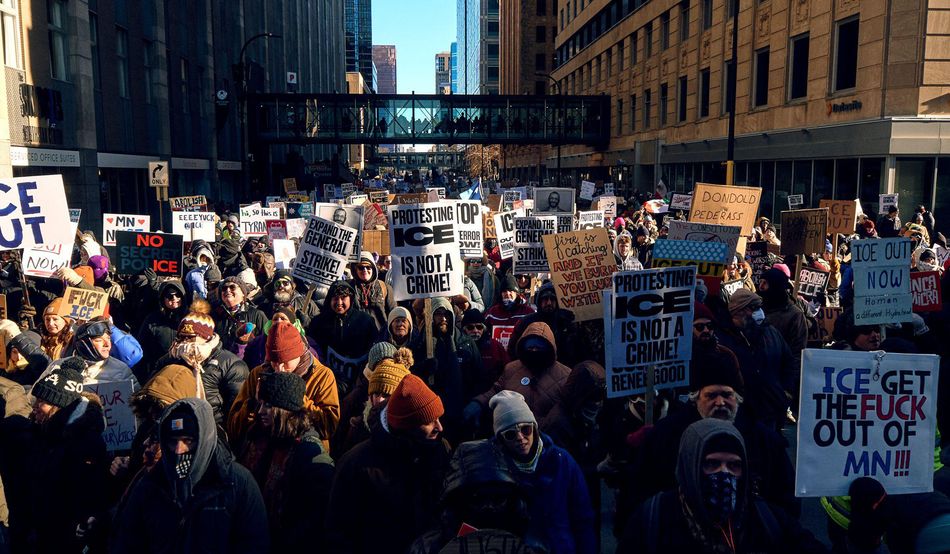
When the Trump administration sent hundreds of masked Immigration and Customs Enforcement (ICE) agents to Minneapolis, conducting sweeps and pulling residents off the street on the basis of race or having an immigrant background, the city’s residents organised mass protests. Two US citizens were killed in circumstances widely believed to be little more than extrajudicial executions, and the administration quickly backed the agents. “Saying this officer is a murderer is dangerous,” Trump’s border czar, Tom Homan, told NBC at the time. “It’s gonna infuriate people more which means there’s gonna be more incidents like this.”
The images to come out of these clashes were astounding: winter-wrapped Midwesterners facing off against lines of masked men; US Border Patrol official Gregory Bovino in a uniform evoking 20th-century fascism, surrounded by federal agents; an older woman on a walker using it to advance into tear gas. The crowds in Minneapolis showed that people were willing to take risks for what they believe in.
And the risk-taking worked. Even for this administration, the optics were too bad. The government moderated its threats and (slowly and partially) started to wind down its activity in the city. Bovino was forced out, followed by the former homeland security secretary Kristi Noem.
This is a fight that can be won. To do so, however, the centre left will have to adapt itself rapidly as the old orders fail
At the same time, resistance liberals with media platforms pressed hard for Democrats to adopt an “abolish ICE” position. Reforms were not enough; the entire agency must be ripped out root and branch, everyone involved fired, people at the top prosecuted. What had been perceived as a radical position became more popular. Public support went from 20 per cent to 50 per cent. Increasingly, mainstream Democratic politicians such as Illinois governor JB Pritzker (who has a credible path to the White House in 2028) are signing up.
This is far from the only issue on which attitudes have shifted. Packing the Supreme Court to break the power of Republican appointees, electoral reform and mass prosecutions for corruption and human rights abuses are among the ideas that have gone from fringe to mainstream or even majority positions among US liberals. They now seek a radical restructuring of their country, on a par with reconstruction after the Civil War. These policies, and even the specific language used to describe them, are being taken up by Democratic senators. A similar pattern repeated in response to Trump’s more recent genocidal threats against Iran. Initially cautious statements by Democrat politicians gave way to calls for his removal by any means necessary.
This is the other great payoff from a radicalised liberalism: if you believe you are in a fight between freedom and fascism, you will entertain far more radical proposals than you would in normal circumstances. Whereas prior generations of liberals may have talked of democratic institutions as an end in themselves, resistance liberals see them as tools to preserve a free society. If they are no longer serving that goal, they can and should be changed.
So-called reactionary centrists insisted on starting with electoral tactics: carefully measure which positions swing voters will accept and allow the results to dictate strategy and values. Resistance liberals knew this was a preposterous inversion—you start with values, with what you are willing to shout from the rooftops. They knew that tactics should follow strategy, that people have to understand what the stakes are and that, in the final analysis, great struggles are won by finding the will to fight. The Trump administration remains dangerous, domestically and for the wider world, but there is a way back for the US.
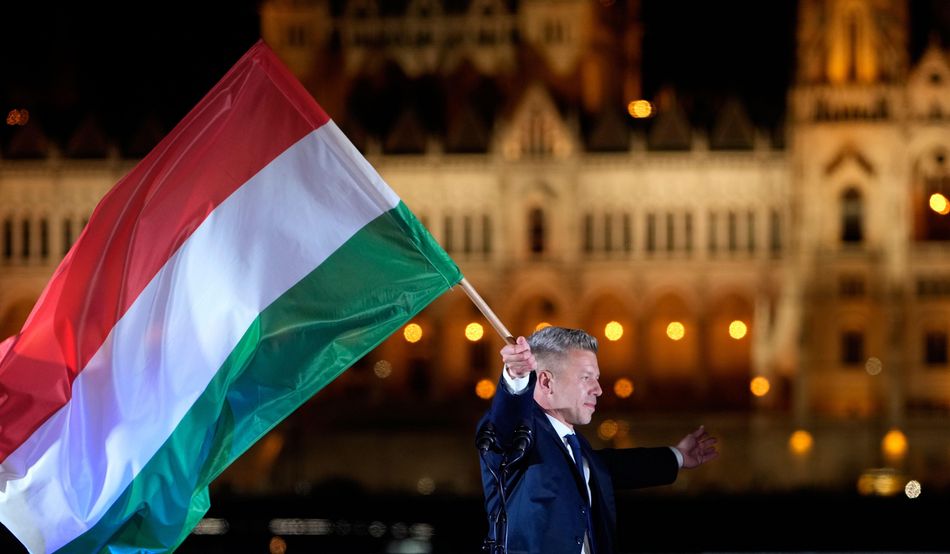
People all too often jump from dismissing democratic collapse as impossible to accepting it as inevitable. In reality, the far right loses all the time. Coups were prevented in South Korea and Brazil and their planners (as resistance liberals would recommend) faced swift justice. In April, Hungary’s Viktor Orbán, an ally to, and model for, the Trump movement, was forced to concede defeat after 16 years in power.
As that example shows, this is a fight that can be won. To do so, however, the centre left will have to adapt itself rapidly as the old orders fail worldwide. A decade into this new era, a clear-eyed view of what has been learned so far is required.
If the story of American liberalism offers grounds for hope for Americans, it also should provoke real fear for the British. I’m a US/UK dual national; I lived in the States for some years, and have returned to find the UK threatened by the same forces. We need to start laying the foundations to fight back now, and are so far behind. The British press is terrified of using the label “far right”, much less the F-word. Our far-right and even centre-right parties have overtly thrown their lot in with the new international fascism. The UK’s main centre-left party has attempted to appease this corrosive political ideology, and the left is hopelessly divided as a result. The UK is not ready to face what is coming. And we are running out of time.