Towards the end of last year I drove around part of the occupied Palestinian territories, an area which inspires such vehemently-held views, but which few have ever deigned to actually visit.
Even most Israelis have little idea of what’s been happening on the West Bank in recent years, since the local media mostly turn a blind eye. International journalists are routinely attacked while Israeli soldiers or police officers stand idly by.
My own guide to this bandit country was Gideon Levy, the 72-year-old Haaretz columnist who, for 40 years, has made it his weekly duty to travel to the West Bank to inform his faithful band of readers what is going on. His column is called the Twilight Zone.
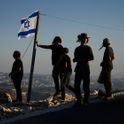
We drove for an hour or so out of Tel Aviv, across the Green Line which marks the de facto boundary between Israel and the occupied territories. As we headed towards the Palestinian city of Nablus Levy pointed out the numerous blue and white Israeli flags illegally planted throughout the landscape. “You see them all over the place,” he said, waving towards one a few metres from the road. “The settlers realised that the war in Gaza is their opportunity, so they settled dozens and dozens and dozens of new, illegal outposts. You will see them on every hill.”
Levy described how a new outpost is established. “They begin with one or two tents. They bring a few cows or sheep, and then they confiscate the whole land around them.” The settlers “just take over, and nobody is there to stop them, and the army is even collaborating with them.”
He used the word “pogroms” to describe the extent and violence of settler attacks in the area. “There’s not one day that they [the settlers] don’t burn a car, burn fields, burn olive trees, burn houses, and from time to time, they also kill shepherds and others. We did so many stories recently about people who were beaten. Whenever we hear a story about pogroms, you hear that there were soldiers there who protected the settlers. In a few cases, they even participated in the pogroms. The West Bank is now a lawless place, unbelievable, and no Israeli knows anything about what’s going on here.”
I asked him if he’d had much engagement with the settlers roaming this area. “I try to avoid it as much as I can,” he replied. “They are all armed and extremely violent—and some of them are disturbed people. I’m very afraid of them.”
You think Levy was using extreme language when he talks of “pogroms”? Then please read a June 2026 letter from more than 200 former members of the Israeli establishment—among them the former prime ministers Ehud Barak and Ehud Olmert; ex-heads of the intelligence services Mossad and Shin Bet; former Israel Defense Forces chiefs; judges; generals and academics—which issued what they called a “final warning” over settler violence in the West Bank.
They accused Benjamin Netanyahu’s government of failing to confront “Jewish terrorism” and said the violence was serving an ideology of “ethnic cleansing” designed to drive Palestinians from their communities and make eventual annexation possible. Olmert subsequently described what was happening as an “organised, systematic, state-funded campaign of ethnic cleansing and crimes against humanity”. These are not the words of outsiders. They are the words of people who once ran the Israeli state.
They were joined on Friday in a letter to the Times by two former Israeli ambassadors, a former attorney general and a former Knesset speaker. They welcomed the UK sanctions against the occupied West Bank, arguing: “distinguishing between Israel and the settlements built in violation of international law is not an act of hostility towards Israel. It is a defence of the two-state solution, and of the security of Israelis and Palestinians alike.”
And yet when UK foreign secretary Ed Miliband used remarkably similar language this week in (along with 11 other countries) imposing a trade and financial cordon around these Badlands, you’d be surprised by how many people reached for the smelling salts. He was (take your pick) anti-Jewish, hostile to Israel, pandering to north London Gaza-obsessed Muslims and performatively stirring up antisemitism in the UK.
The 12 countries taking this action are alarmed not only by the outlaw settlers but by the expedited E1 settlement project, east of Jerusalem, which will drive a wedge through the West Bank. The project is designed to “bury the idea of a Palestinian state”, the far-right Israeli minister Bezalel Smotrich has said.
Now, most of those denouncing Miliband this week would, if asked, trot out a conventional response about “supporting the two-state solution, but…”
The Times of London is, as far as anyone knows, still in favour of such a two-state solution. So is Tom Tugendhat, the Tories’ shadow foreign spokesman. Kemi Badenoch presumably shares the same position. The Chief Rabbi, swift to put the boot into Miliband, (“a dark day for British Jews”), talks about his belief in Palestinian self-determination.
But how is any of this possible when the present extreme Israeli government is actively—and at speed—trying to kill it? At what point does support for a two-state solution become merely declaratory if one opposes virtually every available measure intended to prevent the territorial conditions for it disappearing?
Among those respectfully interviewed about this week’s sanctions was Mike Huckabee, the US ambassador to Israel. He called the move “irrational” and “discrimination against the Jewish people”. He wrote; “The Brits have lost it. The Jew hate of their government knows no boundaries and knows no facts.”
But I didn’t read or hear any interviewer giving any context on Huckabee, a self-identified staunch Christian Zionist, who personally supports Israel annexing the West Bank. During his 2008 presidential campaign, Huckabee said: “There is no such thing as a Palestinian.” In a 2017 visit to the occupied West Bank, he rejected the concept of Israeli occupation entirely.
“I think Israel has title deed to Judea and Samaria,” the former Arkansas governor has said. “There are certain words I refuse to use. There is no such thing as a West Bank. It’s Judea and Samaria. There’s no such thing as a settlement. They’re communities, they’re neighbourhoods, they’re cities. There’s no such thing as an occupation.”
A relevant piece of context, no? This is not any ordinary ambassador.
So here are five questions I think journalists should ask of those who voice their opposition to sanctions on goods and services from the occupied territories and yet pay lip service to conventional solutions:
- Have you ever spoken out against the current violence in, and plans for further rapid expansion of settlements on, the West Bank? If not, why not?
- Do you believe there should ultimately be a sovereign Palestinian state?
- If yes, where roughly will its territory be, if settlement expansion continues at its present rate?
- If a viable Palestinian state becomes impossible, should Palestinians living under permanent Israeli sovereignty receive Israeli citizenship and an equal vote?
- If not, what political rights do you envisage them having permanently?
Question four is the tricky one.
If the answer is yes, the speaker has effectively arrived at the one-state solution, whether or not they call it that. If the answer is no, then the issue is no longer primarily territorial partition. It becomes a question of permanent political inequality. Or, as one might call it, a form of apartheid.
If the answer is “They will have autonomy”, the obvious follow-up is: “Who controls their borders, airspace, security, immigration, foreign relations, natural resources and ultimate legislative authority?”
If the answer to those questions is Israel, “autonomy” doesn’t really solve the sovereignty question.
Did you hear any journalist asking such questions of Miliband’s critics this week? I didn’t. I recommend a day driving around the West Bank with Gideon Levy. He’s been doing it for 40 years. Politicians and pundits, please meet the uncomfortable facts on the ground.