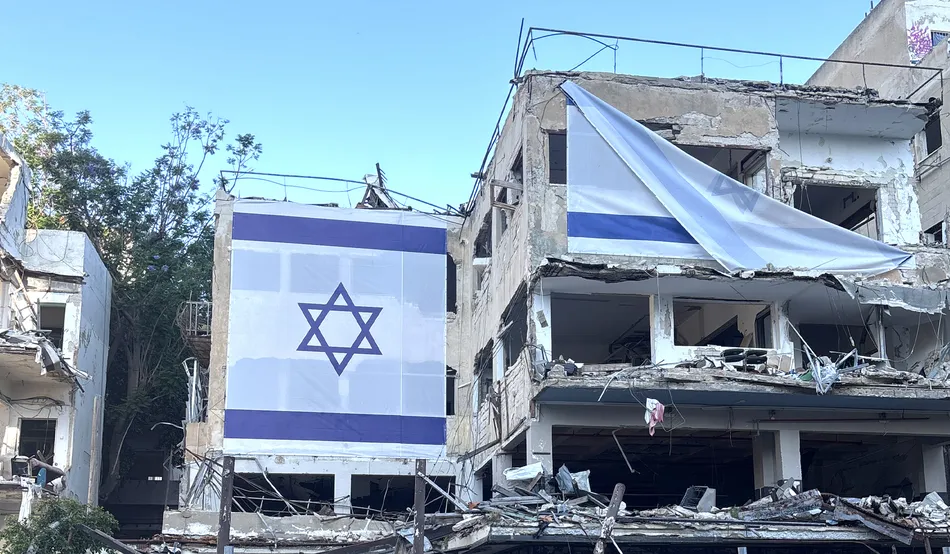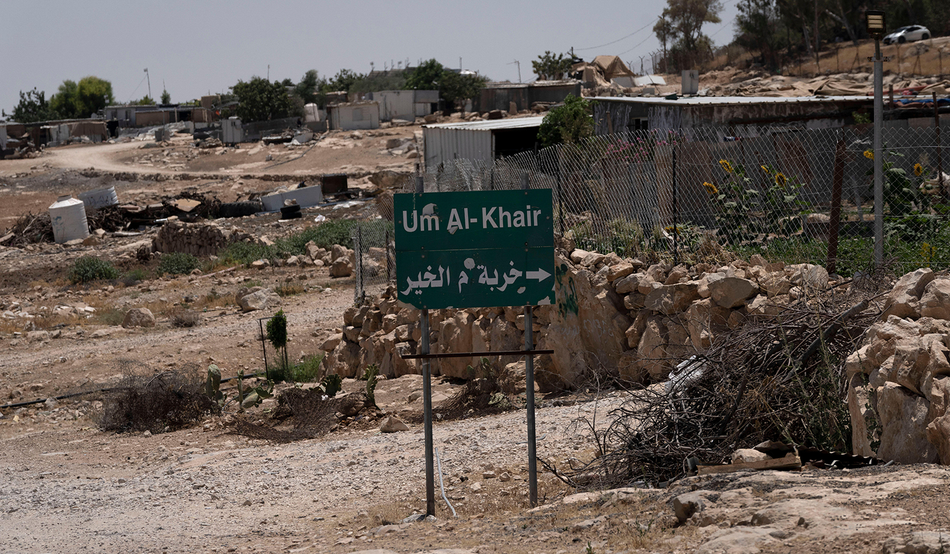
The large pile of rubble looked like it might have been the result of a small bomb. In fact, it was left by an Israeli army bulldozer which had laid waste, with some precision, to the bedroom of Ammar and Jawaher Hathaleen’s two young daughters the morning before I arrived to spend a few days in Umm al-Khair.
The bulldozer, which also destroyed the roof of the family’s now gutted kitchen, shouldn’t have come as a surprise. Almost all the homes in this West Bank village of some 300 Bedouin Palestinians in the rocky south Hebron hills—along with the makeshift community centre, children’s playground and the synthetic turf of a small football field—are under military demolition orders. At least 14 have been executed in the past year-and-a-half.
Yet the family was anything but ready for it. Jawaher’s daughters had been sleeping when the army arrived. Neatly piling up the linen she had salvaged from the wreckage, and doggedly sweeping up the debris inside the house, Jawaher patiently explains what to her family is blatantly obvious. Namely that the partial destruction of her home was inextricably tied to the military’s support for the settlers’ relentless encroachment on the community’s land and property. This harassment has already eliminated Umm al-Khair’s economic lifeline, swallowing up the grazing lands on which the villagers had herded sheep and goats for generations.
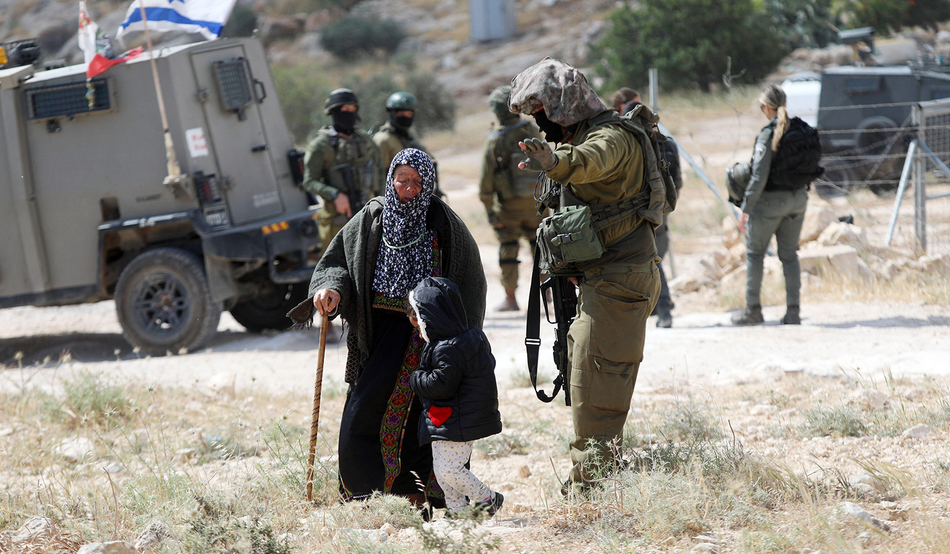
“The settlers come, and then the army comes after them, just to enforce. But really the settlers are giving the orders, and the army are just obeying them,” says Jawaher’s mother-in-law, Fatima. Jawaher gestured towards a dozen caravans, more like prefabricated “caravillas”, erected on concrete foundations and gradually occupied as an illegal settlement outpost on village land since the end of last August. “As you see, they're just trying to expand,” Jawaher adds. “They want to make the life here too hard. And in the end they just want us to leave, so that they can make [all] this area a settlement.”
It’s hard to quarrel with that. For Umm al-Khair is on the frontline of Israel’s increasingly successful de facto annexation of the West Bank. Looking at the detritus outside Ammar and Jawaher’s home, not to mention the dozens of Israeli flags fluttering along the road to the village and around its perimeter, you have to pinch yourself to remember that this is the Palestine recognised by 157 governments, including the UK, which say it should become an independent state.
The Netanyahu government continues to change the face of the West Bank
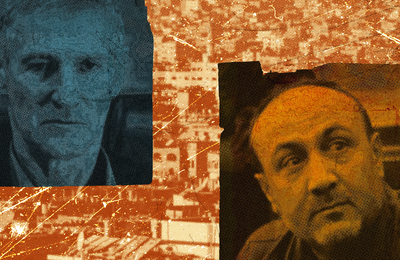
In June, a devastating leaked letter from an array of Israel’s former leading establishment and security figures, including ex-prime ministers Ehud Barak and Ehud Olmert, accused Benjamin Netanyahu’s government of pursuing “an ideology of ethnic cleansing” and allowing settlers to commit acts of “Jewish terrorism” against West Bank Palestinians, often with the assent or even cooperation of the Israeli military.
Inside Israel, their warning appears to have fallen on deaf ears. The Netanyahu government continues to change the face of the West Bank. Not only has it been unable or unwilling to condemn the almost daily attacks involving settlers (23 Palestinians have already been killed this year during settler attacks, according to the UN), it has also promoted and financed an unprecedented growth of settlements across the West Bank—34 in the past six months alone. Since the start of the Gaza war, Palestinians have been displaced on a scale unknown in 59 years of occupation. And now settlers are creating new facts on the ground by extending their territory ahead of the Israeli election scheduled for 27th October.
Since January 2023, when the present Israeli government took office, 47 Palestinian villages have been wholly depopulated, per UN figures. This year alone 3,800 Palestinians were displaced due to settler violence, demolitions and evictions. At a time when some foreign governments, including the UK, have promised fresh sanctions over Israel’s settlement policy, the minutiae of the attrition inflicted on daily life in places like Umm al-Khair makes clear why its residents believe such international intervention cannot come soon enough.
The Hathaleen clan (to which almost all Umm al-Khair’s residents belong) were refugees during the 1948 war in which the Israeli state was founded and some 700,000 Palestinians were dispossessed. They moved from the desert city of Arad in what is now Israel and, in 1952, bought the land where they later established the village from its owners, who had proof of paying taxes on it back to Ottoman times. They grazed their livestock largely unmolested, even when Israel seized control of the West Bank from Jordan in the 1967 Six-Day War. Then in 1981, Israel’s government established a military outpost close to Umm al-Khair, which grew into the large—and in international law, illegal—settlement of Carmel.
Carmel, which is religious Zionist like many other West Bank settlements, towers over, and winds round three sides, of Umm al-Khair. Its red-roofed suburban houses, gardens and basketball courts afford an aura of permanence that the ramshackle concrete, cinderblock and corrugated iron dwellings of the Palestinian village cannot match. The unusual physical proximity of the two communities makes them a visible microcosm of settlement expansion across the West Bank. The new caravan outpost abutting Umm al-Khair has now completed the encirclement of the Palestinian village’s most populous section, casting doubt on its future in just the way that Jahawer Hathaleen describes.
The settlers have laid a track through land previously recognised by the Israeli authorities as Palestinian and privately owned, creating a shortcut between Carmel and the caravans. On a Friday evening I watched with Palestinian residents as small family groups of settlers, several of the men armed with M16 rifles, slowly walked, just metres from us, along the track to hold a Shabbat service, followed by the traditional dinner and singing, in the caravan nearest to a Palestinian house.
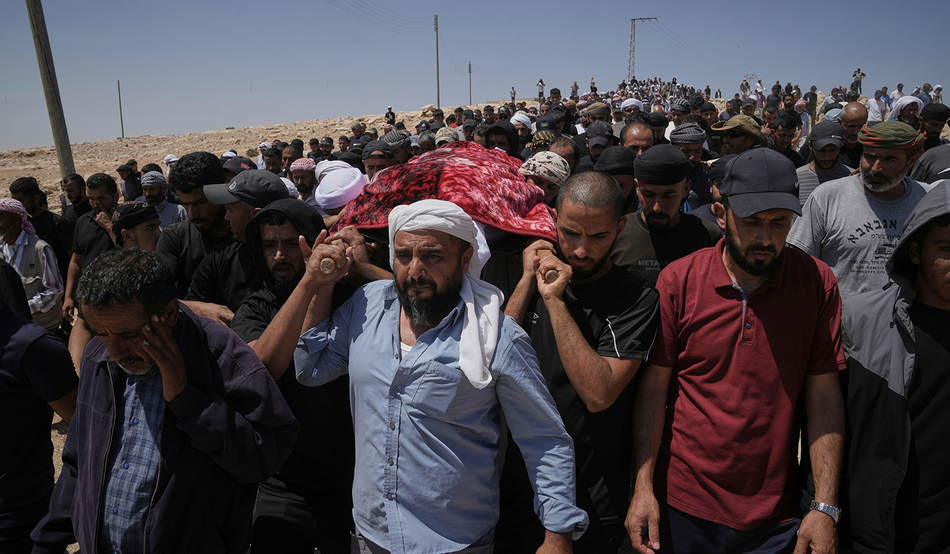
Since they might easily have worshipped in Carmel’s own synagogue, it was hard to see this as anything other than an assertion of “sovereignty”. But the worshippers’ route was significant in another way. Last July, while residents had been trying to stop a bulldozer from starting to clear the ground for this path, an ultra-militant settler, Yinon Levi, shot dead Awdah Hathaleen, a 31-year-old teacher from Umm al-Khair who was also a community leader, staunchly non-violent activist, and father of three children. In August this year, in an extremely rare development, Israel’s state attorney announced that the shooter had been indicted for reckless manslaughter, which carries a maximum sentence of 12 years.
On the day of Awdah’s death, an excavator operated by the Levi family’s construction company, Eyal Hari Yehuda (also sanctioned by the UK government), that had been levelling ground for the new caravan outpost, started to plough through privately owned Palestinian land planted with olive trees—on Yinon Levi’s orders, according to the indictment—to open up the new path.
As Awdah (who worked on No Other Land, the Oscar-winning documentary set in Masafer Yatta, the southern West Bank area where Umm al-Khair is located and where some 4,000 Palestinians live in all) watched from the community centre, his cousin Ahmed stood in front of the bulldozer calling on the driver to stop. Instead, the driver knocked Ahmed down and out of the way, penetrating his arm with the excavator’s mechanised hammer. At this point at least one stone, and probably more, were thrown by one or two Palestinians, though not by Awdah, who was filming the scene while carrying his toddler son Mohammed in his arms, and not at Levi.
Levi pointed his handgun in Awdah’s direction and killed him with the first of two bullets fired at a distance of around 35 metres—an action filmed by Awdah himself. Indeed, the clarity of the widely publicised evidence may be what persuaded prosecutors to act. Levi is the first settler to be indicted for killing a Palestinian since 2019.
Khalil, Awdah’s 39-year-old brother and also a community leader, welcomed the indictment but says that the family would have preferred a charge of murder. “We hope we will achieve justice for Awdah. That’s our sole demand.” Certainly, the indictment alone won’t expunge the memories. Hanady, Awdah’s 25-year-old widow, now left with three boys under six, was watching the events from her house that afternoon. “Even today I don't believe that he’s gone,” she tells me. “I could not believe that someone as full of life and peace and love can just go.”
When the army and police arrived, video footage shows Levi pointing at various Palestinians who he wanted arrested. Five villagers were detained that day, and another 13 on successive days. They were gradually released over the next 10 days, all on bail. Levi, by contrast, was arrested, held overnight, appeared in court, transferred to house arrest and freed after three days. Just over a week later he was back in Umm al-Khair supervising earthworks for the caravans.
A year after Awdah’s death, Hanady says she has “no choice” but to continue the legacy of non-violent activism bequeathed by her husband. She feels a duty to speak out about the conditions that residents say have been imposed on them by settlers and their military protectors. “We don't feel safe. Our kids don't feel safe. They don't want life for Palestinians here. After my husband was killed here, I will never leave... There is blood here.”
Even before he shot Awdah, Yinon Levi’s notoriety had extended beyond the southern West Bank. Levi had been sanctioned as a violent extremist by the UK government, the European Union and the United States (until Donald Trump reversed a sanctions order imposed by the Biden administration). In the weeks after Hamas’s massacre of 1,200 Israelis on 7th October 2023, Levi played a prominent role in driving out the inhabitants of Zanuta, another Masafer Yatta village. He had done so from his base in Meitarim, one of a rapidly multiplying and remote chain of West Bank outposts that have taken over Palestinian land, posing an economic threat to communities like Umm al-Khair that is at least as serious as the physical one.
In parts of the West Bank, that process—openly described by Bezalel Smotrich, the Israeli finance minister and an extreme settler who is now in charge of civilian affairs in the West Bank, as "mega-strategic”—is still underway. Often settlers use their own sheep to supplant the Palestinians’ flocks and deploy cows and even camels to destroy crops and olive trees. But in Umm al-Khair it already seems complete, thanks in part to much of the territory of the village being designated as “state land”. That is the primary and militarily enforceable first step in making it available for settlement.
Amid this harassment, none of Umm al-Khair’s residents graze their flocks in the surrounding fields any longer. Instead, the village’s vastly reduced population of sheep and goats are confined to pens where they depend on expensive store-bought feed. One resident, Mahmoud, explained that whereas in the 1970s his father had some 500 goats and sheep who grazed freely between February and October, he now has around 20; the $8,000 or more he has to spend on feeding them from October to April are more than he can earn from the lambs and milk he sells. “The situation here goes worse every day and we fear every day. The time of leaving is coming, because the settlers and IDF put more pressure on us to remove us.”
Mahmoud was speaking not simply about the loss of land, but the threat posed to the villagers’ homes, a matter powerfully illustrated by the surreal saga afflicting the 17-strong family home of his neighbour, Salem, a 52-year-old grandfather.
The boundaries of Salem’s home are just 20 metres from one of the caravans. At around 7.30pm one July evening, one of his two wives, Ikhlas, was in the outhouse lavatory when a settler banged on the door and demanded she leave. The Israeli army subsequently declared the lavatory to be part of a “Closed Military Zone”. Now, a wooden children’s swing and an Israeli flag have been planted between the house and the family’s only lavatory, signifying that the latter is out of bounds.
Sitting sewing outside the house, Ikhlas speaks delicately of the humiliation over the outhouse and the fact that the family now needs to go next door, even in the middle of the night, to use the lavatory. The changes have been worst for her children, aged three to 25, she says. “This is a simple house but it used to be the best life in the world. Then when the army came, the settlers came, the caravans came, we exchanged the best life for the worst.”
Salem’s property has since become a key battleground in the settlers’ efforts to extend territorial control
When we met, Salem’s once 150-strong flock was down to 10, including three goats which provide milk for the children when he is allowed to reach them in their pens (these have also been subject to periodic military closures). The family’s poverty has been compounded because, having also long worked in Israel, he and many other men in Umm al-Khair are now unable to do so. After 7th October, Netanyahu cancelled the entry permits of around 115,000 Palestinians who used to cross daily from the West Bank to work. By the end of 2025 the UN was reporting that 14 Palestinians trying to cross illegally had been shot dead by security forces. “I am very sad,” Salem tells me in late July. “The future is dark.”
As if to prove his point, Salem’s property has since become a key battleground in the settlers’ escalating efforts to extend territorial control. An incident I observed in real time last Saturday was bloodless compared with many of the daily acts of settler violence elsewhere in the West Bank. Still, it clearly illustrated what one woman from Carmel told France 24 last October was its residents’ approach to Umm al-Khair: “The [outpost] caravans are meant to remind them that we are here, watching everything that happens in the village. It will push them away from the settlement and little by little we will reclaim the land.”
Saturday’s foray started mundanely enough: a group of settler children and teenagers forced their way into the village football pitch where their Palestinian counterparts were playing. They grabbed the ball and ran around with it for 20 minutes or so, watched impassively by adults from the settlement. Eventually a burly adult settler, in shorts and armed with an assault rifle, called off the teenage ringleader, only then to follow the growing band of Israeli settlers—youth and adults—towards Salem’s house in what looked distinctly like a pre-planned sortie. The teenage posse moved on to Salem’s land and proceeded to tear at the fence separating his home from the main road through the village, while the Palestinians tried to protect it.
Of course, the settlers have their own version of history. According to Regavim, the advocacy group co-founded by Smotrich, Umm al-Khair’s residents are “squatting” on Carmel’s land. “It’s not a village. It’s an illegal outpost,” Naomi Kahn of Regavim tells me. She added that the West Bank cannot be considered occupied because it has not been the “sovereign territory” of any other state—including Jordan, which occupied it after the 1948 war—since the Ottoman Empire.
There are several problems with this argument, however, not least the July 2024 International Court of Justice (ICJ) ruling that the settlements are illegal and that member states have a duty not to assist the occupation. At the time, Netanyahu responded by stating that “the Jewish people are not occupiers in their own land—not in our eternal capital Jerusalem, nor in our ancestral heritage of Judea and Samaria [ West Bank].” His declaration went against the long-held stance of most democratic governments—including the UK’s—that the occupied territories are not Israel’s own land. But it also omitted the contradictions in how Israel’s applies its domestic law when it comes to settlement expansion.
The professed reason that villages like Umm al-Khair have incurred military demolition orders is that they were built without permits from the Israeli state. Yet 98 per cent of Palestinian permit applications in Area C—the Oslo Accords-designated area covering 60 per cent of the West Bank (including Umm al-Khair) where Israel has full security and civilian control and where the settlements have historically been located—are turned down by contrast.
As expeditious as it is for Israelis, however, the permit system cannot match the pace of settlement expansion. The settler caravans at Umm al-Khair were built without permits; indeed the Jerusalem District Court ruled last October that the caravan construction there should stop and the existing caravans must lie empty. Though legally impeccable, the district court judgment proved as flimsy as it was rare in the current Israeli political climate. On the very night it was handed down, the settlers accelerated construction and moved families into the existing caravans. Faced with a subsequent demand for enforcement, the same court revoked the original order.
The difference between the standard of living enjoyed by the settlers and that in the Palestinian villages is stark. While Carmel has 24/7 electricity, with power lines crossing over Umm al-Khair to supply the settlement’s profitable industrial-scale chicken coops, the village relies on solar panels—good in summer, not so much in winter. Similarly, Umm al-Khair’s people and livestock depend entirely on seven hours of access to the water grid each week to supply its communal drums, Khalil Hathaleen tells me. The nearest medical clinics are in Hebron or the deeply impoverished town of Yatta. Respectively only 10 and six miles away as the crow flies, reaching both requires much longer and more circuitous journeys because of checkpoints and road closures—and depends on the gate to the village controlled by the military being open. In April, children walking a well-worn path to their school found that the way had been blocked by razor wire, which the military has done nothing to remove. Now children have to be packed into a few cars when there are any available to take them on a circuitous road to school.
A key factor in the survival—so far—of Umm al-Khair and other threatened Masafer Yatta villages has been Israeli and international, more often than not Jewish-American, activists doing what is known as “protective presence”. The activists often stay for extended periods to document and stand in the way of settler incursions, sometimes incurring injuries as they do so.
‘We don’t have lands anymore. Now we are trying to protect our homes’
In the incident I witnessed last Saturday, 22-year-old Finn Joughin, a British London School of Economics student, had joined Khalil Hathaleen and others as they sought to prevent—with practiced restraint—the young settlers from destroying the fence by Salem’s home. Joughin was grabbed by the same armed adult settler who had seemingly exercised authority over the teenagers back at the football pitch and was “kidnapped”, in the words of Israeli human rights lawyer Inbar Shaked Vardi. Several adult settlers dragged him towards the outpost caravans where he was held until the police arrived and arrested him. The settlers accused Joughin of having assaulted one of the children—which video evidence clearly showed to be implausible. While blocking one of the young settlers with his body, Joughin had been holding on to the fence with one hand and trying to film the fracas with his phone in the other. Still, for the settlers the probably illegal detention of Joughin may have had the desired result: instead of being charged the activist was deported two days later.
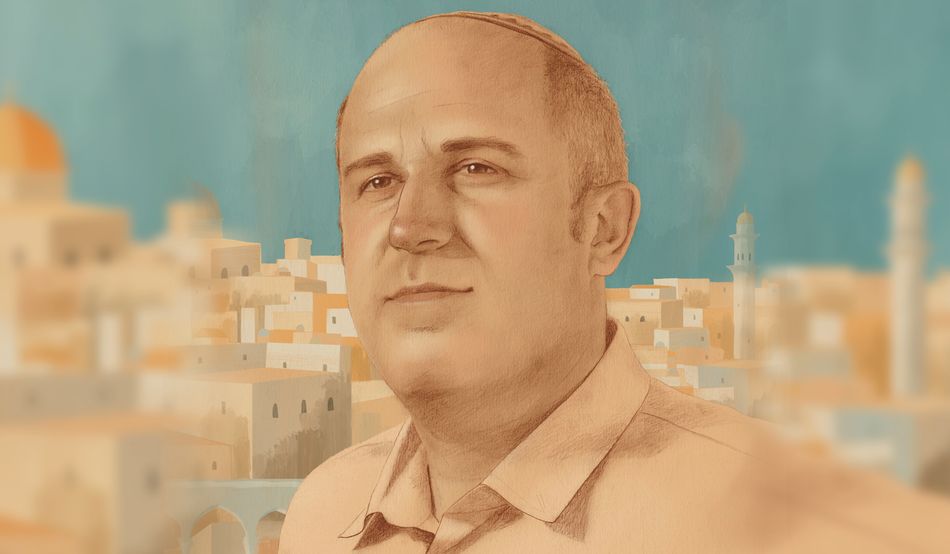
Ta’ayush, an anti-occupation volunteer movement was a “protective presence” pioneer. One of its veteran founders, Amiel Vardi, a senior classics lecturer at Hebrew University, has been serially arrested in the West Bank over the years. In 2002, he was wounded in a shooting by settlers when helping farmers to collect the olive harvest. Increasingly the battle to protect Palestinian land is being lost, he suggests. A Palestinian friend told him: “In the past, we were trying to protect our land. We don’t have lands anymore. Now we are trying to protect our homes.”
Vardi says that, since 7th October, “nobody tries to hide the complete collaboration of the authorities with the settlers’ ideology and programme. And there is a programme …. openly stated by people like Smotrich, of getting rid of the Palestinians from wherever they are even if it is against the law to do it.” With Smotrich now in charge of civilian affairs in the West Bank and the equally extreme national security minister Itamar Ben-Gvir in charge of the police, Vardi argues that “the whole system” is increasingly aligned with annexationist goals, and that “more and more soldiers in all ranks are either settlers or share the settlers’ ideology.”
Indeed, after 7th October about 5,500 settlers were drafted into the ranks of regional defence battalions to serve in the West Bank, replacing soldiers called to other fronts. This creates, according to the pro-two state solution OFEK: The Israeli Center for Public Affairs, “an opportunity for violent settlers to intimidate the same communities they had been attacking as civilians, now with military jurisdiction.”
Smotrich said explicitly in February that he will in the “next term”—in other words, if he remains in office after October’s election—“finally…. cancel the cursed Oslo Accords and get on the path of sovereignty while encouraging [Palestinian] migration both from Gaza and from Judea and Samaria [West Bank]. There is no other long-term solution.”
The process already seems underway. Apart from the settlers’ daily depredations, chronic pressure for just such “migration” is exacerbated by the bar on West Bank Palestinian workers in Israel, the Israeli state’s punitive withholding of taxes owed to the Palestinian Authority (PA), and the dismantling of the West Bank herding economy.
Smotrich’s reference to Oslo was also significant. Under the 33-year-old accords, Israel’s government permitted settlement only in Area C. Area A, by contrast, including the main Palestinian cities, is within the PA’s remit, even though it is still under Israeli military rule. (In Area B, where responsibility is supposedly shared between Israel and the PA, settlers have now established more than 20 outposts.)
Not only were settlements prohibited in Area A (18 per cent of the territory), but Israeli civilians are forbidden by law from entering it. Yet in an unprecedented move last month, the head of IDF Central Command authorised the seizure of Area A land for a road connecting new settlements in the northern West Bank, south of Jenin. A month after the war started in 2023, I was in Nablus for Prospect and was told by a prominent local Fatah activist that he could see Israeli settlers inside the city within five years. I quoted, but did not really believe, him. Now his prediction seems far more plausible.
All of this raises the question of what further steps the international community is prepared to take to back up the two-state solution, which the Netanyahu government adamantly rejects and which the changes on the ground are designed to prevent. Ed Miliband’s robust statement on 1st September that he planned a “comprehensive reset” of policy on the occupied territories appears to mark a distinct hardening of the UK’s approach to the Israeli government’s backing for settlement in the West Bank, as well as the violence which underpins it. An announcement is expected in early September on sanctions curbing trade and economic activity with the settlements.
Whether this will be enough to ease the chronic pressures on Palestinians in Masafer Yatta remains to be seen. “I don’t know how long we will be able to postpone the eviction of the population over here,” says Vardi. “International pressure is the only thing that might make a change”.
The insecurity in Umm al-Khair has been compounded since mid-July by events close by in Masafer Yatta. Several Palestinians were injured in settler attacks in At-Tuwani, where a mosque was set on fire; in Tuba, where homes were torched; and in Mnizel, where more than 200 sheep were stolen in two separate raids. Such incidents—and often far worse—are now repeated every day in one location or another across the West Bank.
And then on 2nd September, Israeli forces suddenly demolished almost all of Khirbet al-Tabban, a hamlet only eight miles way from Umm al-Khair, displacing its 70 residents, including children. Khirbet al-Tabban was in so-called Firing Zone 918, part of Masafer Yatta ostensibly marked for IDF training, and was one of eight villages ratified for planned expulsion in a 2022 decision by Israel’s Supreme Court. Yet the military has done nothing to remove 10 Israeli settlement outposts established within the same zone. And while Umm al-Khair borders the zone rather being located inside it, the demolition of its neighbouring village was another stark reminder that demolition orders can be enforced as well as issued.
Another Israeli activist Itai Feitelson, 31, acknowledges that Israelis can document attacks and connect Palestinians with lawyers and bureaucrats or sometimes get a hearing from the police. “In the end [the Palestinians] protect themselves more and sometimes they protect us. The fact that these communities still exist is because they are incredibly strong,” he says, adding that “there is only so much even a very strong a community can do” without “a big change”. He does not see that coming from inside Israel, even with a new government after October’s election.
In Umm al-Khair, the residents believe the settlers have been emboldened by what they see as an ominous Israeli government decision in August to reclassify most of the section of the village previously recognised as privately owned by Palestinians as “survey” land—a kind of halfway stage to classifying it as state land and allocating it to settlers. They also believe that if Umm al-Khair, with considerable outside support and focus, especially since the death of Awdah Hathaleeen, falls to the settlers, so too will most of Masafer Yatta.
Back at her son’s partly demolished home in Umm al-Khair, Fatima Hathaleen suggests that neither a weak PA—whose writ anyway does not run in Area C—nor the foreign activists could save them.
“We have only God,” she says, before gently amending her daughter-in-law’s explanation that the Carmel settlers were trying to turn the immediate area into an entire settlement. “They don’t just want us out of here,” she says. “They want us out of Palestine.”