Bit by bit, the mask is slipping for Nigel Farage. Once we saw a cheery bloke who’d put the world to rights over an affable pint in your local saloon bar. Now—to those paying attention—I think we see a thin-skinned, irascible man in trouble.
He’s undoubtedly accepted funds that have been donated by people—at least one of whom is a convicted criminal—for purposes that it suits Farage to cloak in a miasma of ambiguity.
This is a man who spent a decade or more hymning the centrality of UK parliamentary sovereignty. Hence Brexit. And who, after his eighth attempt to win a seat in those hallowed halls, has demonstrated that he actually holds the place in contempt.
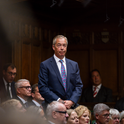
Since arriving in Westminster in July 2024, Farage has given every appearance of finding the Mother of Parliaments rather dull and irritating. Compared with other MPs, he shows strikingly little interest in attending, voting or speaking in its gothic halls.
What he is very interested in is making money. In addition to his parliamentary salary of around £98,000 he has trousered the best part of £2m in fees, according to his parliamentary register—which, of course, does not include the undeclared £5m he pocketed from a crypto billionaire shortly before announcing he would, after all, stand for parliament again.
Add in registered corporate gifts, funded travel and personal donations and Farage has been earning around £95k a month since being elected to represent Clacton. During June 2026 alone, he registered a quite extraordinary £270,000 payment for up to four hours of work per month promoting gold bullion—an hourly rate of around £22,500. He also recorded £18,492 for six hours presenting on GB News, otherwise known as Reform TV.
Compare these sums with the earnings of the people he represents in Clacton. According to the Office for National Statistics (ONS) and local economic data, a typical median earner in Essex’s Tendring District, which includes Clacton, earns around £2,485 gross per month. Add in Farage’s parliamentary salary, and it would take the average Clacton resident three years to earn what their MP is earning in a month. Or nearly a year to earn what he can pocket in an hour promoting gold bullion.
The parliament he told us he so reveres has its own procedures, and one of them involves scrutinising the outside earnings of MPs, both before (where relevant) and during their period in office. But the moment the sovereign parliament of the UK decided to investigate Farage, he cried foul. This was an establishment stitch-up. It was a kangaroo court. It was the elites against the people. It would be for the people of Clacton, not the corrupted establishment, to decide his fate.
The unlovable deputy leader of Reform, Richard Tice, contributed to this narrative in a rather Trumpian way, denouncing “sick” Times Group newspapers for perpetrating fake news (“Shame on you!”). Tice doesn’t have a well-developed sense of irony, having defended two donations of £250,000 from one Fiona Cottrell on the grounds that she hails from “a very successful aristocratic family”.
Anti-establishment takes some funny forms.
Now, of course, Fiona Cottrell is the mother of the man known as Posh George, the subject of a gripping five-part podcast by those sickos at the Times and Sunday Times.
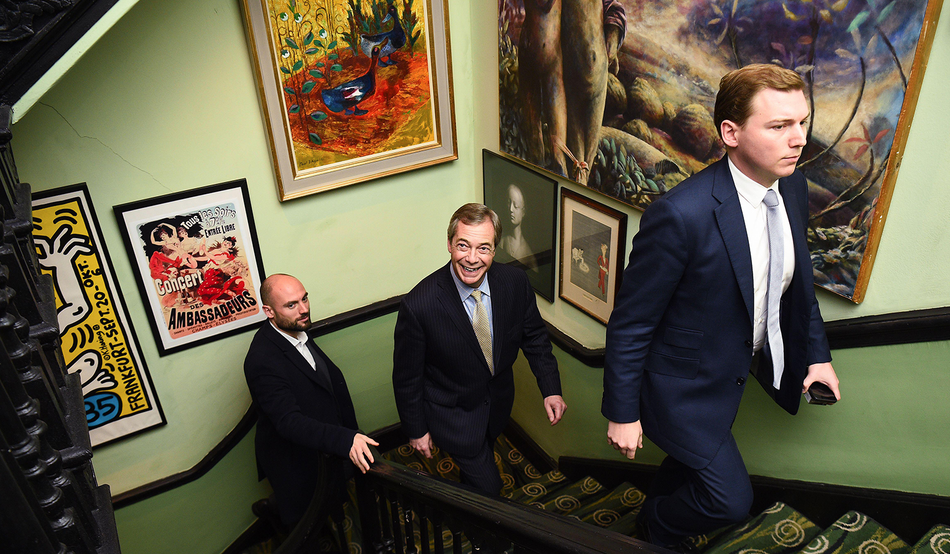
Posh George is the figure who, for ten years, has been joined at the hip to Farage, whom he says he sometimes refers to as “Daddy”. These days he dresses sharply in expensive suits—a contrast to the orange prison garb he wore before serving eight months in a US jail for wire fraud, ending in 2017.
After prison, Posh George took himself off to Montenegro, where he seems to have earned a small fortune—more than enough to support his “Daddy” when needed.
He has also co-written and published a book called How to Launder Money. Even the late Ronnie Biggs never had the imagination to pen a book entitled “How to Rob Trains”.
While written with a view to preventing crime, the book is, if you’ll forgive me, a treasure trove of information for anyone wanting to launder money through, for example, cryptocurrencies or gold bullion—right down to how best to use burner phones so you don’t get caught.
It’s an eye-popping insight into a world Posh George obviously knows only too well. So when he and his co-author tell us that “some 99.9 per cent of all cryptocurrencies are an outright scam”, we might well want to believe them. Chapter five is titled “Gold is the Gold Standard in Money Laundering”.
These are, as Sherlock Holmes would say, deep waters.
Among Farage’s biggest donors is one Ben Delo, a Hong Kong-based cryptocurrency billionaire who recently gave Reform UK £4m. You may remember he was pardoned by noted crypto enthusiast Donald Trump after being convicted of failing to implement adequate anti-money-laundering checks on his crypto derivatives platform, BitMEX. Delo has said that the US conviction was a “blip” and a “non-crime”.
And then there’s the £5m secretly donated to Farage by another crypto billionaire, Thailand-based Christopher Harborne.
He says he wants nothing in return for his donations of around £30m to Farage-led entities and Farage personally. As former Spectator editor Fraser Nelson has written: “it just so happens that Farage proposes a new ‘Big Bang”’’ that could add tens of billions to crypto companies’ market value.”
In the last two days it has been reported—and not denied—that Farage told senior Reform figures he would need “a million a year” to cover lost earnings if he stood for parliament in 2024. That was partly because he anticipated having to give up his lucrative GB News presenting role. Only in his wildest dreams could he have imagined that the sleepy folk at Ofcom would be perfectly happy for him to carry on.
So the mask has slipped, and we see how thin-skinned he is. In the US, crypto has been kind to Trump, earning him $1.4bn last year. We comfort ourselves that the Brits, with our deeply embedded democratic habits and instinctive suspicion of anyone claiming to embody the people, are different. Let’s hope.