When Irfan first saw the letter stripping his daughter Aisha* of her British citizenship, he thought it must be a mistake. “I said, no, once they find out she is British-born, they will realise it doesn’t make sense,” he says. “I didn’t think this is anything serious.” But it soon became horrifyingly clear: his daughter, who had travelled to Syria during the short-lived Islamic State (IS) caliphate, had effectively been made stateless.
Signed by the home secretary but only a few paragraphs long, the letter was short on detail. It said, “I intend to have an order made to deprive you of your British citizenship” because “it would be conducive to the public good to do so”. It added Aisha “would present a risk to the national security of the United Kingdom” if she returned, without specifying why, and that, because she was eligible for another nationality, this decision would not leave her stateless. Aisha had never visited Irfan’s country of origin, let alone applied for a passport there.
The letter was sent to Aisha’s last-known UK address where, for obvious reasons, she had not received it, and no further attempt had been made to contact her or her next of kin. This is entirely legal. Under British law, the government is not always obliged to inform someone that their citizenship has been stripped. It was discovered by a lawyer hired by Irfan and his wife to bring Aisha and her children home. It concluded by saying that, once she had been given notice, Aisha had 28 days to appeal.
At this point, Aisha was in a detention camp in northeastern Syria with her children, following the fall of the last IS stronghold in 2019. It was extremely difficult for her family to contact her and she had no access to a lawyer. Irfan likens it to going into battle with one arm tied behind your back. The whole experience has left him questioning his belief he would always have equal rights in Britain, where he has lived for over 50 years.
“I had great pride in my British passport, and that my children are all born here,” he says. “But they can just take your citizenship away without giving any reason? As far as the government is concerned, they’ve washed their hands of us. Would they do that to a white person? No, they did that because we’re Muslims. They treat us like third-class people.”
Aisha is one of well over 100 people to have their citizenship removed after travelling to Syria when IS held territory there, from 2014 to 2019. The group is depicted as evil by the media; those associated with it in any way deserve whatever they get. Perhaps this is why the draconian legislation used to make them stateless is relatively unscrutinised. It also shows why citizenship decisions require a law-based system, not the judgement of a politician who is subject to media pressure.
The dramatic expansion of this power, almost without remark, over the last 25 years has transformed what British citizenship means and who it can be taken from. Today, stripping citizenship requires no criminal conviction. It is done by the executive rather than the courts, at the stroke of a home secretary’s pen. It can be applied to the point of making someone stateless if the minister has “reasonable grounds” to believe the person could acquire another nationality.
“It fundamentally goes to the heart of who is a part of our society and who isn’t,” says Baroness Sayeeda Warsi, a Conservative member of the House of Lords. “It sends out a message that some people in this country are permanent citizens and some are effectively on probation. The difference between those two citizens is nothing to do with conduct, it’s to do with ethnicity, race and heritage.” As explicitly nativist parties gain popularity and extremist ideas such as “remigration” enter the mainstream, the question is not just if this power is being misused now, but how it could be used in future.
In her 1951 work The Origins of Totalitarianism, the political theorist and Holocaust survivor Hannah Arendt described citizenship as “the right to have rights”, a fundamental prerequisite for all other human rights and civil liberties. In 1958, the US Supreme Court said that citizenship deprivation was “the total destruction of the individual’s status in organised society. It is a form of punishment more primitive than torture.”
The 2014 Immigration Act allowed citizenship to be removed from people who were not dual nationals, as long as it was believed they could acquire another citizenship
Citizenship revocation fell almost completely into disuse across Europe after the Second World War, due to widespread revulsion at Nazi Germany’s policy of stripping Jews of their citizenship before deporting them to concentration and death camps. For over half a century afterwards, Britain removed citizenship rarely, and only on limited grounds: if it had been obtained fraudulently, or if someone had been disloyal. It could only be taken from naturalised citizens, not anyone born British, and only if that person was a dual national and would not be left stateless as a result.
This changed dramatically in 2002. After September 11, the “war on terror” had begun and anxiety about political Islam and the potential extremist enemy within was dominating politics and the media. The Labour government wanted to strip the citizenship of Abu Hamza, an Egyptian-born fundamentalist preacher, so that he could be deported. Ministers worried they might be unable to prove Hamza was disloyal to the UK as he had not been convicted of an offence. And so they passed legislation replacing the list of behaviours for which citizenship could be stripped with the broader threshold of doing “anything seriously prejudicial to the vital interests of the UK”.
The Nationality, Immigration and Asylum Act 2002 also extended deprivation provisions to those born British, provided they were dual nationals. This was the beginning of a legal ratchet: ever-expanding powers with increasingly vague requirements. After the 2005 London bombings, the threshold for depriving citizenship was lowered again the next year to a broader and less precise question of whether doing so was “conducive to the public good”. In 2014, the Immigration Act allowed citizenship to be removed from people who were not dual nationals, as long as it was believed they could acquire another citizenship. In 2022, the change was made that allowed citizenship to be revoked without those affected being notified. In 2025, after the UK Supreme Court ruled that anyone who successfully appeals against losing citizenship should have it restored immediately, the government passed legislation reversing that judgment. A person can now win in court and remain stateless for years while the government appeals.
“It’s one of the worst sentences Britain can impose,” says Maya Foa, chief executive of the legal charity Reprieve, which provides support to a number of people detained in Syria. “We don’t have the death penalty but we can strip people of citizenship, which essentially deprives you of all your rights. And instead of going through a trial with a judge and jury, where you can defend yourself and put evidence forward, it’s a home secretary writing it down on the basis of a totally vague standard. That’s it. That’s the conviction.”
The government’s position, maintained across successive administrations, is that citizenship stripping is a necessary national security tool used only in the most serious cases. As then home secretary Sajid Javid put it in 2018, “the first duty of the government, and my highest priority as home secretary, is to protect the public.” The current home secretary, Shabana Mahmood, said in 2026 that the power is used “in a very specific way to deal with the most harmful offenders, particularly serious and organised criminals and those who pose a threat to national security”.
Ministers have argued they need this option because prosecution is not always viable: gathering evidence of crimes committed abroad, for instance, can be challenging. The obvious counter-argument is that we have extensive terror laws, and Britain has successfully prosecuted at least 40 people who returned from Syria. “If people are alleged to pose national security concerns, the criminal justice process should kick into gear when they land in the UK,” says Dr Connie N Maina Sozi, a solicitor who has worked on cases of citizenship deprivation on national security grounds. “We have a justice system. People under suspicion can be arrested, questioned, charged.”
Where citizenship is stripped on security grounds, the government can certify it is not in the public interest to reveal why someone is a risk
Precise data is hard to come by, but between 2010 and 2024 the Home Office deprived at least 223 people of citizenship on public good grounds, according to a 2025 House of Commons report. France, by contrast, used deprivation just 16 times between 2002 and 2020. After the 2015 Paris attacks, then president François Hollande failed in his proposal to expand the power to apply to all French citizens.
The great majority of British deprivation orders were served to people who travelled to IS-held territory in Syria; almost half of the public-good orders were made in 2017, coinciding with the territorial collapse of IS, when the threat of foreign IS fighters returning to home countries was at its greatest. Rather than putting these people through the criminal justice system for punishment and potential rehabilitation, the government quietly removed their citizenship.
Families are put in an impossible legal situation in which their loved one faces the gravest consequences despite not being convicted of a crime. Cases are usually heard by the Special Immigration Appeals Commission, a court divided into open and closed proceedings. In open proceedings, the appellant and their lawyers receive a statement of the government’s case that they can respond to.
But where citizenship has been stripped on national security grounds, the government can, and routinely does, certify that it is not in the public interest to reveal why someone has been deemed a risk. Secret intelligence is then presented to judges in closed proceedings from which the appellant is entirely excluded. A special advocate—a security-cleared barrister—represents their interests, but after they have seen the closed material, they cannot communicate with the appellant or the lawyer about any element of the case. “Allegations are being made against you, which you cannot fully respond to, because you don’t know the basis of those allegations,” says Sozi.
For families, the entire process appears set up for appeals to fail. “The letter said [to] appeal within 28 days, them fully knowing she was in a detention centre where she had no communication or help,” says Faye, whose relative Maryam is detained in northeast Syria. “It was hard enough just letting her know. Absolutely nothing is transparent. Even though they say ‘you can appeal’, no one is there to help you. It’s like a neverending tunnel.” The government says Maryam, who came to the UK as a child, is eligible for another citizenship because of her parents’ ethnicity, but in practice she can’t claim it due to the technical requirements of that country’s citizenship law. “The question of nationality is super-complex, and you can have days of hearings where experts speak to it, but in practice the government just has to believe that someone has a right to another nationality to strip them,” says Foa. “If you’re brown or black or have a foreign name, they might think you have that right.”
The result is a law that applies to some British people but not others. Research published by the Runnymede Trust and Reprieve in December 2025 found that nine million people in the UK could be legally stripped of their citizenship, with people of colour 12 times more likely to be at risk than their white counterparts. As the Conservative MP Kit Malthouse pointed out in a parliamentary debate last year, two of his children—with a foreign-born mother—could face citizenship deprivation, while the third—with two British-born parents—could not.
“We currently have plenty of British citizens in high-security prisons who have committed acts as heinous as those committed by people whom we have deprived of British citizenship,” he said during the same debate, “but we have decided to deprive them of British citizenship purely because of their heritage and background—purely because they may be second-generation immigrants.”
He pointed out that every Jewish person in the UK could theoretically be deprived of their citizenship, since they all have the right to Israeli nationality. In practice, however, the majority of people subject to deprivation orders have Muslim backgrounds. “What you’re saying is that if you have other heritage, you can never consider your status in the UK secure,” says Sozi. “Isn’t that a problem? If someone is British, they are British. There cannot be classes and categories.”
“I dread to think about potential future home secretaries from parties who make no secret of the fact that they do not consider certain people part of this country.”
Suddenly realising that your citizenship is contingent can create profound disorientation. Safiya’s sister Amina is in a detention camp in northeast Syria after losing her British citizenship a decade ago. The sisters were born in the UK and are theoretically eligible for a second nationality through their parents. “That is your identity. Your citizenship is who you are. If you don’t have citizenship, you don’t have your identity,” says Safiya. “My sister and her kids don’t belong here [in the UK] now, [and] they don’t belong in Syria. It’s like, what is she? What are they now?” As Safiya has attempted to navigate the opaque appeals process, she has found herself questioning her own position, although she has only ever lived in the UK. “I work, I pay my taxes, but I don’t feel I belong anymore,” she says.
The most prominent case is that of Shamima Begum, who was 15 when she went to Syria after being groomed online. Successive court hearings appealing her loss of citizenship have failed on the basis that the home secretary has the right to decide if she is a security risk. The Supreme Court refused her final appeal in 2024 and the case will go next to the European Court of Human Rights.
“The courts have effectively been unable to question the facts behind the decisions. What they’ve been prepared to consider is whether the home secretary had the power, and whether he exercised that power effectively,” says Warsi. “This relies on having a home secretary who has a sense of right and wrong. If we can have someone like Sajid Javid [himself the son of Pakistani immigrants] making the decision he made, I dread to think about potential future home secretaries from parties who make no secret of the fact that they do not consider certain people part of this country.”
The legislation, in its current form, is incredibly broad. Anything could be deemed not conducive to the public good. “It gives the government latitude politically to condemn and convict without a trial,” says Foa. “That is a repressive tool.” Rupert Lowe, MP for Great Yarmouth and leader of Restore Britain, has called for citizenship to be stripped not just from members of grooming gangs (or “Pakistani rape gangs”, in his parlance) but from their “wives, sisters, mothers and cousins”.
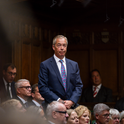
Restore campaigns director Charlie Downes wrote on X that “a policy of remigration must be on the manifesto of every major party by the next election”. Restore is a fringe party, but its ideas are increasingly aired on mainstream TV. Reform UK leader Nigel Farage has abandoned his position that mass deportations are unfeasible, and now proposes to deport any foreign national in social housing who doesn’t find private accommodation within three months. “Is anybody in social housing with a potential alternative citizenship going to have their citizenship stripped? It’s not impossible,” says Warsi.
More than five years after Aisha lost her citizenship, Irfan is still stuck in the appeals process. He is in his 70s and losing hope of seeing his daughter or grandchildren again. After peaking at more than 100 in 2017, the number of deprivation orders “for the public good” dropped to double and single digits per year. But for those held in Syria, losing citizenship is effectively a life sentence.
Germany, Denmark, Sweden and others have repatriated most of their nationals from IS camps, but it is estimated between 50 and 70 British people are still in Syria, including at least 30 children.
Whatever view one takes of the women who travelled to IS-held areas, their children are losing citizenship purely by association
In 2022 Human Rights Watch highlighted that while three dozen countries have repatriated many of their detained nationals, the UK has “brought home only a token few”. British officials have told some families that children can only be repatriated if their mothers stay in Syria, in effect giving up parental rights. Whatever view one takes of these women—and the courts found “credible suspicion” that Shamima Begum, at least, was trafficked—their children are losing citizenship purely by association. Those born after their mother’s citizenship has been revoked may be born stateless.
Neither the Syrian government nor the Kurdish forces guarding the detainees want responsibility for them. Human rights organisations have documented abuses in the camps, describing conditions as “dire”. It is difficult to see how this serves the national security interests of the UK or any other country. The UN has warned the camps “risk becoming incubators of radicalisation”, while the UK’s independent commission on counter-terrorism law said last year that refusing to repatriate citizens could be “counterproductive to long-term security interests”.
“My grandchildren are there,” says Irfan, his voice shaking. “They lost their childhood. We lost our grandchildren’s childhood.” He and his family think of it constantly. When they’re eating, they wonder what the children are eating in the camps, where food is scarce. During the recent heatwave, Irfan thought anxiously of his grandchildren being exposed to the elements in a plastic tent. “It’s a living nightmare,” he says. “It’s a small number of British families there. If they wanted to, the government could sort this out tomorrow. Bring them back, look into it, question them and go from there. But to just leave them? That doesn’t make sense. They’re still human beings.”
*Aisha and Irfan and the names of other families quoted in this piece are pseudonyms. Due to ongoing litigation, we cannot specify country of origin nor other potentially identifying details.