Nigel Farage is right about one thing. The tragic murder of Henry Nowak is a defining moment for this country.
In all other respects, Farage is almost certainly dangerously and maliciously wrong. But he has the extreme good fortune of effectively having his own TV station to amplify his insensitive populist ranting, along with a tribe of nodding journalists who seem to have forgotten the basics of their trade.
So the defining moment is this: whether we allow a talented demagogue to bamboozle us into becoming a different sort of country, one where rage counts for more than evidence. Or whether we can recover a sense of patient decency rooted in a respect for facts.
Let’s start with such facts as are currently available. On 3rd December last year, Nowak, a bright young student at Southampton University, was murdered by a lying, weapons-obsessed 22-year-old, Vickrum Digwa, who happens to be a Sikh.
It’s worth reading the account of what happened, as described in fastidious detail by the judge, William Mousley KC. The attending officers “honestly believed” Digwa’s story that he, not Nowak, was the victim. They had been given a “convincing but wholly false narrative”.
The police made serious errors that night, but Judge Mousley, who obviously heard all the evidence, did not criticise them. “These police officers were faced with having to make quick decisions in pressurised circumstances about the best way to act.” Mousley’s contempt was reserved for Digwa and the lies which compounded his murderous actions.
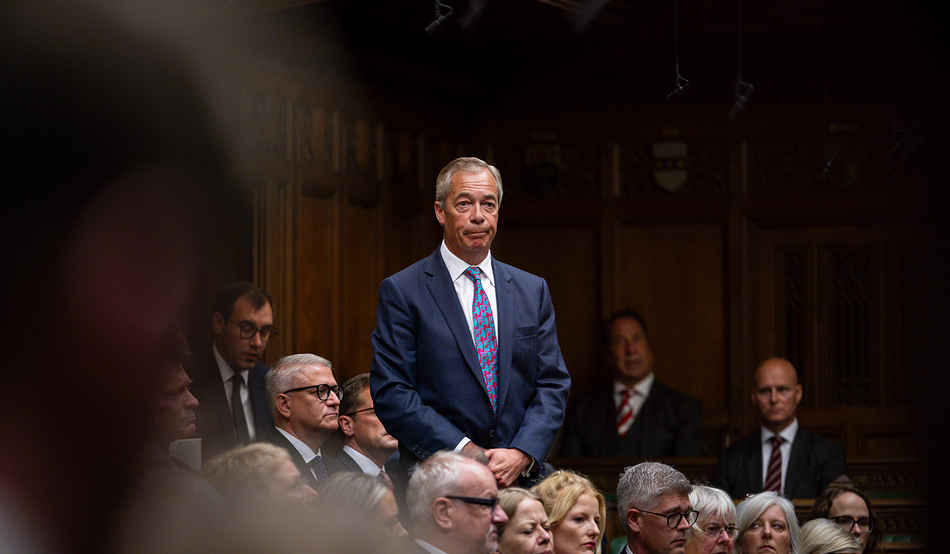
But never mind the judge. Along comes the demagogue—aided and abetted by his cheerleaders in the media—to declare that he has a unique insight into the events of that evening. In an “emergency address”, Farage said that Nowak’s death showed that “the rights and privileges of white people matter less than those of ethnic minorities”, and linked the incident to wider concerns over immigration, integration and diversity policies.
The main lesson from this incident, said the Reform leader—speaking, he said, in “pure cold rage”—was that we had to end “anti-white prejudice and DEI programmes in the police”. His words found echoes with Elon Musk, Tommy Robinson and from Donald Trump’s State Department, which astonishingly announced that the case was a symptom of two-tier policing and—wait for it—“civilisational decline”.
There followed riots on the streets of Southampton.
Who to believe: the judge, Donald Trump or Nigel Farage? Are we dealing with bad decisions taken by police officers in chaotic circumstances, or anti-white prejudice?
There will be an inquest and an independent police investigation by the Independent Office for Police Conduct (IOPC). In time, we should have a clearer picture as to why the attending police officers made such grievous errors that night. Meanwhile, the honest answer—and the correct starting point, journalistically—is to admit we don’t know. Perhaps an answer may lie in the quality of candidates applying for the police today? Maybe young officers are poorly trained for such incidents in ways which have nothing to do with race? Maybe Farage has a point?
We just don’t know.
But you would be surprised—or perhaps you wouldn’t—at how many columnists and editorial writers instinctively and immediately sided with Farage. Journalistic training flew out the window. And, of course, Farage’s own TV channel, which has paid him a cool £750,000 since becoming an MP, fanned the flames.
Britain’s supposed paper of record, the Times, splashed on Thursday with the headline: “Officers from force behind Nowak arrest ‘pressured’ by diversity course.” But a cursory reading of the story indicated that only a small minority of surveyed Hampshire officers who had undergone diversity training—15 per cent—felt this way. So, a more accurate headline would have reflected the finding that very few officers felt “pressured”.
Barely three years ago, the same papers sneering at DEI training in the police were professing themselves aghast at the brutal review of the Met Police by crossbench peer Louise Casey, which uncovered a shockingly toxic culture of bullying, misogyny, homophobia and even criminality within the ranks.
The review, which found no evidence of anti-white, two-tier policing—quite the opposite—concluded: “We have found institutional racism in the Metropolitan Police.” It also found that the vetting system for new recruits “is broken: there is minimal supervision, training and development is not taken seriously, there are no training records and the Met do not know what their workforce needs”.
The Met’s chief, Sir Mark Rowley, responded with an apology, saying he was “appalled” by the findings and promising action.
I could barely find a mention of the Casey review in the coverage of Nowak this week. Goldfish have longer memories.
Casey was reviewing the Met, not Hampshire police. But I will go out on a limb and say that she and Sir Mark Rowley have a deeper understanding of the general crisis in policing standards in the UK than either Farage or the legion of commentators who unquestioningly amplified his quite calculated rabble-rousing rants.
Which brings us to GB News, which has had a field day this week, by and large taking it as a given that there is, indeed, anti-white, two-tier policing in Britain and that this satisfactorily explains the death of Henry Nowak. Presenter after presenter parroted the Farage line.
The mystery of why the media regulator Ofcom has been asleep at the wheel while GB News effectively turned itself into Reform TV has been partially explained by retirement interviews by its departing chair, Lord Michael Grade. The 83-year-old has also promptly resumed his seat on the Conservative benches in the Upper House.
In Grade’s view, GB News is doing nothing wrong that the editing of a single sentence in a script couldn’t fix. He saw no reason why a politician like Nigel Farage couldn’t present the BBC Radio 4 Today programme. The critics of GB News were, he speculated, “embarrassed” by the fact that the channel “speaks to the agenda of the majority... who have no voice on the BBC”.
Grade had a glittering career in television, particularly in entertainment, but proved calamitous as a regulator. His retirement remarks show a staggering degree of complacency, coupled with baffling ignorance of the laws around due impartiality, accuracy and balance which he was supposedly there to enforce.
Fleet Street has a long history of political partisanship. In setting up Ofcom 20-odd years ago, parliament clearly intended to maintain a distinct culture for broadcasters which would act as something of a corrective.
That’s clearly failed. Andrew Neil, who worked to establish GB News, walked out when it became apparent to him that the investors “really did want a kind of Fox News. They worshipped the ground that Nigel Farage walked on.”
Neil, who knows more about news than Grade could ever imagine, is clear that, while Grade dozed, “just as Fox basically became the channel of Donald Trump, it’s clear they have turned GB News into the Reform channel.”
Why does that matter? Listen to veteran editor Tina Brown, who also knows more about journalism than Grade: “I really believe that Fox News has been the single most damaging thing that has ever happened to America,” she recently told The Rest Is Politics podcast.
She was talking about the collapse of journalistic integrity and standards in the face of an arch-manipulator who cares nothing for facts, evidence or truth.
And now in the UK we have just such a creature, and one who aspires to the highest office. The murder of Henry Nowak is a wake-up call. Actual evidence, or surrendering while populists flood our own zone with shit? Truth or post-truth? We have a choice.