It is, apparently, none of our business. It’s an entirely private matter. A would-be prime minister trousers £5m from a billionaire living on the other side of the world. So what? Nobody cares. Mind your own business.
For the past few weeks Nigel Farage has been in hiding from anyone who might ask awkward questions about what—he couldn’t be clearer—is most definitely not a bung. He took to Substack because journalists were being so mean about him. And he started addressing the nation from the middle of a field with nothing but sheep to bother him.
But eventually, he knew that he would have to face the music, if only because the UK Parliamentary Commissioner for Standards, Daniel Greenberg, is on the case. So on Tuesday he abandoned his field, wherever it is, and submitted to a round of interviews.
It did not go well.
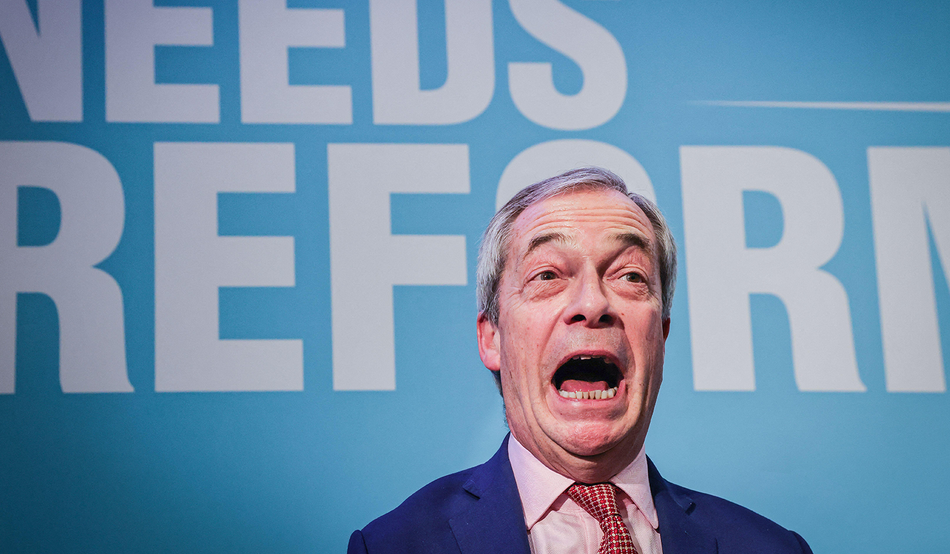
It turns out that Farage struggles to give a consistent story about the £5m gift he accepted from Christopher Harborne, a crypto billionaire living in Thailand who also calls himself Chakrit Sakunkrit. The money switched hands shortly before Farage changed his mind about standing in the last general election. The rules seem fairly clear that, once elected, he was obliged to declare it. Farage, being Farage, disagrees.
There are three versions of what the dosh was for. Version One is that it was intended to pay for Farage’s security for life. He says he has had many threats over time and Mr Harborne’s money has brought him peace of mind in perpetuity.
He won’t say if he has actually spent any of the money on personal security. None of our business. But, in any case, Version Two is different. This goes as follows: Farage has worked jolly hard for the past 27 years and we should think of the £5m as some sort of reward. Mr Harborne apparently has a heart of gold.
But in case you don’t buy Version Two, Farage has another explanation: it was simply an unconditional personal gift. That’s Version Three, and it means he can spend it on what he likes. A Ferrari, say. Or so he speculated to Nick Ferrari (no relation) of LBC.
He was asked by one interviewer if he had, indeed, bought a Ferrari. You guessed it: none of our business. But you can see how it is—how can one put this delicately?—in tension with the need to buy security for the rest of his days. Dropping £350k or so on a banging new Purosangue SUV would punch quite a dent in the piggy bank supposedly intended for a lifetime of bodyguards.
It was the BBC’s Nick Robinson who hit the bullseye, asking “Would you be happy if the next prime minister of this country secretly banked a £5m cheque from a billionaire whose business interests he was promoting?” Farage had two answers to this: a) He was not promoting Mr Harborne’s business interests; and b) —you’ve guessed—it was none of Robinson’s business.
So we are none the wiser, and it will be left to Commissioner Greenberg to try to pin Farage down. I’m sure he will ask whether there have been other generous and undeclared gifts over the years. Farage will doubtless tell him to MYOB. And he will test the proposition that Farage would never dream of doing anything that could be misunderstood as benefitting his generous donors.
Only last week it was disclosed that Farage has been trying to block a Bank of England cryptocurrency plan that could be costly for Mr Harborne, who has so far donated £25m to Reform UK—about two-thirds of its overall funding.
The Guardian reported that he used a private meeting at the Bank to urge the governor Andrew Bailey to drop plans for a state-run alternative to the digital currency that has made his Thailand-based benefactor one of the richest people in the world. It was also reported that Farage’s opposition to the proposal for a “Britcoin” is so strong that, after the meeting last September, he told an audience of crypto enthusiasts he would be “prepared to go to prison” to stop it.
As former Spectator editor Fraser Nelson has written, Farage’s promise of a “Big Bang” reform could add tens of billions to crypto companies’ market value. Harborne reportedly owns a 12 per cent stake in Tether, a crypto giant currently valued at $500bn.
In an interview with the Independent, former prime minister John Major said Mr Farage’s Reform UK was in danger of becoming “the fully fledged subsidiary of overseas billionaire money”. He added: “If I were given £5m, I think I would feel a little obligated to the donor. So what is going on?”
Harborne is in the midst of a marathon defamation suit against the Wall Street Journal. In the judge’s words, the “gist” of the article was that Harborne was a part of a larger scheme of “shadowy intermediaries” to commit “bank fraud.” Harborne says this is not true and has accused the WSJ of acting with malice. The case is set for trial in 2027. Lay in the popcorn.
In a perfect world, the parliamentary commissioner would have the powers to question—on oath—not only MPs, but also their generous billionaire friends. It would be interesting to know which of Farage’s three explanations rings most true to Mr Harborne.
We also await Mr Greenberg’s analysis of the extraordinary largesse the mystery crypto man has directed towards Reform and to what extent, if at all, he might benefit from a Farage government. Mr Greenberg is said to be both forensic and tough. Let’s hope so.
There’s no question that Mr Harborne and Ben Delo, his fellow crypto-billionaire, expat admirer of Farage, want to see the Reform leader in Downing Street—and they want radical change. It doesn’t quite cut it to be told this is none of our business.
American politics can, notoriously, be bought. It would be good to be reassured that Britain is not going down that route.
The relatively modest sums Keir Starmer accepted for clothing and new glasses—remember the screaming headlines?—were a drop in the ocean compared with the Farage millions. The largest sum involved in the 2009 House of Commons expenses scandal was the £63,250 (reduced to a penalty of £36,250) claimed by Bernard Jenkin for rent, which he paid his sister-in-law.
Douglas Hogg was vilified for claiming £2,200 towards the cost of cleaning the moat of his country house. Chicken feed.
A more relevant comparison may (or may not) be the secret £1m Formula One chief Bernie Ecclestone donated to the Labour Party in 1997. He dangled the prospect of another million. Within a year, the Blair government announced it would be exempting Formula One from a tobacco sponsorship ban, which had originally been intended to apply to all sports.
It was quite the scandal at the time. Maybe we were more easily shocked back then. Blair eventually issued an apology and repaid the money to Ecclestone.
The chances of Farage apologising or repaying the money are infinitesimally small. Part of him might even relish being suspended from the Commons for a while, or being forced to re-fight for his seat after a recall petition. What better way of dramatising the narrative of the little guy taking on the corrupt Westminster establishment?
But it’s possible that the average Joe might not, in this case, think that it’s Westminster that’s corrupt.
Even by his own standards, Farage seemed unusually irritable and fractious this week at the impertinent assumption that transparency goes hand in hand with standing for high office. Maybe he’s beginning to acknowledge that this democracy lark is not his thing.
No point in asking him. MYOB.