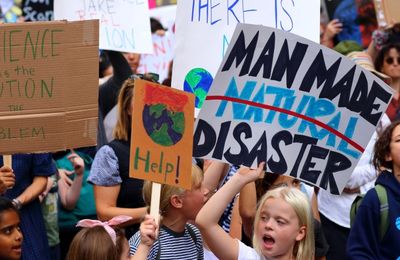
It’s odd that they aren’t in the streets protesting every day until something changes. Today’s young people have been called lazy and entitled; woke and childish; exceedingly left-wing and exceedingly right-wing; incapable of growing up and overly demanding. What if, instead, they’re being unusually mellow?
I’m 34 and a half, meaning that, while still within kissing distance of youth, I get to talk about my own teenage years and twenties in the way a captain discusses what he saw at sea. I marched with other university students in 2010 because we couldn’t believe that the government would treble tuition fees and scrap the educational maintenance allowance. We occupied more than a dozen campuses across Britain and held countless demonstrations in cities and towns. We waved our placards and we tried to make our case to the media, but in the end none of it worked. In 2011, we took to the streets again, accompanied by older generations, for the anti-cuts march—the biggest of its kind since the protests against the Iraq war in 2003. As the slogan put it, we fought for jobs, growth and justice. As with Iraq, we got nothing.
At least we tried, right? That’s what we told ourselves afterwards. We got a bad reputation in the process, but we probably deserved some of it. What have today’s kids done to deserve all their negative coverage?
They have it even worse than we had. Millennials got to leave their parents’ houses and live in grim, gross houseshares as undergraduates; the older members of our cohort even managed to buy their own places afterwards. The economy didn’t recover all that well immediately after the financial crash, but it was in better shape than it is now—limping on following a pandemic and a stringent austerity programme, through an increasingly Mad Max-esque geopolitical landscape. We got to experience the fun, free internet, for a little while anyway; what they have now is riddled with AI and corrupted by malign algorithms. As we grew up, we were seen as the unlucky ones but, by comparison, we were doing all right.
As the last census found, almost 3.8m families in England and Wales had adult children living with them in 2021—a rise of 13.6 per cent over a decade. According to the Institute for Fiscal Studies thinktank, only 39 per cent of 25- to 34-year-olds owned their home in 2022. In 2000, 59 per cent of them did. Though the Office for National Statistics considers rent to be affordable if a household spends 30 per cent or less of its gross income on it, the average for private renters was just over 36 per cent in 2024. For those aged 16 to 24, the government’s English Housing Survey estimated the share to be 46 per cent. Thankfully, no such calculation exists for young private renters living in the capital, as it would probably amount to torture porn.
Elsewhere, figures from earlier this year showed that 735,000 people aged 16 to 24 were unemployed in the UK; a year-on-year rise of more than 100,000. Overall, the unemployment rate for young people has, in that time, gone up from 14.3 per cent to 16.2 per cent. In 2026, the country welcomed another milestone: for the first time since 2003, the UK is now home to more than one million NEETs—young people who are not in education, employment or training.
Really, it shouldn’t be a surprise that in the most recent World Happiness Report, the UK found itself in 32nd place for young people—an especially stinging result, as its placement for the overall population was 20th. Another study by the Children’s Society, a charity, found that out of 27 European countries, the UK’s 15-year-olds were the least happy about their lives, suggesting that this probably isn’t a microgenerational blip, and tomorrow’s young adults are likely to be getting shafted just as their immediate predecessors were.
Still, asking them about their mindset paints a more nuanced picture. A few years ago, the University of Glasgow’s John Smith Centre launched the UK Youth Poll, a wide-ranging survey of 40 questions, sent yearly to a representative sample of around 2,000 16- to 29-year-olds. First published in 2025, it most recently found that 63 per cent of young people were optimistic about their own future, with only 23 per cent opting for pessimism. In 2025, 72 per cent described themselves as either rather or very happy, and 28 per cent said they were not very or not at all happy.
On the other hand, a poll of almost 9,000 adults by More In Common found that only 48 per cent of young people believe anyone can succeed in Britain if they work hard enough—the lowest figure across age cohorts. This ambivalence was captured especially well earlier this year in an Institute for Public Policy Research (IPPR) report on the topic. According to the thinktank, young people are—perhaps surprisingly—less likely than their elders to say that voting doesn’t matter, though they are less satisfied with democracy as it currently operates. Around 65 per cent of them believe the political system is broken, and only one in five feel satisfied by it.
“It would be fair to say that most young people are disillusioned with politics, politicians, political institutions and have a lack of trust in those,” said Ana Isabel Nunes, a senior lecturer in social and political sciences at Nottingham Trent University, “but they are still engaged, they’re interested, they do care.”
Because quantitative studies only go so far, I decided to seek the real-life opinions of some bona fide young people. Establishing my own academically rigorous focus group wasn’t possible, so I instead decide to go down the grotesquely unrepresentative route, and speak to one single person who occasionally does some work for me. Alex, 28, moved down to London a few years ago from Paisley—“Glasgow’s Croydon”—and waits tables while hoping his acting career takes off.
There is, in short, a concerted effort from all sides of society to ensure that young adults are stuck in a teenage limbo until some way into their twenties
“It’s difficult not to feel quite overwhelmed by pessimism, honestly,” he tells me. He didn’t always feel this glum, but “the cozzie livs [cost of living crisis] gets worse year on year,” and he finds Brexit “particularly galling”, especially as a Scot (a majority of whom voted Remain). “From the point of view of national security, it’s clear we can’t rely on the US any more. I want to be pals with [Spanish prime minister] Pedro Sánchez and all the nice Europeans.”
Other issues close to his heart include the climate crisis and the affordability of housing. “Real financial independence would be nice”, he added, admitting that he does still have to rely on the bank of mum and dad more often than he’d like. That last point is probably the most crucial one, and got us talking about adulthood as a concept and a goal.
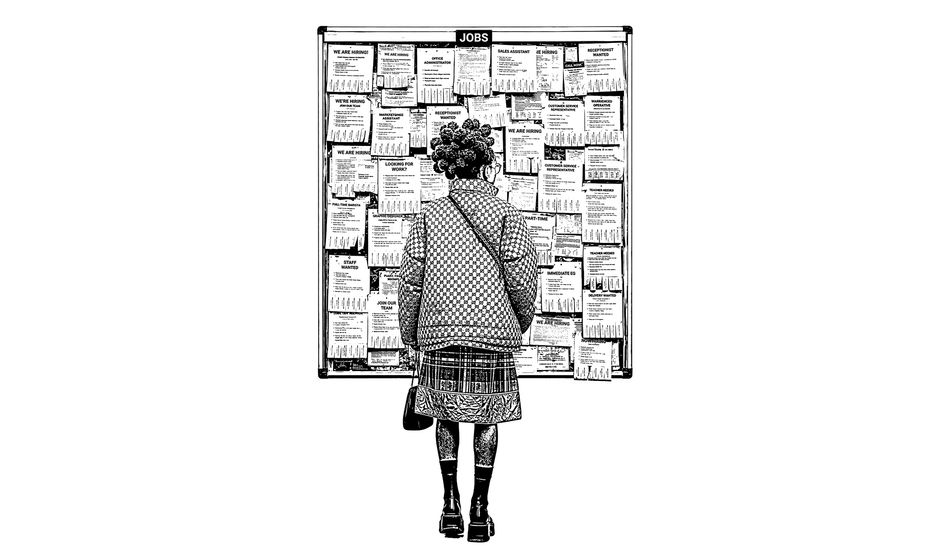
“I think the markers of adulthood, traditional definitions, don’t really apply any more. My dad owned his own flat and had a certain kind of career at my age,” he says. Alex currently has neither, and there’s no obvious path for him to acquire them any time soon. Though he said he finally thought of himself as an adult at 26—a long way after the legal majority of 18—he admits to still sometimes feeling like a teen in disguise. It’s not hard to see why.
His girlfriend is 25 and can’t afford to move out of her parents’ place. “We’re up in the bedroom making whoopee and her mother comes knocking and calling and I feel like a 13-year-old!” he complains. “And we’re supposed to be two adults!” An undignified state of affairs.
Being in one’s twenties today often means being treated as—in the words of Britney Spears’s seminal 2001 hit—not a girl, not yet a woman. Though she sang about needing some time to figure things out, and was 19 years old as she did so, this state of limbo can now extend for much longer. It’s been a subtle societal shift, but one that can be spotted more or less everywhere.
In popular online culture, much has been made of age-gap relationships between celebrities. If, say, a 24-year-old woman dates a man in his late thirties, it is assumed that she must have been groomed, and he must be in some way predatory. There is little room for nuance, or a case-by-case approach: somehow, a legal adult cannot and will not be treated as such.
The chatter could be dismissed as social media nonsense, but it merely echoes some real changes in more serious areas of the world. In 2021, the Scottish Sentencing Council recommended an “individualistic approach” to sentencing criminals under the age of 25. Lady Dorrian, who was Lord Justice Clerk and chair of the council, argued that judges ought to take into account the emotional and intellectual maturity of young people.
Elsewhere, some prominent gender-critical campaigners have been arguing that transgender people shouldn’t be allowed to transition until they turn 21, or even 25—again, some way after 18, the age at which a person legally becomes an adult. Others have also been fighting for universities to have a statutory legal duty of care for their students, even if a vanishingly small portion of those students are underage.
There is, in short, a concerted effort from all sides of society to ensure that young adults are stuck in a teenage existence until some way into their twenties. It isn’t an entirely new dynamic. In 2000, psychologist Jeffrey Arnett wrote about the concept of “emerging adulthood”, arguing that in industrialised societies the experiences of people aged between 18 and 29 had changed drastically. Once, those people would usually have started work, got married and had children before even reaching 25. With those milestones having been pushed out towards their thirties, young people used those transitional years to experiment and figure themselves out. He described it as “a time of possibilities, instability, identity explorations, self-focus, and ambivalence toward adult status”.
Doesn’t that all sound grand? Though Arnett identified a real phenomenon, his was a world where this change mostly felt like an unalloyed good thing, and a choice young people were actively making. Could the same be said of the world in 2026? Bobby Duffy, who studies generations as a professor of public policy at King’s College London, argues that a better term for current circumstances would be “delayed adulthood”. “It’s not a wonderful time of exploration for some people, it’s a frustration that they can’t move on to those more adult years,” he says.
Still, we shouldn’t assume it’s all bad for everyone. “My mum left school at 15 and went straight into a factory job. I’d had 10 terrible jobs by the time I was 17, that I was terrible at, and which were probably inappropriate or dangerous for me to be doing in some ways,” he says. “My daughter’s 17 and all she’s ever done is sell stuff on Depop and Vinted that we bought her and we do all the admin for.
“We think my mum’s model is wrong—we shouldn’t be sending kids out to fulltime work at 15—and we think my daughter’s model is wrong because we didn’t grow up with that. But actually, she’s got a 50 per cent chance of living to 90. She’s probably going to have to work for 45 years. Going a bit slower at the beginning is probably not that dumb.” He isn’t wrong, and his daughter would probably agree, but the dynamic strays into dangerous territory when it infantilises people who, not all that long ago, would have been treated as regular, upstanding members of society.
It’s only possible to think of young people as uninterested in politics if one’s understanding of politics remains confined within SW1
It also becomes especially noxious when backed by hollow science. The Scottish sentencing guidelines, campaigning against transition, and discourse about relationship age gaps all mentioned the claim that the brain isn’t formed until 25. In 2020, a relationship and sex columnist for US outlet Slate even had to respond to an anxious query about the argument that “if you’re under 25, you’re incapable of consent because your ‘frontal lobes are still developing’”.
The prevalence of this idea keeps Dean Burnett up at night. Usually mild-mannered, the neuroscientist warns me that he could sound unreasonably irate about this particular topic. “Even if there are specific stages of brain development that happen at essentially the same time in every individual, this doesn’t map neatly onto cognitive abilities,” he tells me. “Such things are readily influenced and shaped by experience and environment.
“While we can arguably say when the brain enters specific stages of development, this isn’t as useful or applicable as many seem to think—or hope. It’s such a subjective process that you’ll end up with massive individual variations.”
In short: 25 isn’t some sort of magic age when one becomes an adult, but neither is 18, or 34 and a half. Using science to justify an ever longer state of teenagehood might be tempting, but it doesn’t work. If gen Z aren’t ready for office life when they enter the workforce, that cannot be blamed on them. Instead, we ought to pay attention to the world they grew up in and the expectations we place on them—or don’t.
Similarly, the belief that young people don’t care about what happens in Westminster and so willingly disenfranchise themselves is probably comforting to those whom it benefits, but it is untrue. As the IPPR report explained, most assumptions made by older adults about young voters are wrong.
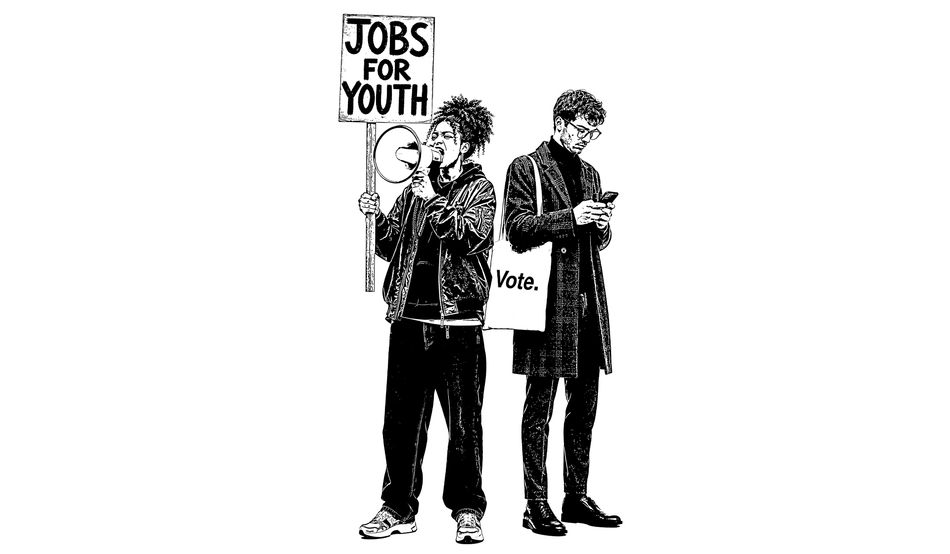
“Before we really jumped into this research, I was happy to accept some of the stereotypes around young people,” admits Chris Bick, one of the authors of that report. “The thing that really surprised me was how much they care about politics. We tend to think of it as ‘Are they voting? Are they political party members? Are they part of unions or other collective institutions?’ But if you just say, well, ‘what if political engagement looks like talking about politics or going to protests?’, they’re actually remarkably engaged, and probably more so than older generations.”
Joe Greenwood-Hau, who worked on the UK Youth Poll, had a similar experience. “Young people have a lot of very well thought-through positions on political issues but also a lot of very well-placed concerns about what’s going on in politics,” he says. “Many of them still think, even after this grind, that their vote matters, that politics is an honourable thing to do.”
As his team found, 59 per cent of them agree that politics is an honourable job, with 28 per cent disagreeing. Thirty-eight per cent felt that politics isn’t relevant to their lives which, while not ideal, isn’t anywhere near as apocalyptic as media coverage of young people would make you believe. Perhaps most striking of all is the fact that only 26 per cent of respondents hadn’t engaged in any political activities in the past year—from signing a petition to attending a meeting or posting on social media about an issue. As Bick pointed out, it’s only possible to think of young people as uninterested in politics if one’s understanding of politics remains confined within SW1.
Similarly, it may be convenient to view this current generation of young people as revolutionaries—Reform-voting, Andrew Tate-worshipping boys to the right, and Palestine-obsessed, stridently green girls to the left—but the data shows quite the opposite. If you ask those under 30 what they care about, you will find that their priorities are everyone else’s priorities too.
When asked by the Youth Poll to rank the most important issues facing the UK, respondents listed inflation and the cost of living (41 per cent), healthcare (37 per cent), housing affordability (32 per cent), crime (26 per cent) and mental health (25 per cent) as their top five. In a separate survey from 2024, the Department for Education polled 14- to 24-year-olds and found their priorities to be the cost of housing (38 per cent), the NHS and healthcare (37 per cent), the economy, inflation and cost of living (37 per cent) and mental health (33 per cent).
The overall picture given by those figures isn’t a million miles away from what you would get from older generations. Pensioners may not care all that much about the cost of renting because they are more likely to own their own homes. Mental wellbeing may also be something that really is most important to those under 30, as an NHS survey conducted last year found that one in four young people has a common mental health condition—a figure that went up by over a third in a decade.
Perhaps most interestingly, More In Common found that only 12 per cent of the 18- to 24-year-olds they interviewed cited climate change as a top issue—two points lower than the general public. Though the war in Gaza and transgender issues ranked slightly higher for them than they did for older cohorts, they were only mentioned as top issues by under 5 per cent of respondents. As Greenwood-Hau concludes while discussing the topic more broadly: “This is not a group of people who are banging the culture wars drum. They are very, very concerned by bread-and-butter issues.”
As his own research found, the top three contributors to anxiety for that age group were financial worries (37 per cent), work pressure (23 per cent) and job insecurity or unemployment (20 per cent). When asked what would make them happier, they cited higher wages and financial stability (41 per cent). Again: who wouldn’t relate to that, no matter their age?
While political parties sometimes believe that attracting the youth vote must mean relying on gimmicks or leaning into intergenerational warfare by trying to turn them against their elders, the truth is both simpler and more uncomfortable than that. The operative word in “young people” is, it turns out, “people”: voters fundamentally want many of the same things. If the British economy remains stagnant and the public realm keeps crumbling, learning to use TikTok will not save the political mainstream, and youth discontent will endure.
This is especially obvious when looking at Lithuania: in 2024, the World Happiness Report found it to be the country where young people were happiest. Though foreign journalists flocked to the small Baltic nation to discover its secret, their findings were disappointing. As it turns out, it really helps under-thirties if their home country’s national GDP has more than quadrupled in their lifetime. It is also dandy if, in the year before they were interviewed, average gross earnings in the country increased by just over 12 per cent. Amazingly, rents sitting some way below the European average and university being free to most students also fosters youth contentment. Isn’t it all quite irksome? There’s no great Lithuanian recipe to steal. The way to bring optimism back for new generations is to, well, fix everything for everyone else.
That being said, some studies have found that young people do have some views and problems they can call their own. There is little point in taking “millennials”, “gen Z” or “gen Alpha” wholly seriously, as the terms originally came from marketing firms, and people can’t be neatly separated along those lines, but generations do matter.
As Duffy puts it, three important things influence someone: their life cycle, period and cohort. “‘Life cycle’ is that we change as we age and go through life stages,” he says. “Then you’ve got period effects, so events like pandemics, economic crises, wars, as well as slowly changing fashions and norms. Then you’ve got cohort effects, which is where a generation is different from other generations… because they were brought up in different circumstances. Your formative years shape you, and you take some of that with you.”
Today’s lucky, lucky young people have lived through a pandemic, several economic crises and a number of wars abroad, as well as a series of governments which either did not care about their needs or forgot they even existed. They stayed at home for months at a time to protect the old and the vulnerable, and the old thanked them by throttling their futures. An average 29-year-old became able to vote in 2015 and probably voted for the Labour party, which lost. A year later, they probably voted for Remain in the referendum, and lost. In 2017 and 2019, they almost certainly voted for the Labour party, again, and both lost and were vilified and mocked for having voted Labour in the first place.
Is it really a surprise that, as Greenwood-Hau explains, they now feel they have it worse than most? “They have similar concerns [to other voters]; the only difference is that they feel them differently. When you talk to them about their experiences, they often talk about feeling particularly hard done by. They’re concerned about the same issues, but they feel like they have been especially exposed to them.
“They’re entering the workplace as thousands of jobs are being shed to AI. They are entering a housing market pretty much at the peak time when there’s not enough housing, and it all costs too much. And they are entering adult life, when they have to start paying for things, in the aftermath of a massive series of inflation shocks. They just feel that it’s affecting them even more than the previous generation.”
They aren’t wrong. Also, any cohort living in tough times will find itself more divided. You may remember the stat from earlier about how young people feel about their personal future. The headline figure was encouraging, but closer -analysis reveals a concerning picture. Seventy per cent of those working full time were, in 2025, optimistic about their personal future, but only 44 per cent of those not in work said the same. Elsewhere, a Electoral Commission study of 2,501 young people aged 11-25 found that 67 per cent from the most comfortable socioeconomic backgrounds (AB) were interested in politics. That figure dropped to 32 per cent for those from the other end of the spectrum (DE).
Crucially, things are unlikely to get better or more equal soon. As Duffy explains, “It’s very fractured within gen Z. A huge concentration of private wealth in the baby boomers and some bits of gen X is going to flow down, but very unevenly. Some people are getting a huge amount of help already, and it doesn’t encourage generational solidarity when you’ve got people with very different financial support situations from their parents and grandparents.”
This may be one reason why new generations are attracted to the political fringes. Well, one side anyway. Though much has been made of men under 30 turning to Reform UK, the fuss about this doesn’t reflect reality. Misogynistic content is flourishing online and the populist right is actively trying to recruit younger generations, but it doesn’t seem to be working so far.

As the IPPR report found, young men are the most progressive male age cohort on every salient culture war issue, from immigration to sexism. The increase in voting intention for Reform was also the lowest among men aged between 18 and 25. Really, the gender gap among the under 30s mostly comes from young women, who have become more left wing over time. This, too, has received its fair share of hysterical press coverage, alleging that mouthy, intolerant broads are merely waiting for the revolution to happen. That young female voters are flocking to the Green party has been seen as a sign of radicalisation when, according to Ceri Fowler, a fellow in comparative politics at the University of Oxford, the situation is altogether more nuanced.
“Women in general—across generations—are more supportive than men in their economic values, around issues like redistribution and state intervention,” she explains. This slight political realignment along gender lines may simply be about them “responding differently to the economic hardship and challenges faced by young people today”.
“Some of what we see is arguably about composition from generation to generation: women and men who have similar educational backgrounds, class backgrounds and positions in the labour market have relatively consistent views and values across generations, but the proportion of women with a degree, for example, has changed substantially
over time.”
What this means, after two years of Keir Starmer’s disappointing, tepid, oddly reactionary Labour government, is that many of these women are
looking further afield. What it doesn’t mean is that they’re a lost cause for the centre left. “We can see this in the two by-elections in Manchester,” Fowler says. “In Gorton and Denton the left was split—and it seemed like the Greens were attracting lots of support from younger women. In Makerfield the left, and it seems women, consolidated behind Andy Burnham in response to the threat of Reform.
“I think there’s every possibility that, at the next general election, Labour could bring voters back into the mainstream with a combination of a more liberal position on some cultural issues and economic support for young people in education and their early careers.”
So, at risk of stating the obvious: one way to encourage people to vote for you is to make their lives better and to treat them with respect. It sounds crazy but it might just work. Burnham may still be getting used to life back in Westminster, but it is something his government needs to keep in mind. As every academic will tell you, young people aren’t dim or disconnected from the world, or unusually childlike; they see what’s going on and—not unreasonably—keep concluding that no one meaningfully cares about them or their priorities.
Repeated studies have found that people who fail to vote in the first election for which they’re eligible are a lot less likely to start voting later
Policies aside, trying to fix this broken link also means “recognising that maybe young people don’t want to do politics in adult terms, in the ways we tell them to do politics”, says Nunes. “Young people are experts in their own lives, they know what issues they want to see addressed, they know what matters to them.” If they’re feeling alienated from political processes and infantilised by older adults who refuse to take them seriously, they will keep believing that Westminster doesn’t serve them.
While fixing housing, jobs and the economy would be the easiest way to make people under 30 feel less glum, some slightly easier policy changes could help repair the relationship between parliament and younger generations. In electoral politics as in romance, symbolic grand gestures may not be able to fix everything, but they can sometimes help change the narrative.
One idea is to make voting compulsory in general elections for first-time voters. Because everyone loves a carrot, Australia-style (meat and plant-based) “democracy sausages”—cooked up at festive, communal barbeques— could even be offered at polling stations. Compulsory first-time voting isn’t a new idea, but one that is yet to be put into practice anywhere. Crucially, it feels like a policy with few downsides and a surprising number of benefits.
Firstly: repeated studies have found that people who fail to vote in the first election for which they’re eligible are a lot less likely to start voting later. It turns out voting is, as Peep Show’s Super Hans found with crack, really quite moreish. It’s also infectious, as multiple researchers have found that an individual is more likely to go to the polls if another member of their household is going. It may not be ideal that so many people live with their parents until they’re not so young, but it could lead to more of their older relatives going to vote themselves.
Secondly: the policy would complement the likely introduction of voting for 16-and 17-year-olds at the next general election. According to various pieces of research from Scotland, Austria and some South American countries, early enfranchisement can lead to higher levels of trust in politics and political parties, and voters who first go to the polls before turning 18 are more likely to keep voting as they get older.
Finally: some may argue that young people do not need yet another duty, but the symbolism around making this first vote compulsory could be incredibly meaningful. At a time when young people are feeling patronised and forgotten, telling them that their vote matters most of all could seem wonderfully significant. Instead of a chore, the requirement to vote could be treated as a sign that they are trusted, valued and being warmly welcomed into the next phase of their life.
It could also force politicians to take young people more seriously. The UK’s vicious cycle for young people in elections could, if we wanted, end tomorrow. No more alienation leading to sluggish turnout, leading to being ignored some more. It’d be too late for Alex, but those coming after him could, maybe, live in a world where social progress, especially compared to previous generations, is no longer seen as a distant dream.
This could, in turn, revive the fortunes of a United Kingdom which has been feeling a bit too hopeless for a bit too long. “Young people can no longer expect a better future than their parents, which is new,” Duffy says. “That’s a problem for all of us, because it’s quite deep in us that we want our children at least not to slip back from what we had. So the real threat of the lack of generational progress is more people thinking: ‘Christ, the system doesn’t work at all.’ It’s that sense that the system is broken, because why are we bothering if we’ve had a terrible time and can’t see it getting any better for our kids?”
In 2024, before the last election, when Starmer was riding high in the polls, his party launched its new slogan: “Let’s get Britain’s future back.” He failed, but his aim was the right one. Time is now running out to find that future again.