A year ago it looked as if Reform UK had rebranded itself as a conventional centre-right party. It also looked as if Nigel Farage was destroying the Conservatives and that Kemi Badenoch would not long survive. There was obviously a connection between these trends, as there is between their reversal since. The truth, however, is far from straightforward.
As ever with politics these days, it goes back to Brexit. A decade ago, Farage hijacked the Tory establishment with his anti-EU policy. But the reason there was a Brexit referendum in the first place is that his Ukip party had already seized a sizeable part of the Tory electoral base—notably in the poorer swathes of “left behind” provincial England—while becoming a voice of radical Thatcherites on immigration and issues well beyond leaving the EU.
There had already been a split among Tories, in terms of both voters and policies, which the 2016 Brexit referendum turned into a rupture. In effect, that rupture has continued ever since. Boris Johnson appeared briefly to have restored the old Tory electoral coalition in his 2019 election victory, but that was only because Farage unilaterally decided that, in order to get Brexit over the line, his party (by then called the Brexit party) would not stand candidates in Tory-held seats.
Come the following election, the Tories were again leeching votes to Farage’s party, now called Reform UK. Farage himself won in Clacton on the impoverished Essex coast, a seat which Ukip had won a decade earlier.
Indeed, by 2024 Brexit was scarecely part of the political debate. But the fact that small boats filled with asylum seekers were still crossing the channel, and Johnson’s extraordinary post-Brexit policy of encouraging a massive wave of immigration, gave newly elected Farage equally potent populist campaigning issues from the same xenophobic stable—and with even greater appeal to the Tory grassroots.
On the Tory side, 2024 saw significant losses not only to Farage but also to Labour and the Liberal Democrats. This went well beyond the reversal of the Conservatives’ gains in 2019. The centre and centre-left parties seized a large part of historic Tory territory in London and the affluent Home Counties. This was partly in response to Brexit and its effect in undermining the former bond between the more affluent and the Tory party.
Put all this together, and it looked by the end of 2024 as if the Tories might be squeezed out of existence between Reform, Labour and the Lib Dems. Badenoch performed badly in her first year as Tory leader, while Farage seized even more of the limelight once he was an MP. He also, last year, courted prominent Tory defectors and eschewed more extreme anti-immigrant messaging. The media started to portray him as a possible prime minister, in the Conservative mould.
However, over recent months all this has changed. Badenoch has performed much better and managed to position herself as more “responsible” than Farage. She has done this while adopting much of his platform and even pledging to expel so-called “wets” who don’t agree. Farage, meanwhile, has become mired in sleaze and lurched even further to the right, doubling down on Reform’s talk about mass immigrant deportations. The series of Tory MP and local councillors defectors slowed, never turning into the flood that had appeared possible a year ago.
Tory resilience, plus the relative unpopularity of both Labour and Reform in more affluent London and southern England, prevented a Conservative rout across these regions in May’s local elections. Reform cleaned up in its provincial heartlands, but Zack Polanski’s Greens, not Farage’s Reform, surged as the populist party of the young and the cities. The Lib Dems held firm in the areas of their 2024 gains against the Tories but did not advance further. And in the recent Makerfield byelection, Restore Britain, challengers from the further-right, ate into Reform’s expected vote share. This was only the latest in a long line of byelections that Reform has lost.
The net effect is an uneasy stand-off between Badenoch, Farage and their respective parties. Each aspires to conquer the other, but has so far proved strong enough to achieve only partial occupations. There now appears to be a Tory bedrock, in London and southern England, which is beyond Farage’s reach, because his populism and personality are simply too offputting in these regions.
The Clacton byelection, a defensive manoeuvre by Farage in face of the sleaze controversies, reflects his weakened state. Victory over Count Binface will at best be a holding operation.
The long battle between Farage and Badenoch
Each aspires to conquer the other. As ever with politics these days, it goes back to Brexit
July 15, 2026
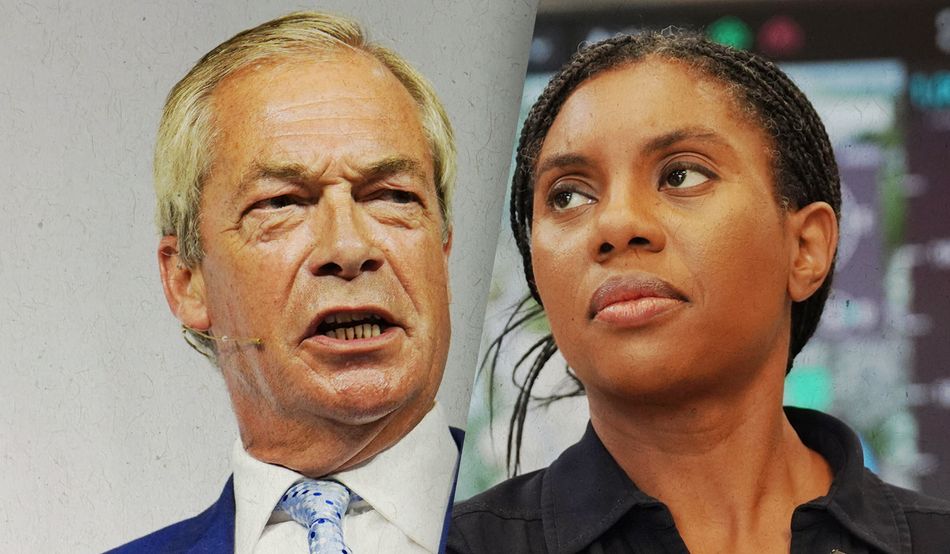
Image: Alamy / Prospect