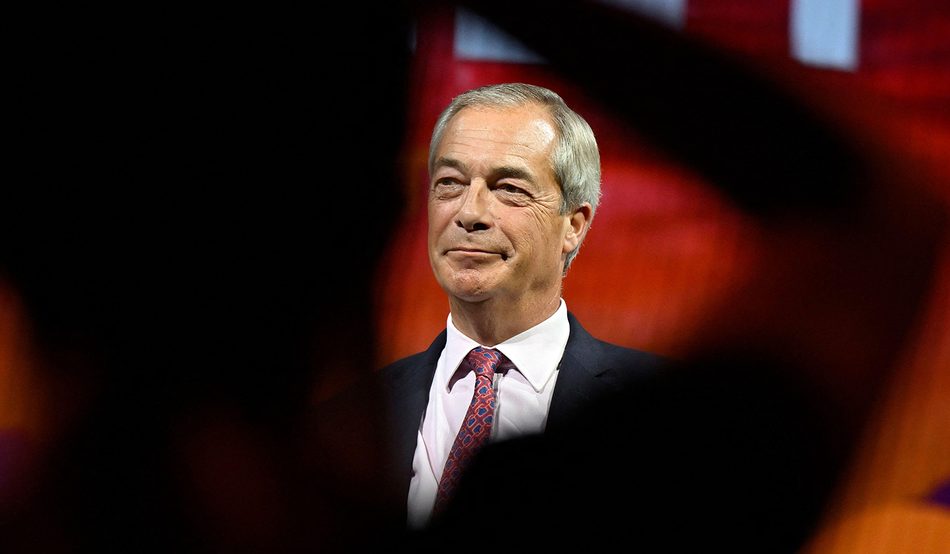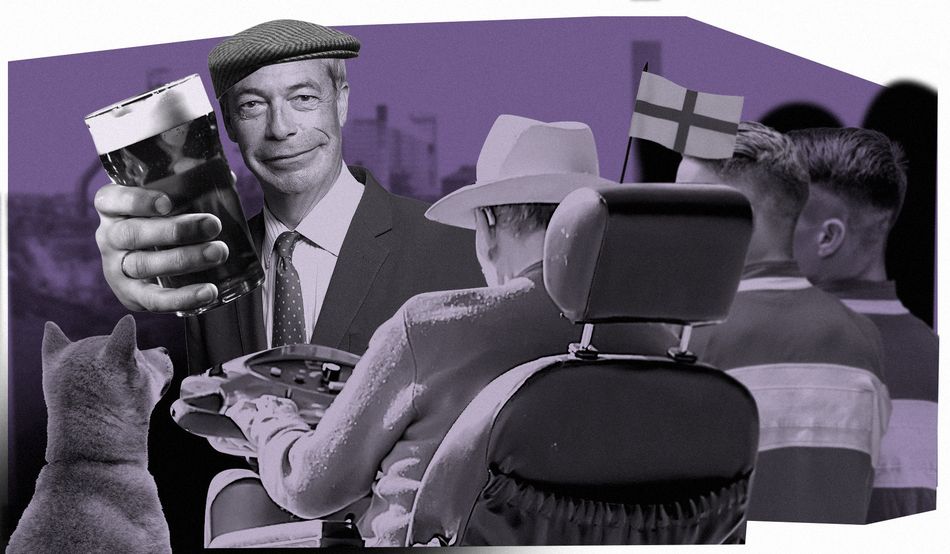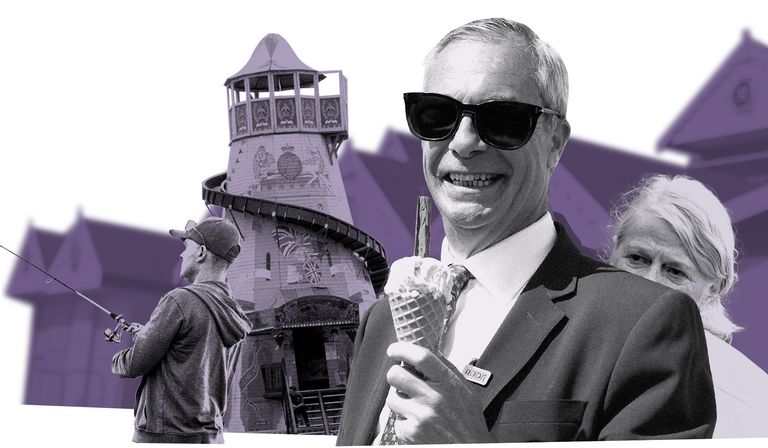
Given the furore surrounding a £5m donation, Nigel Farage has been keeping a commensurately low profile. But things that are lost so often turn up in the last place you think to look. Which is how I find him in Clacton.
Standing amid a long line of fishermen at the end of the pier is a narrow-shouldered man in mustard slacks, a broader woman in a turquoise blazer and an uncomfortable-looking man in a gilet, clearly scanning the horizon for men of fighting age.
Nigel Farage, flanked by Ann Widdecombe and Robert Jenrick, does not seem surprised to see me. But perhaps he should be. His explanation that the crypto-billionaire Christopher Harborne gave him £5m pounds to enhance his security is not borne out by the ease with which I just approached.
“Au contraire,” says Farage, nodding in the direction of the helter skelter, where two burly men with earpieces stare at me with an implied menace most commonly found behind NHS reception desks. “You’ve been tailed since Colchester.”
He wags a twisted, nicotine-stained finger, as though about to select a name from a deportation list, and points at the 4D Dinosaur Experience. “See those men in front of
the Velociraptor?”
“An Advanced Milkshake Protection Unit. Four SAS, two Navy SEALs, and a Spetsnaz. A McFlurry can’t make it within 30 feet of me without AMPU knowing about it first.”
Next to us, a fisherman’s line goes taut. His jaw clenches and he begins to reel something in. We all turn to watch. A small mackerel breaks the surface and lands in front of Farage’s loafers. The fishermen cheer.
“You couldn’t have caught that under the Common Fisheries Policy,” says Farage. Everybody laughs, apart from Widdecombe, who delivers a firm ecclesiastical nod.
It all feels incongruous. Farage’s attractiveness to voters is built on accessibility; he is an everyman baiting the elite. Yet here he is, greeting fishermen on the Essex coast like a visiting dignitary from a teetering republic. The illusion of spontaneity is preserved only by the distance his security keeps.
One of the earpiece men touches his headset and stiffens.
“Code 10, Code 10, Code 10—lactose suspension perimeter penetrated.”
Farage is immediately swallowed by his close protection unit. I freeze, briefly seized by the feeling of naked vulnerability with which frontline politicians must live. Jenrick cowers behind an overflowing bin. Widdecombe watches with distaste, conveying the disapproval of one convinced that security incidents are the inevitable consequence of legalising same-sex marriage.
The whole thing is over almost before it’s begun. Someone has been restrained beneath an animatronic Dilophosaurus.
“Threat neutralised, threat neutralised. It’s just Darren Grimes.”
“Have I done a bad politics?” pipes the flushed deputy leader of Durham Council’s Reform contingent from inside a headlock.
The security people blend back into the life of the pier. Farage relaxes. Jenrick, standing nearby, is unable to shake the curiosity of an interested herring gull. Widdecombe picks up her lunch, and chews.
An apprehensive-looking fisherman recognises the Tupperware in Widdecombe’s hands.
“I think that’s my bait actually,” he says. Widdecombe looks at the plastic box without emotion, nods, and swaps her tub of ragworms with his.
“The MSM are asking why I need £5m for my security,” says Farage, steering the conversation back to his favourite subject. “There’s your answer.”
“To stop Darren Grimes from drinking a can of Nurishment?” one of the fishermen asks.
“It was a Frijj,” Farage answers, gravely.
“The point is, you can’t put a price on Nigel’s safety,” says Jenrick, whose voice rises an octave while he tries to avoid the now fixated gull.
“I thought we just said five million?” says one of the other fishermen.
“Nah, he spent £1.4m of that on a house,” adds another.
“That was my money from I’m a Celebrity… Get Me Out of Here!” snaps Farage.
Farage’s driver, having heard only the end of the sentence, appears and offers to remove him from the situation.
“Which house?” says another. “He’s got at least three.”
Then, the words “I prefer Rupert Lowe” are carried on the wind, likely from a conversation thought inaudible. Farage bristles. He is beginning to realise that tribunes who start as voices from the crowd often end as men who can no longer stand safely
in it.
The fishermen on this pier are the nearest thing Clacton has to a public assembly, and my mind turns, unhelpfully, to the Gracchi. Not because Clacton resembles 2nd century BC Rome but because, in politics, crowds rarely stay acquiescent for long. Even the most principled appeal to “the people” tends, in the end, to require protection from them. The Gracchi fell to the cudgel; modern tribunes fall to Yazoo.
“What’s that?”
Farage interrupts my reverie, pointing seawards. Widdecombe dives behind the fixed yellow coin-operated binoculars.
“Just a pedalo,” she says, sounding disappointed.
But Farage’s team has already moved him away. It is time to extract him from the public square.
Fortunately, anti-elitism remains well funded. Although, quite how much is spent on the Reform leader’s security, as opposed to the broader comforts associated with embattled importance, remains unclear. The perimeter, one suspects, now extends well beyond physical danger.