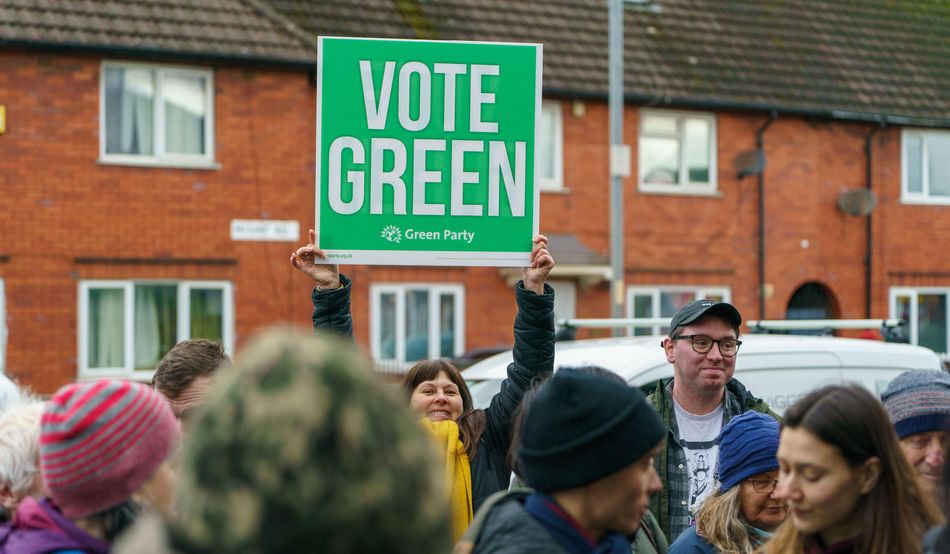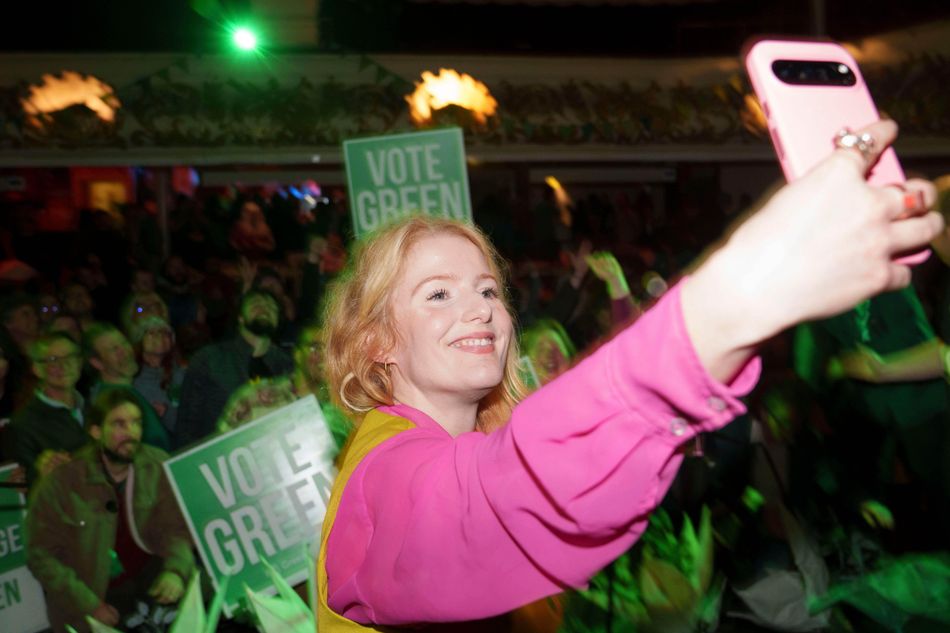
The one certainty was supposed to be that it would be close, but it wasn’t. The Greens stormed the historic Labour citadel of Gorton and Denton with ease. Hannah Spencer—the folksy, 34-year-old plumber who inspired hundreds of activists to trudge wet Manchester streets—topped 40 percent of the ballot. She emerged 12 points clear of Reform’s Matthew Goodwin, and a full 15 points ahead of Labour’s Angeliki Stogia.
The Labour to Green “swing” of over 25 points is on its own just about enough to put the result among the great byelections of history. But for all sorts of reasons it is more disruptive than this arithmetic suggests. The old pendulum didn’t just swing: it snapped. The catastrophe for Keir Starmer and his government was not matched by a resurgent opposition, but the worst Tory result ever: less than 2 per cent. Nor does adding the similarly-dreadful Lib Dem score into the mix brighten the picture for the “traditional” parties. All three combined totalled just under 30 percent of the ballot here, markedly less than the 32 percent Jeremy Corbyn’s Labour party received nationally when it was crushed by Boris Johnson’s landslide in 2019.
It is worth going back to that year to fully understand the disaster now confronting Starmer. The local Labour party’s slide has unfolded in two stages. Back in 2019, Labour attracted a notional 30,814 votes here (“notional” because of adjustments to allow for minor boundary changes). By 2024, while the country as a whole turned to Labour, Labour heartlands like Gorton and Denton were already losing a bit of heart: both turnout and the party’s share of the ballot fell, its total vote plummeting to 18,555.
Now—with the national tide having moved out against Labour—all that was rotting away under the surface in safe seats like this has been exposed. The attention and the activists flooding the constituency did manage to prevent any further fall in turnout. But the most intensive Labour ground game that anyone can remember couldn’t persuade more than 9,364 electors to stick with the party that tried to persuade them it was the only progressive force that could win.
Labour, then, has sunk from winning more than 30,000 votes here in its ultra-radical opposition incarnation to less than 10,000 in its uber-respectable governing pose. This is, of course, partly because left-wing, inner-city seats are very different from the marginal Middle England constituencies where elections are normally won and lost. From that contrast, Starmer drew the conclusion that he should court Middle England while ignoring, and occasionally deliberately aggravating, his base. The government has wilfully obscured the more left-leaning social and fiscal policies it has quietly pursued behind noisy immigration crackdowns and endless flag-waving. During this byelection, the party has reached—without any conviction—for scaremongering claims that Zack Polanski wants to see crack sold to teenagers. In Gorton and Denton, this approach was tested to destruction: treat your core vote with contempt and it treats you with contempt, too.
There are particular dangers of taking minority voters for granted, especially in this populist moment. The gleeful way that Goodwin, Nigel Farage and his deputy Richard Tice all instantly jumped on disputed claims about irregular voting in—as Farage prejudicially put it—“predominantly Muslim areas” shows the stakes. Only the emphatic nature of Spencer’s win has meant that the news is not being dominated by the Trumpian doubts Reform has been trying to cast on the integrity of the byelection.
Before the 2024 election, Labour sources were sometimes heard to whisper that, because the party already controlled virtually all of the 50 or 60 seats with Britain’s largest Muslim communities, there wasn’t really much political cost to treating with disdain the early demands for a ceasefire in Gaza. The loss of several seats to independent candidates on this very issue should have shaken the party out of its complacency, but this byelection suggests Labour still has to wake up. To be fair, Labour was happy to let Reform lead on the charge that the Greens printing election literature in Urdu was in some way inherently divisive, and is within its rights to suggest that the Greens are not automatically immune from the temptations of “dog whistle” politics amid real tensions between communities. But it needs to do a better job of understanding why it is that Narendra Modi—who controversially featured in Green campaign material—is a figure that British Muslims, many of whom are of South Asian heritage, have good reason to regard with suspicion.
A more general lesson is that machine politics doesn’t work. At least until this defeat, Starmer knew he could control Labour’s internal processes so tightly that it was easy for him to block the one local candidate—Andy Burnham—who might just have kept the seat red. Many people (including me) immediately warned that this top-down approach would prove just as doomed as Tony Blair’s efforts to block Ken Livingstone in London and Rhodri Morgan in Wales. Many Labourites remained sincerely convinced that their army of local councillors and solid canvassing records would protect it. The party’s ground operation was, as I reported from Manchester, much more tightly marshalled and controlled than that of the freewheeling Greens, who lacked the data to do anything other than knock at every door.
Now Labour is looking at a terrifying set of local and devolved elections deprived of the one frame Starmer hoped to put around them: “only we can save you from Reform.” Early recovery seems unlikely to the point of impossible, but minds must turn towards the possibility of recovery before a general election that is still three years off.
If there is one lesson for the government from Gorton and Denton, it is that salvation will require a strong message pointing towards clear answers, rather than a powerful machine. What should that message be? Well, ironically, it was none other than Spencer who voiced a very plausible draft of one in the wee hours of Thursday: “Working hard,” she said, “used to get you something. It got you a house, a nice life, holidays, it got you somewhere. But now, working hard, what does that get you?”