On a drenched Mancunian February evening, Stockport Road in Longsight is thronging. Endless shopfronts are ablaze in the dark, offering jewellery, clothing and cuisine from every corner of the world. One establishment, Prime Mobile, catches my eye: it has both Vote Green and Vote Labour posters in the window. I ask the smiley young man on the till why the business is backing two bitter rivals in the Gorton and Denton byelection. “No idea”, he says. A colleague along the desk is fixing someone’s phone: he’s got no idea either. I step back into the rain, wondering if it’s owned by a husband and wife with divergent views. But just a few shops along I stumble on a take-away which has also pinned up a Vote Labour sign right next to Zack Polanski grinning from a Green party leaflet.
It might seem bizarre, but take a few steps back and it becomes understandable why some locals—particularly people from minorities fearful of a Reform UK win—might be uncertain about who to back in Thursday’s race.
The last time I was in Longsight was about 25 years ago. My two oldest friends were sharing an extremely cheap house in the neighbourhood. I remember police tape just along the street—someone thought there’d been a murder—and a man from the Housing Benefits office turning up to check whether or not the full rent my friend was claiming for was a reasonable amount.
“£35 a week, mate?” he scoffed, “not here. If you were half a mile down the road, then sure, but this is a pretty shitty area.”
Poverty and poor housing have not been banished, but the diverse population has built a far better place during the quarter-century since. Many are worried about the threat Reform poses to the progress they have made. People are, however, entirely—and perhaps disastrously—unsure about how best to stop them.
This area has been Labour for as long as anyone can remember. The seat returned an outright Labour majority last time, it is essentially made up of seven Labour-dominated wards, and Labour’s candidate, Angeliki Stogia, is a longstanding Manchester city councillor. It is right in the middle of a red metropolis, where Andy Burnham carried 214 out of 215 wards two years ago—and the popular Labour mayor is popping up everywhere to make the party’s case. When I traipse along with three of its canvassers around semi-sheltered housing in Denton—the older, whiter, tired-er and less central side of the constituency—they knock on the door of one man of about 75 who has an almost cartoonish loyalty: “Labour? The only party worth bothering with in my opinion. I’ve voted for you all my life, and will again.”
Such exuberant support was always a rarity. In 2026 it ranks as freakish. On these streets many voters either don’t know or don’t want to know that an election is taking place: Westminster may be obsessed with Gorton and Denton, but Denton is definitely not obsessed with Westminster. I spot (slightly) more posters for Reform UK in this part of the seat than I do anywhere else. The enthusiasm of the canvassing Labour trio is real but imported: two are London activists, one a councillor from Darlington in the northeast who has answered the national party’s call for help.
There’s nervousness, too. When the trio finish the round and say they’re heading back to their HQ on Pink Bank Lane—back in the seat’s bustling inner-city half—I ask if I can tag along, but they phone ahead and relay it’s not a great time for visiting journalists. Being a journalist, I immediately head there under my own steam. I half-imagine I’ll walk in on fierce rows about Keir Starmer’s divisive decision last month to block Burnham from standing in the seat. Instead, I meet an earnest young man on reception who says things are mostly going okay. He is occasionally interrupted by the odd local activist braving the rain to take marching orders for the next canvassing round.
For years before Burnham was blocked, Starmer had been following the political playbook of his now-resigned aide Morgan McSweeney. This involved wilfully aggravating Labour’s inner-city base on everything from immigration to international relations in order to court Middle England. Manchester’s Labour party could easily have given up. But it hasn’t yet.
The party’s deputy leader, Lucy Powell, who represents neighbouring Manchester Central, raised the lone hand against blocking Burnham in the crunch vote in January, but is slogging away nonetheless.
“A line has been drawn,” she tells me on the phone. Yes things are difficult: “it’s mid-term, many people are unhappy with the government, all that is baked in. The real surprise is that we’re holding on as strongly as we are.” This, she suggests, is because of the diverse community’s determination to keep Reform at bay, and also because Manchester Labour has built local trust.
Regeneration goes back more than 20 years and is now complemented, she says, by the “Andy effect”—thanks to Burnham wins such as bringing fractured bus services under public control.
Powell’s pitch—and Stogia’s slogan—is “unity” over the “division” of Reform, and implicitly, also, over the splintering-off of self-indulgent consciences to the Greens. “It’s Reform versus Labour in Denton, and Green versus Labour in Levenshulme,” and so—Powell’s hopeful conclusion runs—“only we’ve got the support to win across everyone.”
The local electoral arithmetic puts this seat well to the left of the country—with only 22 percent of right-wing votes split between Reform and the Conservatives in 2024. After an abortive visit to Reform’s HQ, I suspect the party’s strategy relies more on apathy and division among opponents than on reaching out to persuade voters. In Denton, at the far end of a long and grim industrial strip of land, parts of which are wrapped up in razor wire, sits a smart shopfront emblazoned with huge images of Nigel Farage and GB-News-presenter-turned-local-candidate Matt Goodwin. Stepping inside I have just enough time to clock an atrium and counter—like an empty Post Office—before being escorted out by a stout young man in black who wants to know my business.
As I’m from the media, he says, I need to make an appointment for a time when my “safety” can be guaranteed. He’s chatty enough, but something seems amiss. He says he’s just hired security who’d rather be guarding “machines on building sites,” and that he has zero interest in politics. Yet he also insists “Matt is a great guy,” and adds “this is personal for me, because I grew up 10 minutes down the road.” And why the Reform beanie? It’s just “a present from the party, a thanks for all the shifts I’m doing.”
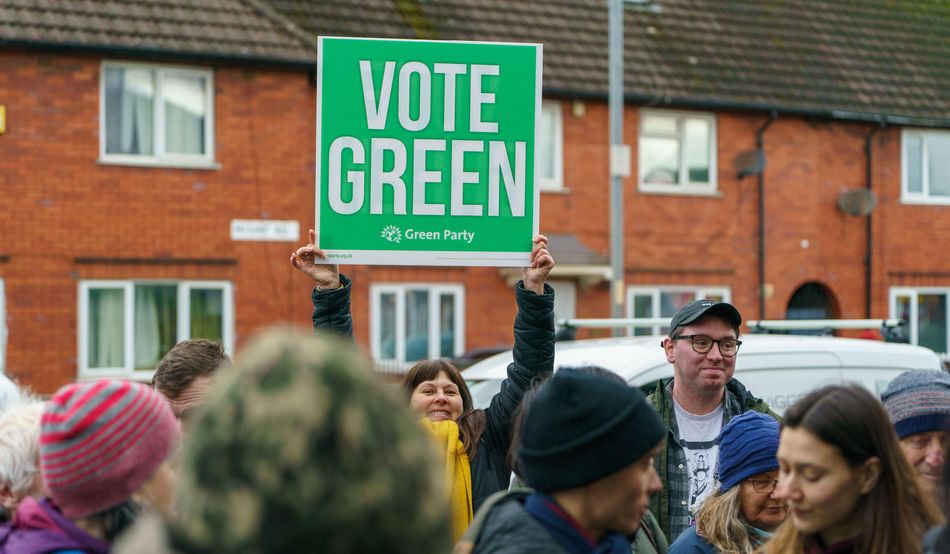
The Greens, by contrast, are entirely unguarded. I stumble on a trio of canvassers in South Gorton—two younger men based in Manchester, and an older canvasser named Andrew, who has trekked up all the way from Colchester. They’re delighted to have me tag along (Andrew even tells me he’s got a Prospect mug at home). They don’t have anything like Labour’s canvassing records, so are essentially knocking on every door. Their enthusiasm is sometimes met with puzzlement, occasionally with hostility. I watch Andrew amiably absorb a diatribe on immigrants and Nato from a man with a loud voice and two large dogs. I see more Green leaflets bobbing in Manchester puddles than in windows of the more depressed terraced streets. But eventually, I witness a good few firm pledges to vote for the Greens, and a couple of voters agreeing to take posters.
As the rain gets heavier, one of the canvassers offers to walk me back to HQ to dry off. The organisers don’t seem to care who is a campaigner and who is a journalist. The homely informality is in keeping with the style of the party’s candidate Hannah Spencer, a 34-year-old plumber I later catch on the phone. If elected, she insists, she will “always” hang on to the plumbing tools which honed the attributes she imagines an MP needs in Westminster: “to be resilient, to get my hands dirty and to fix problems.”
Just like Powell, Spencer’s general theme is seeing off Reform’s “division”, but she also resents Labour dividing up the electoral map and pointing to white working-class wards where the Greens can’t win. “There isn’t much variation, people everywhere want something different: honest politics,” she says, adding that Labour is in for a shock. The people it still thinks it can take for granted have other ideas now that the party is “so far removed from what it once was.”
Wandering around Gorton market, there are plenty of Don’t Knows and Don’t Cares: as always in byelections, apathy and low turnout could be critical. One extended family eating sandwiches includes a young man who volunteers “Reform all the way”; a young woman who declares “Green – because I’m red!”; and older relatives making a joke of it all so everyone can just get along. A 30-something couple is keen to talk, having been to a hustings. The woman had been especially impressed by two candidates—Sebastian Moore of the Social Democratic Party, these days reincarnated as a socially conservative “party of the patriotic state,” and Hugo Wils of the Communist League.
In a tight scrap, small numbers backing such fringe figures could make the difference. Rob Ford, a psephologist at Manchester University who knows Gorton and Denton well, tells me the more likely spoiler is the hard-right Advance UK, a party led by former Reform deputy leader Ben Habib. Its candidate is Nick Buckley, a charity staffer who won an MBE for work with homeless people, but waded into the culture wars at the time of Black Lives Matter and never waded out. Born in Longsight, he managed third place in the 2024 mayoral ballot, winning nearly 8 per cent across Greater Manchester as an independent in the Burnham landslide. If he scored anything similar on Thursday, he would probably sink Goodwin—especially as the equivalent wildcard on the populist left, George Galloway’s Workers Party of Britain, is sitting this contest out.
Nobody I spoke to mentioned the Conservatives or the Lib Dems—not even as potential confounding factors. That’s a reminder, if one were needed, that the end of the supposed “main parties” could indeed be nigh. That bodes ill for Labour, as does the anti-establishment mood of much of this constituency. One of its wards, Burnage, was redistricted from Manchester Withington—a constituency that abandoned Labour for the Lib Dems for a decade after the Iraq war. Students and the broader university population were a big factor then, along with the local Muslim population. Gorton and Denton has many more Muslim residents than Withington, and Labour’s hesitancy in confronting Israel’s war crimes in Gaza over the last few years carries echoes of Blair’s Iraq fiasco.
More generally, Starmer’s whole pose—of being a grown-up who deals with the world as it is, not as we might like it to be—grates with a chunk of urban voters who are instead attracted to temperamental political outsiders, whether moderates like Charles Kennedy or radicals like Jeremy Corbyn. One chilling statistic for the local Labour party is that it somehow already mislaid 15-odd per cent of Gorton and Denton’s vote between 2019 and 2024, plunging from 67 to 51 percent of the ballot between Corbyn’s national defeat in 2019 and Starmer’s great triumph in 2024. It is probably only being in the Manchester fiefdom—with a pretty well-regarded city council, a popular metro mayor and decades of canvass returns—that is keeping Labour in contention.
And yet anything other than a Labour hold will trigger an almighty reckoning. Should Reform sneak through the middle to win , a vicious blame-game on the left will begin. Spencer insists she “couldn’t feel guilty” because she has “stood up to Goodwin, pulled him up in hustings” and has taken on the right’s logic in a way that Labour has shirked. Powell returns the compliment: “I’d lay it at the Greens’ door,” for having “misrepresented reality by pretending they can win in places like Denton,” and posturing about “sending a message to Starmer” instead of just working “to keep Reform out.”
In a scenario where Goodwin’s defeated enemies tore strips off each other, Farage would claim victory as proof that his outfit could win anywhere.
But even if Reform were to edge it this week and then romp home nationally in 2029, Goodwin would likely be a one-term wonder in what would remain a naturally left-leaning seat. Once the people of Gorton and Denton have settled on the best way to see off Reform, I suspect they’ll manage to do so. The problem just now, is that there is no agreement on how. The one semi-credible poll of the contest suggests a pretty equal three way split, with a slight edge for the Greens over Reform, and Labour narrowly third. Even if this small gap isn’t just a facet of sampling error—which it could be—it could still be overpowered by better organisation on the day.
In short, anything could happen. Regardless of who wins, however, the outcome that would give this contest the most lasting legacy would be the Greens overtaking Labour. In the Caerphilly byelection for the Senedd last year, Plaid Cymru bested Reform by squeezing Labour to a miserable third in a traditional stronghold. Now polls suggest Labour could be reduced to an also-ran in Wales-wide elections this May. The national factor may make Wales a special case. But if Labour turned out not to be the most credible force against the hard right in Manchester, of all places, what stronghold would the party have left?