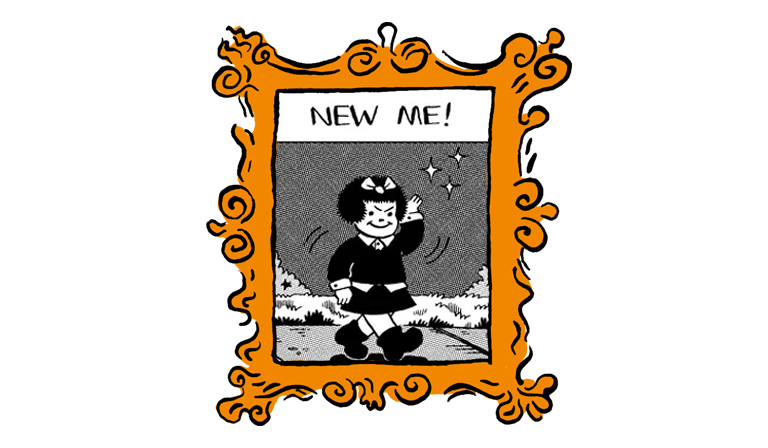
Comics characters often outlive their creators. Some have carried on for decades, others more than a century, picked up by new artists and writers who weren’t around when they started. Ernie Bushmiller’s Nancy is one of them.
During its original run under Bushmiller from 1938 to 1982, Nancy was one of the most popular daily newspaper comics in the United States, syndicated in over 900 titles at home and abroad. It never received the critical acclaim of Charles Schulz’s Peanuts—some derided it as clueless—but still it has retained an audience up to the present day, with six cartoonists having taken the helm since Bushmiller’s death.
In the 19th and 20th centuries, it was comics that sold newspapers. Nowadays the newspaper strip is seldom more than a stagnant pond of over-familiar faces, a symptom of stasis: there just to tread water and keep the copyright current for whoever owns it.
Nancy seemed destined to a similar fate, until in 2018 it received its most notable (and thoroughly millennial) takeover by the pseudonymous artist Olivia Jaimes. Jaimes is credited with freeing the comic from the sentimental-evangelical mire of Guy Gilchrist, whose 22-year run on the strip had long become stale. Further, Jaimes’s Nancy affirmed that an artist could thrive within the confines of this old-school format: from day one, she turned an iconic strip over-under-sideways-down. Modern-day tech and argot replaced the former homey middle-America vibe. If some fans whined—It’s ugly-looking! It’s not funny! I don’t get it!—that was simply validation of the gleeful risks Jaimes took in her work. Her Nancy also found a new audience online, via websites such as GoComics, where readers can comment under each day’s episode.
Some of the changes Jaimes brought were of a piece with Bushmiller’s original strips, themselves innovative for their day. The fourth wall is frequently broken and the characters aware they’re in a comic, for instance, or the artist revealing their omniscience and interacting with their pen-and-ink creations. Others were more poignant, such as the introduction of non-white characters, around which Jaimes often focused a loose continuity over the usual cast of Nancy, her buddy Sluggo and her aunt Fritzi Ritz.
In one edition from 2022, Jaimes traced the Nancy-Fritzi relation back billions of years, to the fossilised specimen Eukaryote Ritz. This level of high-functioning conceptual comedy breached the notion of what a newspaper comic is and can be: brainy, cheeky, deadpan. That’s the Queen Jaimes version of Nancy.
Now, after seven years, Jaimes has passed on the crown to Eisner Award-winning artist Caroline Cash. Known for her confrontational urban comic Peepee Poopoo, Cash originally appeared as a guest cartoonist for the strip in the summer of 2024.
While there’s not enough to base a critical thesis upon quite yet, Cash looks like the strongest personality to enter newspaper comics in years. Her Nancy teeters between crowd-pleasing and shocking, a vibrant imbalance that has the reader in a state of constant suspense. Each new strip is a surprise. She draws with vigorous, thick lines; her lettering is defiant in its lack of professional poise. I don’t envy her the graphic challenge of drawing the strip’s three main characters. Their iconic look is tricky; get one thing too small (or large) and it’s off.
Cash’s figures feel human and hands-on; drawn rather than engineered. Head sizes change from panel to panel; some drawings dazzle, as in the final frame of 8th January’s strip (which one imagines as a canvas painting in a gallery), where an angry Nancy shouts ‘CLOSE ENOUGH!’ as Sluggo, tense and frustrated, exudes a bead of sweat on his forehead. (This panel could serve as the official image for 2026.)
To celebrate her 30th birthday on 9th January, Cash made her own appearance in the strip. At a crowded soiree, she smokes a cigarette in a white dress shirt, with black tie and trousers. Her gender-fluid demeanor and bold body-language are bellicose, but in a purposeful way. She stands for a new generation of cartoonists intent to push the medium forward. In one of her original guest strips from 2nd August 2024, she speaks (through Nancy) the aspirations of her comics generation: Maybe I should start drawing comics. I’ll make my own characters, and I could publish my own zine.
In time, Cash might heed her own advice and start a new, original newspaper comic strip. For now, we can enjoy her work on Nancy as vibrant, authentic, edgy—everything it has not been for a very long time.
Where might newspaper comics be if their slate was wiped? If all legacy strips were retired, young cartoonists brought in and the comics page of a newspaper once again made into something people wanted to see?
Comics have so much potential to thrive, if they’re given the opportunity to reflect the here and now. There are enough young artists working today to incite a much-needed revolution and stir the medium’s soul—artists like Caroline Cash.
Long live Nancy!
The newspaper comic is one of America’s longest-running traditions, but it’s been in the doldrums for decades. Now a new generation of artists is leading a change
January 29, 2026