In April last year, a Bristol academic named Matthew Steggle published a paper that upturned everything conventionally assumed about William Shakespeare’s marriage. In a convincing analysis, Steggle demonstrated that an Elizabethan letter held at Hereford Cathedral had in fact been sent to Anne Hathaway, wife of Shakespeare and the central character of this month’s must-see film, Hamnet. It demanded money. William Shakespeare, the letter recounted, had stood as trustee of a neighbourhood boy’s small inheritance; with William refusing to pay out the trust’s obligations to the fatherless boy, it asked, might Anne tide things over out of her own resources?
Traditional academics—men—had assumed that Shakespeare deposited Hathaway in their native Stratford-upon-Avon and paid her scant heed during his years of self-fulfilment in London. By contrast, Steggle’s analysis of the letter placed Hathaway as living at Shakespeare’s address in London, managing his financial affairs and acting as an equal partner. She may even be the author of a forthright response on the reverse side of the letter, where scraps suggest someone insisting on a third party’s liability.
If his wife was living alongside him, in Trinity Lane near the Globe Theatre, then perhaps our national playwright did not have the freedom to spend his London years rolling from mistress to mistress, as in depicted in Shakespeare in Love (1998). Perhaps—although he certainly understood same-sex desire—he was inspired to write at least some of his romantic poetry for the woman most present in his life: a wife who shared not only his famous second-best bed in Stratford, but also his chambers in London.
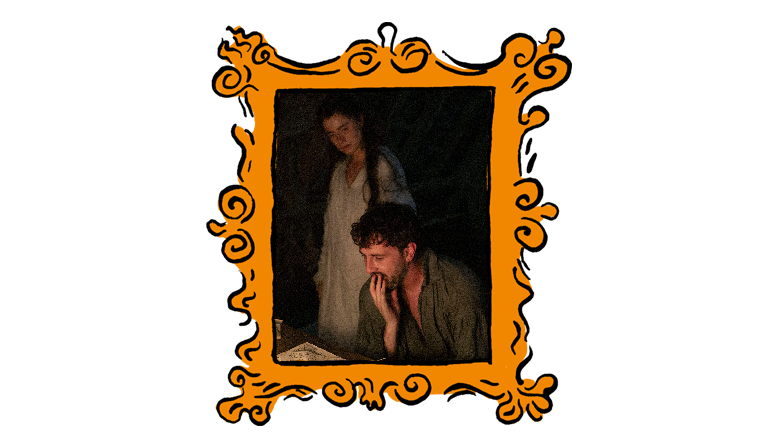
You will see no trace of this urban Hathaway in Chloé Zhao’s movie Hamnet, an adaptation of Maggie O’Farrell’s prize-winning novel, which looks set to win Jessie Buckley an Oscar for the role. (As in the novel, she is here referred to as Agnes, as if to create distance from our preconceptions.) Zhao’s film is faithful to the tone and aesthetic of O’Farrell’s novel: slow-moving, lyrical and occasionally dissociative, as it meanders through the early happy days of the Shakespeare marriage to the devastating grief the couple endure on the death of their son, the “Hamnet” of the title.
Zhao is faithful, too, to O’Farrell’s pseudo-progressive conception of Hathaway’s contribution to the marriage. As in the novel, this wife of Shakespeare is steeped in only the most conventional of women’s wisdom: herbal lore and nature worship. We first meet her curled up, foetus-like, in the roots of a great oak tree, the sacred site to which the women of her maternal line return routinely to birth their children. At her head, autumn leaves decay: wherever nature is present, there is also death. This is a film about the inspiration for Hamlet, Shakespeare’s most intellectual work, but it is also a film that peddles in the “green witch” imagery of the Marvel Cinematic Universe, in which Aubrey Plaza plays “the original green witch”, whose other face is Death.
Both Zhao and O’Farrell have talked extensively about the need to reclaim Hathaway’s dignity as a historical character. As O’Farrell told the BBC on the occasion of Steggle’s paper, “There have been very respected scholars who’ve said that she was ugly, that Shakespeare hated her, that she trapped him into marriage, that she was illiterate, that she was stupid.” The myth that Hathaway trapped Shakespeare into marriage has been particularly persistent, but the only evidence is that, like 25 per cent of late Elizabethan brides, she was pregnant at the altar. (Amongst country couples going steady, where marriage was eventually expected and families accommodating, pregnancy often merely determined the courtship timeline.) A marriage license once perceived to be made out to Shakespeare and “Anna Whateley”, and used to argue that Shakespeare was previously promised to another woman, is now widely accepted to be a clerical error for “Anna Hathaway”. Even so, the overwhelming pattern of male scholarship on the issue, up until Germaine Greer’s game-changing 2007 book Shakespeare’s Wife, has been to assume that no male genius could have been happy with his lawful wife.
O’Farrell has cited Greer’s book as a pivotal influence, and both O’Farrell and Zhao clearly see themselves as building on her defence of Hathaway’s legacy. So too do Lolita Chakrabarti and Erica Whyman, the playwright-adapter and director, respectively, of a successful Royal Shakespeare Company version for stage, revived to tour the US from this year (it opens in Chicago in February). Hathaway was eight years her husband’s senior, but at 26 she was of average age for an Elizabethan bride. So when I interviewed Whyman a few years ago, she pointed out that normal Elizabethan age patterns make a mockery of the twin ideas that Shakespeare represented Hathaway’s last chance at marriage and that “she must have been monstrous and desperate for a husband”. In fact, it was Shakespeare who was outside the usual age range for marriage, but this does not mean he must have been unwilling. As Whyman pointed out to me, his plays are full of ultra-young men who nevertheless find true love in the countryside: The Winter’s Tale, As You Like It…
Like the RSC version, Zhao’s film captures this sense of Shakespeare as the gormless romantic hero of one of his own forest comedies. In early scenes, Paul Mescal’s Shakespeare gawps in wonderment at the witchy beauty who runs rings around him. Buckley, who gave an assured Perdita in Keneth Branagh’s 2015 production of The Winter’s Tale, could easily be reprising that role here. Yet piled on top of this celebration of earthy womanhood is a series of retrograde assumptions about male and female spheres. “We as an industry are built on celebrating masculine qualities in storytelling and in life,” Zhao recently complained to the critic Peter Debruge, clarifying that “Civilization is masculine; nature is feminine.”
That could be the tagline for Zhao’s Hamnet. Buckley’s Hathaway refuses to engage with her husband’s sonnets. When she visits London, she is bewildered by it. Even at the film’s clichéd climax—the much-trailed scene in which Hathway sneaks into a performance of Hamlet and comes to understand how her husband has channelled his grief into a great work—she is so unable to understand the artifice of theatre that she has to ask her brother Bartholomew basic questions about what is going on.
Elsewhere, Hamnet is taught Greek; his twin sister Judith is taught his mother’s lore of the forest. When they swap clothes in an attempt to trick their parents, it is this difference in knowledge that gives them away (and the difference is presented as somehow revealing an innate and sexed truth, rather than a learned inequality). The moments that dwell on their relationship are nonetheless amongst the film’s strongest. There is a profound alternative adaptation somewhere in here about the extent to which Judith and Hamnet shaped their father’s obsession with mixed-sex twins and led to the grief-stained beauty of Twelfth Night. Yet, where Virginia Woolf once imagined a Judith Shakespeare who shared the family talent as a playwright, there is instead every suggestion that the highest dream of any woman’s life should indeed be the conventional Tudor way: marriage, children and muttering superstitions over herbs.
There’s much else to admire in Hamnet, if much else to dislike. Buckley gives a terrific performance as a woman convinced that one of her children, Judith, is marked for an early grave, only to discover far too late that she’s fretted over the wrong child. Yet in a downright dangerous move, the film repeatedly suggests that Hathaway’s insistence on giving birth to her children in a forest is a mark of sacred femininity, something that sets her apart from the blinkered women who prefer to give birth indoors, with a qualified midwife around. There’s nothing feminist about pushing high-risk birthing techniques on women: just this winter, a major Guardian investigation into the Free Birth Society found that its peddling of similar messages had led to dozens of stillbirths and cases of maternal-infant harm. By contrast, Hamnet suggests that the one occasion on which Hathaway is forced to give birth indoors is the moment that dooms her child.
Other critics have listed off Hamnet’s other flaws, including its mawkishness and its limited understanding of Shakespeare’s actual work. But next time there’s a biopic of Hathaway, I’d much rather see the Anne (not Agnes) of the Shakespeare couple’s London correspondence. Urbane, financially literate, capable of navigating capital’s sharpest corners. As with Hamnet, we will have to imagine her from scraps and glimpses. And not even the most indulgent feminist wishful-thinking can pretend she shared her husband’s once-in-a-millennium genius. But she belonged at his side, at the beating heart of an Elizabethan civilisation that only a reactionary would define as “masculine”. By relegating Anne Hathaway to the wilds of nature, Zhao and O’Farrell sideline her from what really matters.
How ‘Hamnet’ sidelines Anne Hathaway
Historical records suggest that Shakespeare’s wife was central to his career and life. So why does this film reduce her to a woman of the woods?
January 22, 2026
Image