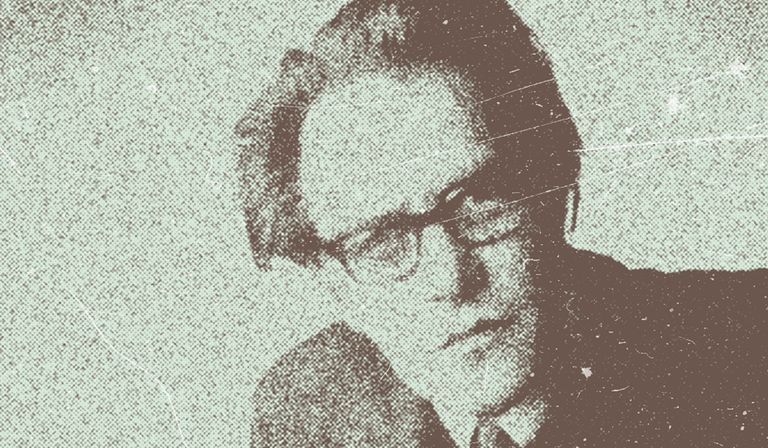
Who, today, remembers Robert Vas? His Refuge England (1959), a partly autobiographical account of a Hungarian migrant trying to make sense of London—its confusing streets and dizzying profusion of signs—is a marvel of Free Cinema. But he’s far less heralded than other figures in that briefly flaring movement; the likes of Lindsay Anderson or Karel Reisz or Tony Richardson. In just two decades, he made over 30 expansive and deeply humanistic films, on topics ranging from Laurel and Hardy to Solzhenitsyn, the Katyn forest massacre to the trial and death of Jesus. Almost none have been commercially released.
Born in 1931, Vas grew up in a Nazi-controlled ghetto in Budapest. Ninety per cent of Hungarian Jews ended up in Auschwitz, and he himself witnessed inmates being executed and dumped into the Danube. Later, his mother committed suicide, while his father fled alone to Australia. During his military service, he became an army projectionist, screening revolutionary Soviet films to thousands of soldiers in a huge open-air cinema. He ended up in a psychiatric hospital. Then, after the failure of the 1956 Hungarian Uprising, he escaped with his wife and child over the border to Austria, eventually landing up in England.
Following stints as a cleaner, Vas found a berth at the British Film Institute (BFI) where, when he wasn’t cataloguing magazines, he watched as many movies as he could. He also penned articles for Sight and Sound, tracking trends in arthouse and international cinema, championing directors such as Humphrey Jennings (the topic of one of his films) for his ability, in his wartime features, to conjure up a “sea of moods, connections, contrasts, episodes” in place of one-dimensional propaganda. No wonder that, writing about Godard, he argued, “Movies are a world of fragments, so why pretend smoothness?” This, after all, was an exile who believed “My life has been broken like a piece of film”.
Vas’s films are often about the brittleness of things. Landscapes—both local and national—that seem to be forever can be destroyed. By money, politicians. Master Singers (1965), narrated by Ewan MacColl, is set in Senghenydd, in a Welsh valley of “5,000 people, 14 chapels, seven rugby teams”. The choirs here are made up not just of miners, but of newsagents and bus conductors. Their proud, sonorous voices evoke the solidarity of trade unions, of shared terraces. Keening, too—for nearby lay Universal Colliery where, in 1913, a gas explosion killed 439 men, the most grievous industrial accident in British history. Vas thought that song was a form of survival; now, in 2026, his film is a time capsule, enshrining on celluloid mining communities that no longer exist.
Vas thought that song was a form of survival
The Vanishing Street (1962), supported by both the Jewish Chronicle and the BFI Experimental Film Fund, is a vivid portrait of the dying days of the Jewish East End. Here is a Whitechapel shtetl—street markets and garments stalls, sewing factories and kosher butchers. Here, often in close-up, are faces—those of cantors, bargain-hunting grannies, owners of shops going out of business. So much chatter and song. Diasporic drama. Thickness of life. But high-rise developments are sprouting up. Indians and Pakistanis are out and about. Vas captures a world that was on the brink of disappearance, that would have rekindled in him memories of his own lost home.
Belonging (1967), also set in east London, is to my mind one of the finest artist films ever made in Britain. It’s a triptych devoted to three distinctive figures—up-and-coming painter Johnny Martin, prole poet Johnnie Quarrell who works at a lathe factory and septuagenarian Polish-born Yiddish poet Avram Stencl. Each pounds the streets daily. Each channels the spirit of the place. Vas shows us peeling shop exteriors, darkened alleyways, gaslit corners. He lets us hear its clanging riverside machinery, echoic early-morning silence. He intuits—and allows us to glean—how history feeds their sometimes-dark visions.
In The Frontier (1964), meditative and essayistic, Vas returns to the Austro-Hungarian border and looks at and across the barbed wire there. He peers at fields being harvested, watches other tourists watching, ponders on how he came to love Hungary by being forced to live abroad. It’s a film about the Iron Curtain that could be about any country, in the present as much as in the past, that’s been partitioned or walled off.
Vas died, most likely of an accidental overdose, aged just 47. His liberal use of archival footage makes copyright clearance expensive. Still, it beggars belief that the BBC, which commissioned his body of work, hasn’t digitised or made it more accessible. Three cheers, then, for Birkbeck College which, on 27th March, is hosting “Robert Vas In Context”, a day-long symposium devoted to this great filmmaker.