When Tom Stoppard died in November, he left behind over 30 stage plays. But it was to Arcadia, his story of a Regency-era girl genius, that the obituarists most frequently returned.
In Thomasina Coverly, a teenager who anticipates Mandelbrot’s discoveries in fractal geometry by 150 years, the playwright created the perfect vessel for his virtuoso ability to get theatre audiences thinking about maths and science. Shortly after Stoppard’s death, a surgeon named Michael Baum achieved viral fame by writing to the Times to declare that a performance of Arcadia in 1993 had inspired him to discover a new form of chemotherapy, saving “many lives”.
Yet Arcadia is no cold work of science education. One narrative traces Thomasina’s forays into the world of desire and poetry, while in a second timeline a pair of academics compete to understand her disappearance from history. (“We shed as we pick up, like travellers who must carry everything in their arms, and what we let fall will be picked up by those behind,” says one character of humanity’s hapless attempts at documenting the past.) The result is as much a showcase for Tom Stoppard, chronicler of history and the human heart.
So it is a relief to find that the Old Vic’s new production, directed by Carrie Cracknell, is a fitting tribute. It is also a heartening reminder of the power of old school, text-based, intellectual drama, in a West End landscape threatening to abandon it.
Which is not to say that this Arcadia is perfect. The 19th century feels fresher here than the 1990s. The former timeline has the advantage of rising star Isis Hainsworth portraying Thomasina with an earnest naiveté that allows us to believe she can sketch the curves of the galaxy but can’t tell if she’s being lied to about the meaning of the phrase “carnal embrace”. She’s well-matched by Seamus Dillane as her tutor Septimus, who wears his sparky dialogue lightly, ably carrying much of the narrative responsibility for situating us in the literary coterie of the 1810s. Above them, two overlapping ellipses from set designer Alex Eales keep our minds nicely on the beauty of planetary geometry.
In the 1990s, the jostling of academics Hannah and Benedict echoes the rivalries that Septimus maintains, including with an off-stage Lord Byron. But post-#MeToo, there’s a darker element to Benedict’s pestering, and Cracknell allows Leila Farzad’s Hannah sharper retorts than in previous productions—and a fiercer act of defensive violence.
Post-#MeToo, there’s a darker element to Benedict’s pestering of Hannah in ‘Arcadia’
At other moments, Farzad’s performance can feel workmanlike (as my companion muttered: “it takes more than putting a pair of oversized glasses on a beautiful actress to make her an academic”). As Valentine, heir to the Coverly estate and to Thomasina’s numeracy skills, Angus Cooper struggles with making Stoppard’s exegeses on statistics palatable for an audience with digital-era attention spans. But the always-good Prasanna Puwanarajah is there to keep things biting as Benedict.
Arcadia is that rare thing: an ensemble work of live theatre that doesn’t underestimate its audience. Over at the Noël Coward Theatre, the other big theatrical opening of the month offers a glimpse of what we have to lose if theatre continues down the opposite path.
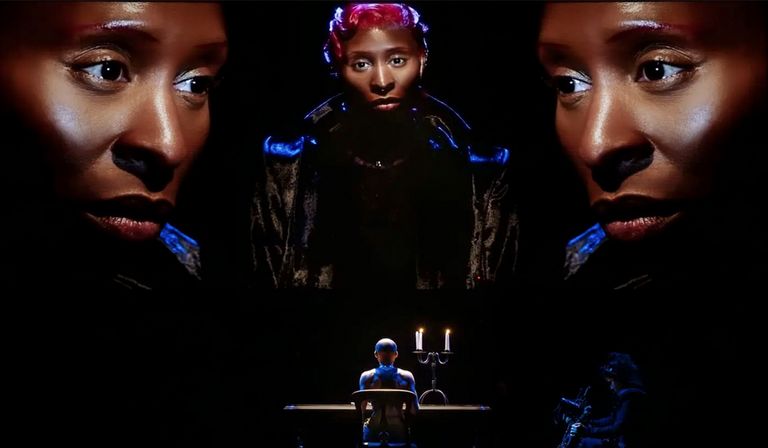
Dracula is the latest from Kip Williams, the Australian director—or, rather, video instillation artist—whose formula consists of placing a celebrity actor in front of a live-feed camera, training them to memorise a camp literary classic and adding split screens or Instagram filters to create the impression that multiple characters are live on screen at once.
Sarah Snook won a Tony for her work in The Picture of Dorian Gray. In Cynthia Erivo there is no doubt that Williams has another bona fide dramatic performer, long loved by stage critics before Hollywood found her. But her job here is reduced to audiobook narrator, reciting chunks of text while our eyes stay fixed on the huge screen that dominates the stage. Most of the time, Erivo’s birdlike body is barely lit, hidden behind furniture, or turned away from us in the darkness.
There are interesting ideas here. Erivo displays a chameleon-like range of accents and gives Dracula the Igbo accent of her own heritage. The scholar Stephen Arata famously proposed that Dracula’s Eastern European accents in Stoker’s novel reflected the era’s fears of “reverse colonisation”; Erivo’s version occupies much the same space in the contemporary racist imagination and carries enough glamorous appeal to be no subaltern.
But even Erivo struggles under the weight of reciting a text for 110 minutes—hence headlines about her use of an autocue. How I longed for her to be given some castmates to share the burden. But one-woman shows—even with technical fireworks—are cheaper to stage than ensemble dramas. Which means that in theatre’s post-Covid, budget-strapped era, they are here to stay.