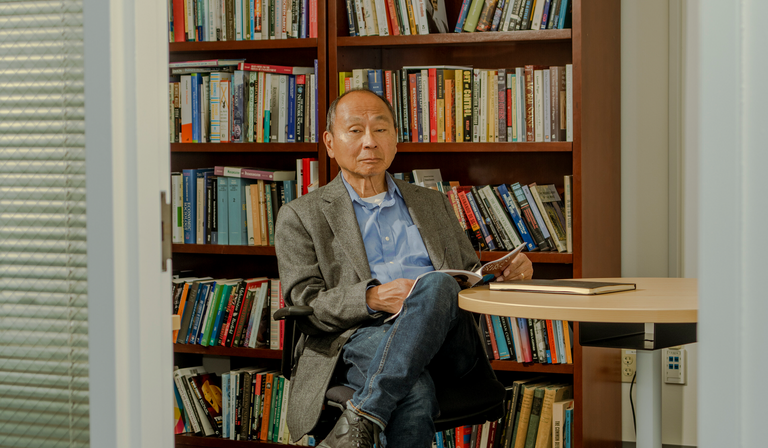
One thing I hadn’t expected from Francis Fukuyama’s intellectual autobiography was advice on building your own computer, but there it is: “There are a number of little tricks you learn along the way, such as properly seating the cooling fan on top of the microprocessor.” Why might such technical self-sufficiency be a good idea? The writer turns out to be dogged by nightmare visions of a “cascade” of “failures” overwhelming disempowered moderns—people unable to read a paper map when their GPS falters, a generation whose dads fixed cars yet have no idea where to start if their robotaxi breaks down. More “the end of days”, in other words, than “the end of history”.
Thirty-seven years have passed since the famous (or infamous) 1989 paper that made this American thinker a global name but also seared his reputation with that four-word catchphrase. To the millions who, as he fairly complains, “never read beyond my title”, he was the scholarly equivalent of an Economist editorial: a gratingly upbeat herald of our supposed march towards the best of all possible worlds, in which liberal democracy was not just triumphant but unchallenged.
The 35 quirky yet unapologetically intellectual mini-chapters that make up In the Realm of the Last Man meander their way towards dispelling this lingering caricature. Fukuyama wants to establish that he was never a Panglossian cheerleader for democratic capitalism, but rather someone who has always had a feel for the dark as well as the light in human affairs. He is also out to catalogue all the extra things that decades of hard thinking have taught him to worry about, on a globe that has spun from the confident certainties of the first President Bush’s “New World Order” to the anarchy of Planet Trump.
Certainly, it’s a moment to take stock. Despite Fukuyama’s measured way with words, there’s no missing the alarm he sounds about where Donald Trump, Vladimir Putin and assorted other villains are trying to lead us. His new book opens by charging America’s 47th presidency with breaking from 250 years of chequered advancement towards the ideals set out in the Declaration of Independence. Trump is “trying to turn the United States into an authoritarian country”. But the late 20th century’s great political optimist has not turned into a prophet of doom: Fukuyama doesn’t think this attempt will succeed—at least, not soon. Looking ahead to the autumn midterm elections, which some fear could be warped by interference and intimidation, he tells me he remains “confident that there will be a big pushback” against Republican rule. Moreover, Trump’s humbling will be “part of a larger pattern of pushback against populist-nationalist forces”, also evident in Viktor Orbán’s recent ousting in Hungary and Putin’s increasing difficulties “on the battlefield in Ukraine”.
The mature Fukuyama seems to find a bit of good news with which to caveat every item of bad news—and vice versa. In Germany, “the [hard right] AfD may come to power in one or two states and that’s going to be a big precedent,” but a proportional voting system will still require them to operate within the serious constraints of coalition. In France, Marine Le Pen could finally capture the Élysée next year, yet find she has to govern in the same (EU- and Nato-compliant) spirit as Italy’s Giorgia Meloni, rather than that of the Putinesque Orbán. And while those 2026 US midterms should be fine, Fukuyama is very worried about the next race for the White House in 2028, fearing that Democrats “living in cloud cuckoo land” could adopt the kind of radical candidate who “could win in New York or San Francisco” but “just cannot win nationwide”.
In discussing where the world is headed, far from peddling complacent presumptions, Fukuyama seems to regard virtually everything as being in play. This approach is not simply the reasoning of an erudite head. It is just as much about maintaining heart for the fight. In the face of the chauvinist tide, he says, “You’re not going to stop this movement unless you are mobilised, and you’re not going to be mobilised if you think the victory of the other side is inevitable, and so we have to assume we can exert agency, and push history in a different direction.” Towards, it is tempting to say, a different end.
Two things jumped out for me from Fukuyama’s brief rendering of his own backstory. Both could have threatened his sense of belonging, but he found ways to ensure neither did. The first was his father’s family being sent to one of the US’ notorious internment camps during the Second World War, purely on grounds of their Japanese heritage. The Los Angeles hardware store on which his grandfather had built his social position was lost for good. This grim tale of discrimination was, however, softened by his father’s escape via a scholarship awarded by a small college in Nebraska. “There’s always these bleeding-heart liberals that want to reach out to people being mistreated,” Fukuyama half-jokes when I ask him about this, “and I appreciated that.”
His dad went on to a successful academic career and, Fukuyama relays, “I remember him saying that he didn’t think there was a single moment in his life where his race stood in the way of him accomplishing anything.” The main thing he takes away from his family’s experiences is instead “the possibility of assimilation”, even in the face of great obstacles. He sees racial identity politics as “foolish” since “it confines you to an ethnic ghetto, if you don’t just think of you as an American.” Indeed, throughout Fukuyama’s evolution, love for his country remains a perennial, even as he has come to despair at its current government and many longer-standing particularities of its political system.
The second potential force for alienation in the Fukuyama backstory was his personal relationship with that father, whom, he writes, “never gave me credit for being able to think for myself”, and assumed he’d been “brainwashed” whenever “I said something he disliked”. That must have been painful for a thoughtful young man. And for as long as his father “was alive”, Fukuyama “resisted reading” the classic works of social theory that his old man had studied—Weber, Durkheim, Marx and so on. Only after he died in 1995 did Francis pick them up and discover “one of my greatest intellectual pleasures”. The broad emphasis on concepts and causes in this canon is something Fukuyama contrasts with the narrow, data-driven methods of contemporary social science, and is an approach he has tried to make his own.
The immediate reaction to his father’s disdain was however, predictably perhaps, less reflective than rebellious. As a youth, Fukuyama had absorbed his leftist father’s pacifism, and the future builder of computers was sufficiently tribal in his leanings to scorn the likes of engineers, because he presumed such practical types “tended conservative and supported the Vietnam war”. Things changed on leaving home, however. While most new students arriving on campuses in the early 1970s were propelled to the radical left, Fukuyama “turned more conservative when I left for Cornell” and fell under the influence of the right-leaning thinker Allan Bloom. An abortive flirtation with fashionable but ultimately “bullshit” French postmodernist theory only confirmed his drift. Fukuyama abruptly put down Foucault and Lacan, picked up Churchill’s The Second World War, and moved away from the humanities to study international relations at Harvard. By the late 1970s, he was snugly installed within those Cold Warrior circles that would in time become Washington’s “neocons”. He has spent most of the 21st century thinking his way back to independence from the tribe to which he once belonged.
Fukuyama abruptly put down Foucault and Lacan, and picked up Churchill’s ‘The Second World War’
The first public break came over the second Iraq war, although not—to Fukuyama’s regret—in the buildup during which, he recalls with embarrassment, he “rather casually” signed one of the “periodic” public letters going round his circle calling for the unseating of Saddam Hussein. He didn’t break with the neocons when the fighting started early in 2003, or that summer when the first sparks of civil war were glowing, but only in 2004.
This conflict, by design, trampled over the principle of state sovereignty that was the claimed motivation of the first Iraq war back in 1990. Washington’s stated case for launching it relied, as MI6 relayed to Tony Blair, on the “facts… being fixed around the policy”. Even today, however, Fukuyama recoils from Iraq “conspiracy theories” and charges of bad faith, prosecuting instead the “practical” failure “to think through what the consequences of using force would be”. It’s the same “maddening” mistake that he tells me he now sees Trump making in Iran. Back in 2003, he writes, “I knew full well that the [Iraq] intervention was likely to lead to huge unintended consequences… The problem was psychological.” With neocons such as Paul Wolfowitz—someone Fukuyama deferred to and regarded as “one of the smartest people I had ever met”—busily rationalising the misadventure, Fukuyama encountered “a mental block” on concluding his old mates were wrong. Only when faced with the full scale of the catastrophe did he realise that “sometimes it takes an extremely intelligent person to convince themselves of something implausible.”
Eventually, he got there—and endured being blanked by former friends at parties in Washington DC. But once the painful break was made, “it was actually liberating”. Fukuyama began interrogating all sorts of other nostrums which tended to be taken for granted among the cheerleaders for the carefree deployment of American force, including the merits of untrammelled finance and contempt for the role of the state.
As he began to think anew in middle age, Fukuyama was lucky to be able to draw on his early education with Bloom (and, indirectly, Bloom’s own mentor, Leo Strauss), which was rooted in the big questions that have kept philosophers since Socrates and Plato busy. What makes for a life well lived? Or for a just society? The memorable insights in the new book come in brief, brilliant flashes, where Fukuyama goes beyond specific scholarly detail and pronounces on the big picture. The observation, for example, that it was Machiavelli who first lowered the “the horizon of politics” from the classical concern with “the cultivation of the good life” to “the preservation of life itself”—and, in so doing, cleared the way for Hobbes, Locke and Rousseau. The reflection that each of this trio built their distinct philosophies on very different views concerning what human beings are actually like. And the salute to each of them for trying to grapple with our nature, rather than reducing people—as Fukuyama charges Kant and such heirs as John Rawls with doing—to desiccated reasoning machines.
Fukuyama accuses mainstream economics, too, of walking into that last trap. He deftly dispatches modish claims that tweaking its atomistic analysis with a bit of evidence on “altruism”, “habit” and “other nonmaterial” preferences could ever be an adequate fix. Once we reckon with the capacity of individuals to want things for others in the same way as they do for themselves, he argues, then anything can happen, and the economists’ so-called models “will obviously have trouble predicting” anything at all.
The hardbitten ultra-realist school in international relations is accused of the same hopeless reductivism. It sees states as impenetrable “billiard balls” whose movements around the other balls on the table are observed without troubling about their inner workings. Fukuyama draws a neat parallel between the way economists shrivel us all to our pursuit of “utility”, and the way realists attribute everything that governments do to an ill-defined “national interest” without asking how internal politics determine what that interest is judged to be. In economics and international politics alike, real life is complicated and hard to predict.
So where does this leave the “end of history”? To answer that, we first need to go back to the strange and distinct nature of Fukuyama’s original thesis. He grabbed and twisted a thought from a series of influential lectures on Hegel that the Russian-born philosopher (and later Eurocrat) Alexandre Kojève had given in Paris in the 1930s. Kojève had (somewhat “playfully”, as Fukuyama acknowledges) “asserted that history had ended at 1806”, when Napoleon routed the old aristocratic order of Prussia and consecrated the French Revolution on the battlefield. Obviously, Kojève understood that wars, revolutions, conquests and colonial struggles continued. His point, Fukuyama explains, “was that once the idea of universal freedom got out, it was only a matter of time” before that winning principle prevailed everywhere. No-one has or will come up with a better basis for constructing a society than “equality of freedom” and “equality of dignity”. In the realm of ideas, traditional appeals to hierarchy and dominance were no longer in contention: liberalism reigned alone.
There were many oddities in this provocation, not least that Kojève himself eventually turned out to be a KGB agent—and so a man of the Russian, not French, revolution. And yet, 1989 was an opportune moment for Fukuyama to disinter and freshen up the argument. With Communism crumbling, the countries it used to run had looked set to converge on the western model. Fukuyama’s memoir is at pains to remind us, though, that even then he was not triumphalist. “The end of history,” his original paper said, “will be a very sad time,” as “daring, courage, imagination and idealism” are rendered superfluous in a future of peace, prosperity and stable liberal-democratic rule.
By 1992, Fukuyama expanded this argument about what could be lost into a book, incorporating five chapters inspired by Nietzsche’s goading portrait of the pathetic, passive and bovine “last man” left living in a world where humans had nothing to struggle for. “Man does not strive after happiness,” the hammer philosopher had sneered, “only the Englishman does that.” Fukuyama was already fretting that a human appetite for dominance, or just plain “boredom”, could lead people to kick against liberal democracy. Today, he looks at the populist wave and feels vindicated.
The big thing that has changed for him is not, to my surprise, the long decades of wage stagnation and inequality in many western economies. On Fukuyama’s Olympian long view, liberal democracy continues to provide “objective material conditions that have never been better”, which would have been unimaginable across most of history. His new worry instead is a “generational cycle”, because “one of the most powerful drivers of belief in liberalism is to live in an illiberal society”. After decades of liberal hegemony, the rising cohort in a country such as “Poland has no direct experience of living under a dictatorship, so they can now start thinking that, well, ‘Brussels is the real dictatorship’.”
“And so it may be the case,” he sums up, “that the ‘end of history’ is going to be a sort of cyclical thing, where we are going to have to go through periods of experimenting with illiberal solutions to this longing for an alternative, and then learn how bad they are, and then go back to accepting liberal democracy.” An interesting thought—though not, in any ordinary sense, an ending.
In the Realm of the Last Man by Francis Fukuyama (Profile, £20) is out on 8th September 2026