In the early 12th century a French monk, Baudri of Bourgueil, wrote a long poem for Adela of Normandy. Adela was William the Conqueror’s daughter. She had been born in about 1067, just months after her father’s famous victory and coronation at Westminster Abbey, but likely grew up in a convent on the other side of the channel. In the mid-1080s, when she was still just a teenager, she married Stephen of Blois, a nobleman some two decades her senior. Adela had an uncertain number of children: at least five sons, one of whom became King Stephen of England, and a less definite number of daughters.
Baudri’s poem was written with this brood of children in mind. Over more than 1,300 lines of Latin “elegiac distichs” (a form that consciously aped Ovid), Baudri taught the children about the nature of the world, using a description of Adela’s bedchamber as his classroom. Every inch of this imagined room is covered in knowledge: there are tapestries on the wall that show biblical and classical stories the children must learn; there is a magical, ornate floor that shows a mappa mundi, with the land of the continents and the expanses of blue, wild ocean. The vaulted ceiling is painted to be a replica of the night sky, with constellations of stars and planets. The room’s walls constitute a microcosm of the known world, with the children at its centre. The pedagogical benefit is only slightly tempered by the shock factor of Baudri, a monk, imagining himself deep within Adela’s most private space.
The pinnacle of Baudri’s wonders of interior design is the hanging that envelops Adela’s bed. It was woven, he tells the children, by a hand “unprecedented in skill”; a hand that spun gold thread with silver as fine as a spider’s web, and stitched in jewels and gems. These fine colours reveal a sequence of events that seem uncannily familiar. In one scene, we see Adela’s father, William, careering masculinely across the textile; in another, we see the red-hot tail of Halley’s comet as it streaks through the sky. There is shipbuilding for the invasion and fleets of vessels crossing the channel, and crowds of people fleeing the “forest of spears”. Captions embroidered below describe the terrifying noise of the battle and encompass the violence in which Harold is killed by the famous arrow. Eventually, 300 lines later and some distance further around the textile, William rides across victorious.
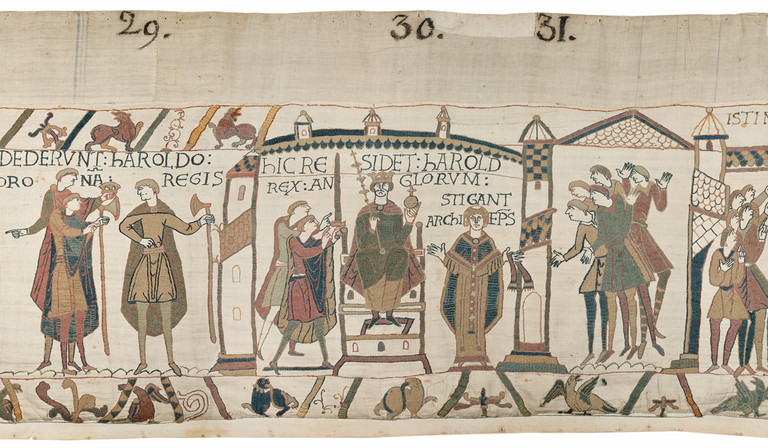
These “historic events”, as Baudri calls them, are of course the events of the Norman Conquest. This described, imagined textile art winding its way around a noblewoman’s bedroom bears more than a striking resemblance to the Bayeux Tapestry.
Baudri’s poem has posed something of a riddle for later readers, scholars and academics. He was likely writing in the early 1100s. Does that mean that the Bayeux Tapestry was already finished? Had Baudri, an abbot in the Loire Valley, had a chance to see it? His descriptions would suggest he knew of its existence, but the work he describes is far richer and more ornate—gems stitched with gold thread, rather than woollen yarn on linen backing. Baudri could have been working from nothing more than pure imagination, but there’s a chance his poem hints at something wider: a whole world of early medieval textiles, woven for kings, priests, or bishops, recording historical events. But why do we only ever hear about Bayeux?
The British Museum’s Bayeux Tapestry exhibition opened on 10th September, and the first release of tickets has long since sold out. But preparations for the show, and the textile’s journey from northern France to London’s Bloomsbury, have been riven with controversy. Should the textile (despite its name it is an embroidery, with designs stitched onto a background, rather than a true tapestry) have been moved at all? Is it too fragile? Too important? Some 75,000 French citizens signed a petition arguing that its journey was a “cultural crime”. A rival British petition to keep the tapestry permanently in the UK only has 25 signatures at the time of writing. Even the late, great David Hockney weighed in, arguing that “some things are too precious to take a risk with”.
These debates have revolved around just how exceptional the textile is. It is so special, so rare and so much a part of our shared cultural history that we can’t afford any chance of damage. It’s an argument that is hard to disagree with. The nine extant panels (there are thought to be at least two missing) have so far avoided almost every enemy of historical textiles. They have not been lost by hapless local museums, devoured by moths or corroded and “replaced” by the minerals in soil (such as an embroidered cuff found at Sutton Hoo). The stitches were not sealed inside a coffin and have not been subjected to the bacteria and acid of a decomposing body; they have not been discarded into a peat bog and left to fend against the elements until rescued by a Victorian antiquarian (like the 3rd-century Orkney Hood).
The continued existence of all 68.3 metres of the tapestry is something of a miracle
The tapestry first finds its way into the historical record in 1476, when an inventory was made of the contents of Bayeux Cathedral. Though it was likely made in England in the late 11th century, the first four centuries of its history—and its first Channel crossing—are now unrecorded. And after its discovery in the 15th century, it wasn’t all plain sailing. During the French Revolution, it narrowly avoided plans to refashion it into a carnival float for the newly revered “Goddess of Reason”. A few years later, Napoleon moved it to Paris to drum up support for his planned invasion of England. During the Second World War, the Nazis looked into moving it to Germany.
In short, the continued existence of all 68.3 metres of the tapestry is something of a miracle. It has avoided almost every possible pitfall, from natural wear-and-tear to political drama. (Though, apparently, the conservation work undertaken once the tapestry arrived in heatwave London has resulted in some close calls. The conservators can’t use fans for fears of damaging the work and have had to avoid beads of sweat landing on the textile.)
There is no way of matching Baudri’s imagined, described textile with the real Bayeux Tapestry, but the poet does include one tantalising clue. He tells Adela’s children that it was his mother who directed the creation of the work:
She herself oversaw and instructed the girls in their weaving,
Told them exactly what she wanted their shuttles to do.
Is Baudri just buttering up his patron? Stressing Adela’s talents to win favour? Perhaps, though many aristocratic and elite women in this period would have been skilled in needlework. There is next to no chance that Adela worked on the real Bayeux Tapestry (it was probably being created when she was a child overseas in England), but Baudri’s nod to his patron’s creativity is intriguing.
In recent press about the Bayeux Tapestry, much has been made of the fact that its creators were almost certainly women (likely nuns, possibly from Barking Abbey). The evidence is overwhelming: in this period, there is not so much as a mention of a man undertaking needlework. Embroidery and weaving were works of difficult, fiddly labour; the means by which many women were able to earn a living, either working alone or in communities or schools with other women. Evidence for early medieval textiles—even after the finely worked fabric has decayed, disintegrated, or been lost—are far more than just a contemporary talking point. They are often the means by which the names and lives of early medieval women peep through into the historical record.
One woman, Eanswitha, appears in a charter from the early 9th century. She was given a lifelong lease on a large farm in Hereford by Deneberht, bishop of Worcester, in exchange for her services. She “mends, cleans, and adds to Worcester’s ecclesiastical vestments”, the document reads. The size of the job, and the size of the 200-acre estate, suggest that this may have been the work of more than one woman. Eanswitha may well have headed up a team of women, their needles moving together some two centuries before the teams of women who must have worked on the Bayeux Tapestry.
A little later, there is another tantalising record of women’s embroidery. After the Battle of Maldon in 991 between Anglo-Saxon nobles and Viking invaders, the widow of one of the Saxon leaders, Byrhtnoth, commissioned a wallhanging in his honour, which hung in Ely Cathderal. The textile has long been lost, and known only from its mention in a 12th-century chronicle, but could its use of textile as a means of recording history have influenced whoever commissioned the Bayeux Tapestry?
Ely Cathedral gives us other records of needleworkers. In a copy of an 11th-century will, one mother, Leofflæd, made plans for her daughters: if they did not marry, their land was to be given to the church. One daughter remained unmarried and, in exchange for her land going to the church, she received an estate outside Ely, where she spent her time weaving and embroidering with other young women, producing ecclesiastical textiles. Hidden in an unassuming copy of a will is a record of something that must have been more widespread: women working, their labour creating the fabric of early medieval Christian society. After the conquest, two other women feature in the Domesday Book, compiled in 1086. Æfgyth and Leofgyth both held land in exchange for their work with gold thread.
It would be easy to dismiss this history as a ghostly mirage, records of women who worked with their needles but for whom, sadly, no attributable work now exists. That is true for an overwhelming amount of textile material: so much has been lost, and stitches now only survive in dry descriptions or oblique mentions. (Even objects found as late as the 1980s, in the case of one relic pouch, have been lost after accession to museums.)
But it is not all doom and gloom. Some works have indeed endured, from the tiny pearls and gold thread of the early 9th-century Maaseik Embroideries to the glowing splendour of the Cuthbert Embroideries held in Durham Cathedral.
For the Cuthbert textiles, there is no ambiguity about who commissioned the work. Embroidered on the reverse is a line of text, which (in translation) reads “Ælflæd ordered this to be made.” The early 10th-century stole, maniple and girdle were found when the coffin of St Cuthbert was opened in 1827. They show Old Testament prophets, saints and popes—in more detail, and more elegance, than any of the figures in the Bayeux Tapestry.
And they’re on show, every day, at Durham Cathedral, with no ticket queue necessary. Who needs the Bayeux Tapestry, anyway?