Who’s afraid of eccentrics? Some see them as weirdos, outsiders, fundamentally off. As victims whose tics and sensibilities invite diagnosis or suspicion, they’re on the spectrum. Others, though, think of them as amiable mavericks, individuals who plough their furrows with no thought of fame or fashion. Edith Sitwell, herself so singular she once confessed to feeling like “an unpopular electric eel in a pool of catfish”, believed eccentrics flourished on this island “because of that peculiar and satisfactory knowledge of infallibility that is the hallmark and birthright of the British nation”. In this telling, eccentrics are proudly independent, march to the beat of their own drum, represent the best of “us”.
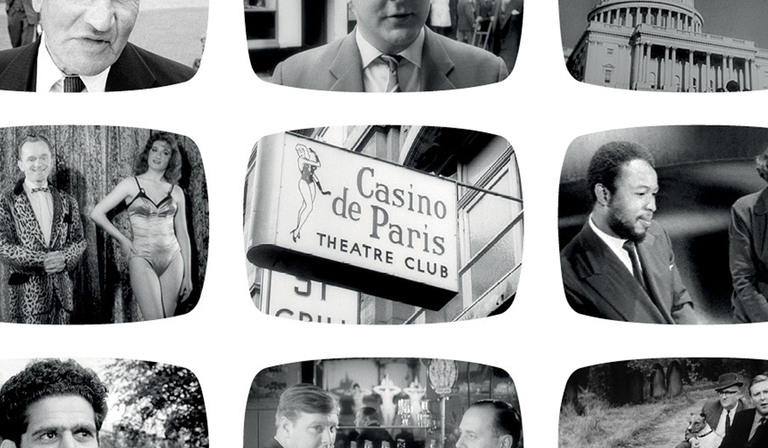
Eccentrics of all types spill out of Daniel Farson’s Guide to Britain, a pair of delightful Blu-rays from the British Film Institute—the first volume released in February, the second in mid-September—bringing together a bevy of long-unseen current-affairs shorts originally broadcast in the 1950s and 1960s on ITV’s Associated-Rediffusion network in London. Winds of change were blowing across the nation: mass migration was bringing the empire home, teenagers—or the idea of them—provoked social conniptions, brash advertising fuelled desires and terraformed psyches.
Tracking these eruptions and energies was the cultural in-betweener Farson—son of an English mother and the well-known American journalist Negley Farson—who for many years had bounced around the Atlantic as an evacuee, soldier and merchant sailor. He had also been a political correspondent and worked at Picture Post, though he was most at home in the more déclassé bars of Soho, where he sozzled away the hours with a motley crew of lushes, drifters, rent boys and artists. (A book he later wrote about one of them, Francis Bacon, formed the basis of John Maybury’s 1998 film Love Is the Devil.)
Farson relished this chaotic republic of irascibles and outliers. Some of its spirit is present in the programmes he fronted: on strippers, the beat scene, unmarried mothers, mixed marriages, zeitgeisty artists such as A Taste of Honey playwright Shelagh Delaney. One series he presented, Out of Step, focused on men and women “who hold odd views about life. Are these people just cranks or are they one step ahead of us?”
A typically untypical episode was devoted to witchcraft and featured Gerald Gardner, a Wiccan philosopher (also known as “Scire”) who resembled an ancient satyr and lived in a ruined mill on the Isle of Man surrounded by hideous relics. Farson, initially sceptical, asks him if “covens are excuses for sexual orgies”; by the end, though, he finds himself wondering if witchery is everywhere—in the charismatic power wielded by Hitler, the intoxicated dancing of rock ’n’ rollers, the tabloid Gnosticism of the daily horoscope pages.
Farson, initially sceptical, asks him if ‘covens are excuses for sexual orgies’...
Wonderful humanity! Here are the proud nudists of Hertfordshire. And here, in One Man Against the World, is Harold Steele, a former poultry farmer and conscientious objector who travelled to Japan hoping to sail into the Pacific to halt Britain’s H-bomb tests. Other Worlds Are Watching Us, about modern UFOlogy, gives extended screen time to the Hon Brinsley Le Poer Trench, editor of the Flying Saucer Review—and to George King, editor of Cosmic Voice, who recounts visiting (in his “etheric body”) a space station from Mars. “What are the women of Venus like?” Farson asks him. “Very, very beautiful.” There are moments when Farson can barely stifle his laughter, but he has no interest in debunking or denouncing his interviewees. He always ends his programmes by encouraging viewers to be open to the subcultures they have just been exposed to.
Shot in 35mm, with atmospheric location photography by Adrian Cooper, Farson’s finest film—in his 1959 series Farson’s Guide to the British—concerns cat lovers. He meets Christabel Aberconway, dowager, posh and endearingly awkward, who looks to be on the verge of tears when he suggests cats are fickle. “Why do you say that? That’s the most untrue thing I’ve ever heard said.” He talks to a pair of taxidermists; a woman who makes up ads in the Times personal column (“Vicar leaving country rectory to work in Docklands wants home for his enchanting black and white cat”); a pair of older ladies who wander bomb sites at 4.30am every day to feed meat and potatoes (and gravy!) to London’s unhoused cats. It deserves to be better known.
For a while, in the 1960s, Farson became a publican on the Isle of Dogs. He wrote dozens of books, continued to drink prodigiously, and died, semi-forgotten, at the age of 70 in 1997. These archival releases should do much to restore his reputation. And to fly a flag, too, for eccentrics: seekers, autodidacts, enchanted and enchanting.