In between concerts, I’m returning to work on my book about Britten’s War Requiem. I talk about the piece—which I love and have performed so many times—but its genesis and structure give me ample opportunity to go off-piste. Half of the text is the traditional Latin mass for the dead, as set by the likes of Mozart, Verdi, Fauré and Andrew Lloyd Webber. For the other half, in an ironic juxtaposition, Britten sets war poems by Wilfred Owen—which opens up possibilities for talking about artillery or war aims or field punishments for delinquent soldiers.
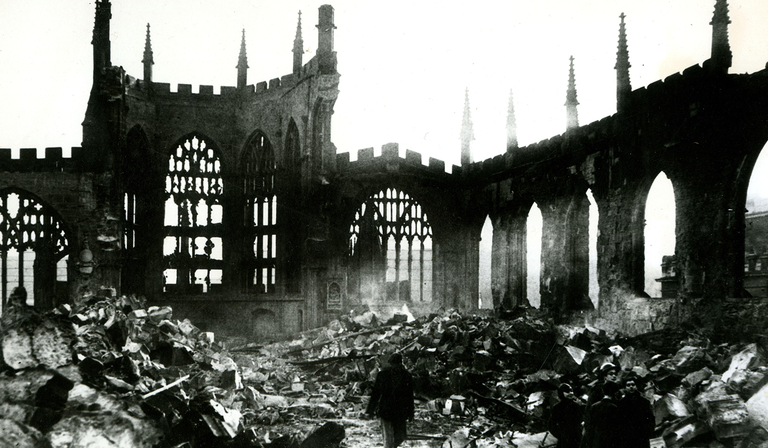
The Requiem was written in 1961, to be premiered in the new Coventry Cathedral in 1962. So the Second World War is also part of my brief—the new building was set at right angles to the old one, bombed to bits in 1940—as well as all those things that were going on in the early 1960s. The Cuban Missile Crisis, the Eichmann trial, the Berlin Wall. It’s a lot to grapple with.
The early 1960s were undoubtedly a time of challenge for received views about the First World War and its second round, 1939–45. The 50th anniversary of 1914 was coming up in 1964, and a work like the War Requiem both fed on and stimulated new interest: it was certainly one of the reasons why Owen’s poetry achieved canonical status from that decade on.
♦♦♦
In 1961, there was a huge controversy in Germany when the historian Fritz Fischer published his study Griff nach der Weltmacht: Die Kriegszielpolitik des kaiserlichen Deutschland 1914–1918—literally, “Grasp for World Power: the war aims policy of Imperial Germany 1914-1918”. From the 1920s on, the mainstream line had been that the nations of Europe had, as Lloyd George put it, “slithered into war”. Contrary to the provisions of the Treaty of Versailles in 1919, no one was to blame. This view was so entrenched that, in 1951, German and French schools made an official agreement that it should be reflected in textbooks on both sides of the border.
With a vast mass of documentary evidence behind him—British historian AJP Taylor compared the book to a Mahler symphony, “it just goes on and on”—Fischer argued that Germany had risked or even encouraged war in July 1914. An aggressive policy had been driven by imperial interest groups whose expansionist aims were reflected in Fischer’s great discovery, the so-called “September programme” approved by the Reich chancellor Theobald von Bethmann Hollweg.
Fischer’s new interpretation was discussed in the German parliament, excoriated by conservative historians and serialised in Der Spiegel. The German foreign ministry even went as far as to withdraw sponsorship for Fischer’s lecture tour in the US. It was a scandal. But, by 2014 and the centenary of the war’s outbreak, the president of the Federal Republic, speaking in Belgium, a victim of German assault, wove something of spirit of the Fischer “thesis” into his commemorative address.
♦♦♦
The other big war aims book of 1961 was brash, witty and scandalous. It looked at the outbreak of the Second World War and argued that Hitler’s goals were very much in line with those of the statesmen of 1914–18, those whom Fischer had spotlit. It was sheer synchronicity that the two books appeared in the same year.
I first read AJP Taylor’s Origins of the Second World War as a teenager. Rereading it now, it’s entertaining, its emphasis on Hitler as an opportunist half-convincing. What it necessarily misses out on is all the subsequent research—much of it stimulated by Taylor—about the depth and breadth and reach of Nazi ideology, its commitment to war, far beyond even what the most extreme German nationalists were planning before and during the First World War.
Taylor plainly set out to ruffle feathers. Already in the 1950s, he was being provocative. Hitler “had only to sit up on the Berghof, eating cream buns, and the artificial system of European security fell to pieces before his eyes”. He wasn’t denying the particular “wickedness” of Hitler—a word he preferred to the more metaphysically loaded “evil”—but he was denying him control of events, denying that a plan had been conceived in Mein Kampf in the 1920s and executed, more or less, from 1933 through to 1942.
Taylor’s Tolstoyan emphasis on the uncontrollable nature of events is appealing; but in an era which the historian Alec Ryrie has recently characterised as “the age of Hitler”—in which Hitler’s monstrous designs and actions were the measure of a new international secular morality—he was bound to meet with outrage.
♦♦♦
It set me thinking about how variously we manage to find “truth” in history. The Fischer thesis reasserted German war guilt; but setting those German plans and actions in the detailed context of other nations’ actions and plans in July 1914 (as Fischer didn’t do) will, if nothing else, muddy the waters. Hence Christopher Clark’s renewed vision of the statesmen of 1914 as The Sleepwalkers. The complexity of events doesn’t always allow for the clarity of legal prosecution.
On the other hand, a simple change of perspective can reframe a whole debate. Ian Kershaw’s brilliant, evidence-based characterisation of Nazi policies, politicians and bureaucrats as “working towards the Führer” cuts through the framework Taylor worked within to show how vague but apocalyptic fantasies can result in hideously radical actions.